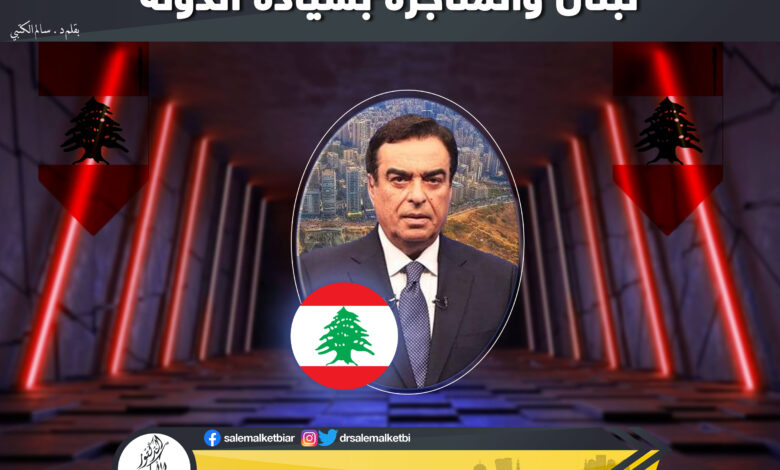
As I have been following the course of events in Lebanon lately, especially with regard to the management of the crisis following the remarks of George Kordahi, it is becoming clear to me and others that what Lebanon lacks most politically is the state in its traditional political sense in international relations. The Lebanese state exists and has an entity, sovereignty and influence that is respected by all Arab countries. But in reality, this “state” seems to be absent or “made absent” by an actor. In this case, the actor is known, and is constantly working to undermine the influence of the state, by encroaching on its national role and responsibilities, sometimes acting as a parallel state, or by taking political and military decisions and positions that are central to the state’s tasks, structures, and constitutional institutions.
Thus, the essence of Minister Kordahi’s crisis lies in the absence of the state’s role or the weakness of that role, to the point that there is little political speed and determination in resolving such issues.
What happened to the Lebanese minister has less to do with democracy and freedom of expression, and more to do with the lack of professionalism, the breadth of horizons, and the big question marks it raises about the sovereignty of states and their ability to manage crises, especially when they are related to the person of a minister or a senior official.
For example, Prime Minister Najib Mikati has repeatedly stressed that his country attaches great importance to relations with GCC countries. However, this minister “appeals” to one of his ministers to invoke his “conscience” and protect the country’s interests. He could be implicitly referring here to an “apology” or a “resignation,” or perhaps other possibilities that we do not know about.
In all these cases, however, he is unable to put an end to a crisis that is nevertheless unnecessary for Lebanon and its people if there had been any sense of responsibility. George Kordahi is no politician. He has not practiced politics with all the complexities and sensitivities it entails.
There are many examples and evidence of his limited personal ability to understand the differences between show business and politics, between the “public” and the “private.” He stuck to his narrow self-interest and chose to further widen the circles of crisis and impinge on the “patriotism” of everyone, fully aware of the sensitivity of the present moment in Lebanon’s history.
Even the media scene, in which he is a major figure in the Arab world, albeit as a show host, has not been well enough understood by the Lebanese minister.
He did not take into account the subtleties and intricacies which pervade the space of Arab-Arab relations while he expressed a purely political opinion. Worse, his opinion is based on false beliefs through which he tried to sound like a defender of freedoms and rights. Yes, the crisis is not just about him.
For example, Lebanese Foreign Minister Abdullah Bouhabib says Saudi Arabia is dictating “impossible conditions” to his country by demanding that the government rein in Hezbollah, which continues to express its loyalty to the Iranian regime. Strangely, the Lebanese minister claims that Hezbollah does not hold sway over the country and that it is “a Lebanese component that does politics.”
“It has a regional military extension, but it does not use it in Lebanon,” he said. A statement that the Lebanese minister knows very well is out of place and far from the truth. No one believes that the Hezbollah party is only doing politics.
No one buys into the idea that the Hezbollah militia does not inject its military might into the Lebanese political game. The examples are countless and all Lebanese know them very well. If the Lebanese government believes what the foreign minister says, why would it consider it impossible to limit the party’s hold on the authority of the Lebanese state?
M. Bouhabib forgot that Hassan Nasrallah recently threatened to unleash 100,000 trained and armed fighters against his political opponents on the Lebanese scene. Or has he forgotten that the party is putting its political partners out of the game by subjecting them to gun point and intimidation. Is this intimidation part of the political game from the perspective of the Lebanese foreign minister?
We all know the dark history of Hezbollah since its emergence two decades ago. We know its track record of sinful crimes against Lebanon and the Lebanese. So why the foot-dragging and evasiveness and why putting office and personal positions ahead of national interests? What amazes me is that Lebanese ministers seem far more capable of deepening and widening the crisis than seeking to resolve it.
Minister Bouhabib says there is a “big problem” and that they “just want Hezbollah’s head and we can’t give it to them.” But he seeks to muddy the waters with fallacies that will only drive the wedge further. No one wants the “head of the party,” as Minister Bouhabib claims.
And no one wants to interfere in the affairs of Lebanon. The Arab capitals he nods at do not have the luxury of getting involved in the conflicts of an Arab country, especially Lebanon, with all its regional and international complexities. They have things to do first on the development and economic front.
All the Arabs want is for Lebanon and all other countries to get rid of the cross-border groups, militias, parties, and all forms of external loyalties that have ruined these countries and disrupted their progress for many years.
The truth is that regional security and stability require kicking out expansionist powers with well-known nefarious relations with sectarian militias, whether in Lebanon, Yemen or other Arab countries.