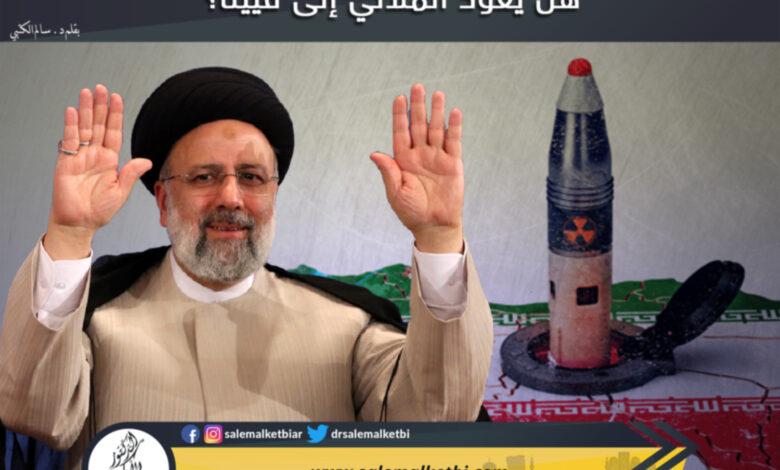
The question that had been looming for some time concerned the chances of the Vienna talks achieving a breakthrough that would ensure the revival of the 2015 Iran nuclear deal.
The question now, specifically since Ibrahim Raisi took office as Hassan Rouhani’s successor, is whether the negotiations will resume or whether the mullahs will settle for the previous six rounds in which no final results were achieved.
All indications are that the doubts surrounding the previous rounds in Vienna about the possibility of a scenario satisfactory to all parties have turned into doubts about the possibility of continuing negotiations. Politico quoted US envoy to Iran Robert Malley as casting doubt on Iran’s return to the Vienna talks.
It is clear that the mullahs’ regime has yet to make any proposal on when to resume the rounds. There are no signs of positive attempts at communication between Raisi’s government and Western capitals. Of course, there are several explanations for the current impasse in the negotiations, so it is difficult to draw definitive conclusions about the outcome of the Vienna talks.
At the forefront of these conclusions is the departure of the negotiating team leading the Vienna talks, headed by Foreign Minister Mohammad Javad Zarif, who was a driving force in relations with the major powers. He held the position for eight years.
It takes some time for those who replace him to study the negotiating position and present perceptions of what is to come. It should be noted here that Zarif played a leading role in communication with the West in particular. He leaves a void that will be difficult to fill, given Zarif’s abilities, extensive personal experience, and extensive connections with politicians around the world.
In this context, it appears that the US envoy’s “pessimism” about the fate of the nuclear negotiations did not come out of nowhere and is not the result of the mullahs’ regime’s delay in setting the date for the seventh round of negotiations only.
It is mainly related to Raisi’s guidance in choosing Hassan Hossein Amir Abdollahian as foreign minister to succeed Zarif in a predominantly radical government formation. The new Iranian government includes a number of ministers from the Revolutionary Guards who are on the US sanctions list, as is Raisi himself.
Iranian television has described Abdollahian as a “distinguished diplomat of the axis of resistance,” and he is known for his close ties to Iran’s armed proxies, militias, and extremist organizations in Syria, Iraq, and Lebanon.
Abdollahian’s first meeting with the deputies of Iran’s Shura Council focused on his belief in the geopolitical doctrine of General Qassem Soleimani and that he would follow in his footsteps. He came to oppose the orientation of his predecessor Zarif, who publicly criticized Soleimani’s foreign policy interventions despite Soleimani’s ignorance of the rules.
The mullahs’ system has thus become consistent with itself. There is no longer any room to talk about a reformer and a hardliner. The political scene is looking more and more like the Revolutionary Guards. A foreign minister known to be the IRGC’s man in the Iranian foreign ministry is not expected to show any flexibility if he were to come to the negotiating table with the West.
Overall, a new round of negotiations is not expected anytime soon. Abdollahian says he is “working to develop a new model and mechanism for consulting with experts to determine how to deal with the nuclear deal.” Even if a date is set for the seventh round, it will be an exploratory visit pending the new mechanism Abdollahian is working to achieve.
This will likely be a mechanism that stems from a radical hawkish ideology. Despite the minister’s diplomatic experience, his relations with Western circles remain very limited. He is still inclined to precisely implement the directives of Supreme Leader Ali Khamenei without seeking to think outside the box on his own.
This is probably one of the personal characteristics that tipped the scales in his favor over the other candidates for the position. It is clear from the analysis of the mullahs’ nuclear messages that Raisi wants to continue negotiating. But he wants to change the mullahs’ strategy and show a new approach.
But one of the reasons he is reluctant to take a specific position on the fate of the next round of negotiations is to put pressure on US officials, who certainly do not want further failures, especially under successive criticism from the White House on the Afghanistan withdrawal scene.
So the mullahs may think that waiting now may push Washington to make further concessions to achieve a much-needed political feat for President Biden, just as Ibrahim Raisi did early in his first term. The problem, in my view, is that the US does not have effective strategic alternatives to respond to Iran’s escalation on several issues.
In particular, the provisions of the agreement on uranium enrichment rates continue to be violated. Messages from Washington provide nothing new to deter the mullahs from continuing the challenge.
US envoy Robert Malley, tasked by Joe Biden with restoring US commitment to the Iran nuclear deal, says his country has other options if the 2015 agreement is not revived. Those include signing a new agreement, completely separate from the one that expires by 2030.
The other option is to impose sanctions against Tehran in coordination with European allies. Robert Malley did not explain what these sanctions were or how a new agreement could be signed, despite the failure to reinstate the old agreement and despite the mullahs’ refusal to raise issues outside the current nuclear deal.
Ultimately, it is difficult to say whether or not the mullahs will return to Vienna and when that return will occur. But they certainly plan to develop a different vision than before. From then on, merely waving new sanctions is no longer effective in taming the mullahs’ regime.
There is an urgent need for the US to formulate a new strategic vision for dealing with the Iranian threat, in line with the new government in Tehran.