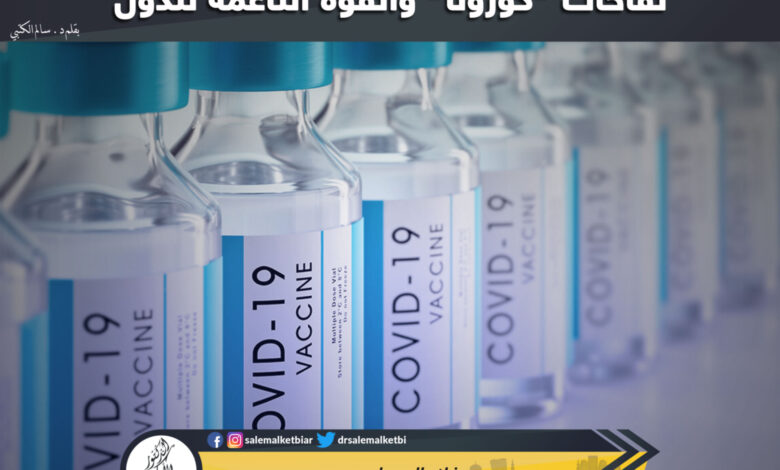
The debate over vaccines produced by the major powers has recently shifted from efforts to control the coronavirus epidemic to a political and strategic battleground. Talking about these vaccines is more and more about the influence of the producing countries. It becomes a manifestation of the soft power these countries have.
Discussions about the validity of this link between vaccines and power are certainly supported by current practices.
Whether it is vaccine distribution or the spirited defense of leaders and politicians, which has more to do with nationalism and national dignity than with scientific and health standards, vaccine distribution and stockpile management as available to countries and institutions is more about geopolitical signals than anything else.
This is a given. But it must be viewed with caution and rationality. The Russian vaccine issue is perhaps a good example to understand the political dimension of the problem. It is not just a question of a division between EU member states over the use of the Russian vaccine.
Indeed, some in Moscow’s Cold War orbit do not hesitate to accuse Russia of using the vaccine as a tool to restore its erstwhile influence. Between the different points of view, there seems to be a strong link to state power and influence.
The choice of the name, Sputnik, which evokes bipolar rivalry and power in the Cold War era, in itself illustrates the vision and value that the Russian state attaches to the vaccine.
It is not only Russia, but also the UK, China, the USA and all countries engaged in this scientific field. Science is a demonstration and a sign of countries’ soft power, and there is nothing wrong with that. The link between science and power is not a passing thing in geopolitics. But what is new are perhaps the mechanisms of exploitation and the grounds of this science-based conflict.
It is no longer a question of displaying scientific domination in space, for example, or of launching rockets and exploring galaxies. It is a competition on the territory of other countries.
The geopolitical factor seems obvious. Some criticize what they see as the political instrumentalization of epidemics and vaccines. I think that this phenomenon has emerged since the beginning of the crisis. It didn’t wait for the vaccines to come out.
Former US President Donald Trump called the virus the “China virus” in a strategically motivated, mental-image-related stance aimed at bruising China’s reputation in the context of a fierce bipolar rivalry for leadership of the post-coronavirus world order. But the vaccine war may seem more indicative of the political dimension of the whole issue.
Slovak Foreign Minister Ivan Korčok did not even agree with his prime minister, who welcomed his country’s receipt of a batch of Russian vaccines, saying that the issue had nothing to do with geopolitical factors. His foreign minister described the vaccine as a “tool of hybrid warfare.”
The same is true in the Czech Republic, where President Miloš Zeman called on Russian President Vladimir Putin to provide the vaccine, while his health minister refused to accept the Russian vaccine without approval from the European Medicines Agency. This move prompted the president to call for his resignation.
Looking at these divergent positions, some are convinced that Russian vaccine diplomacy is aimed at creating a rift within the European bloc. But the reality is that other countries’ vaccine production is limited, and there are distribution problems due to the massive and simultaneous demand.
Finding solutions to this problem may require going beyond conspiracy theories, whether or not they are warranted. Europe is suffering from a slow vaccination program. There are differences and controversies about certain vaccines and who gets them first.
In my opinion, this issue needs to be looked at from a human perspective. Slovakia and the Czech Republic recently had the world’s worst death rate per population for weeks, according to AFP statistics based on official data. Hospitals were at maximum capacity.
Talking about the political aspect of vaccines becomes a luxury that is not granted in such difficult humanitarian conditions. It is true that defending some vaccines has taken on a national flavor, while others have been distributed in a geopolitical subtext. But half the people who get vaccinated reduce the risk of disease and suffering globally.
The crisis, which has not been managed with a moral and humane compass since it hit, confirms that discourse on humanitarian principles is one thing and actions another. Humanity is now in a situation that requires strong solidarity if the world is to truly return to the pre-Covid era.
Talking about soft power and geopolitics is a privilege that many nations do not have. It should not be an obstacle to collecting vaccines, following the rule that the best vaccine is the one that is available now, not tomorrow.