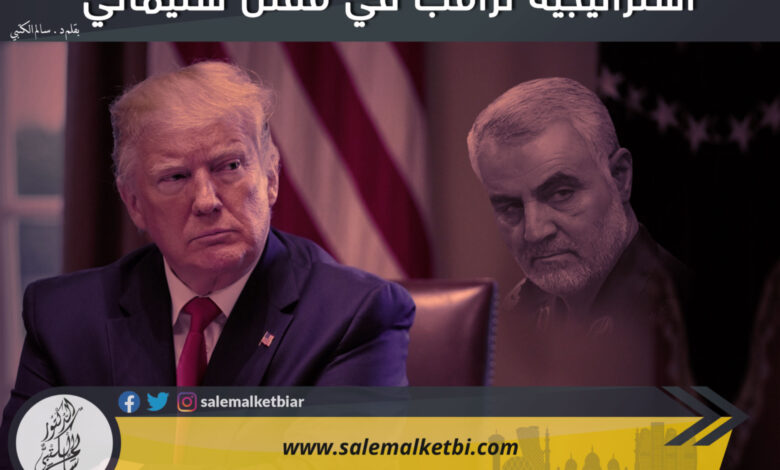
After the dust has settled considerably in the Iranian-American tension following the assassination of General Qassem Soleimani during a US military strike in Iraq, it may seem important to make a quick summary of US President Donald Trump’s profit and loss accounts in the management of this crisis.
First of all, not all the reasons for President Trump’s decision to kill General Soleimani stem from the acceleration in the development of Iranian-American tension in recent weeks. There are certainly internal American factors that have influenced the decision making and pushed President Trump to take a decisive step vis-à-vis the mullahs’ regime.
In the midst of Congressional investigations, the White House has sought to mobilize American public opinion on an event more important than the plans of Democratic competitors to trap President Trump in investigations throughout the presidential election year until it results in his removal or resignation (both possibilities completely ruled out), or until his political reputation and ability to lead the country is damaged, which was by far foreseeable.
Discrediting Trump was closest to reality, but its effectiveness was difficult to determine. So President Trump wanted to completely destroy this potential with an alternative plan.
Looking at the profit and loss accounts of President Trump’s administration on this matter of assassinating General Soleimani, it is fair to say that the calculations are very much in the interest of the American President.
In this connection, several points can be noted. Number one is that the American administration has been very successful in presenting the decision internally. This is the most important thing in the year of the presidential elections.
In the case of Iran, many knew that President Trump had been unwilling to wage war since he took office. He is essentially betting on tough economic sanctions as a mechanism to bring the mullahs’ regime to its knees and force it to sit down to negotiate.
By deciding to kill General Soleimani, President Trump has violated many standards related to his political performance since his entry into the White House.
This is not a strategic change, but a tactical reversal. In other words, President Trump has not lost faith in the effectiveness of the sanctions imposed on the Iranian regime. All Trump wanted was a military manoeuvre to get rid of a certain stereotype that his political rivals wanted to stick on him. He wanted to appear as the political leader capable of making a decisive military decision if necessary. He sent direct messages to strategic adversaries of the US like Iran, North Korea, and China.
He improved his image in the eyes of his supporters and deeply scuppered the plans of his Democratic rivals for the presidential election. His decision to kill Soleimani shifted them from fiercely attacking Trump to defending their competitive chances by seeking to disprove the motives and effects of the decision just to win the sympathy of the American public. The polls show this attempt will not be enough to shore up their competitive position.
President Trump also gained an additional strong point by the precisely calculated military response in a clear message that the Iranian mullahs do not want a military escalation. The fate of the regime is more important to him than the idea of “revenge” and the response to the assassination of General Qassem Soleimani.
The mullahs have clearly understood the adventurous mentality of President Trump if his political future is at stake. His own threats of a stronger and harder strike will be carried out if Iran’s response goes beyond the limits expected by the US, if it affects the prestige of the US and influences in one way or another President Trump’s position in domestic political calculations. President Trump has gained much from the limited Iranian military response.
President Trump postponed a presidential statement commenting on the event until the following day after receiving an immediate report on the Iranian missile attack on two US military bases in Iraq. The reports seemed to give a reassuring picture of what had happened, leading him to say that “all is well.”
President Trump should reap the fruits of his administration in this crisis, according to opinion polls, thanks to the growing support of public opinion for his firmness in the face of the Iranian threat to lay siege to the US Embassy in Baghdad.
President Trump escaped an Iranian trap which aimed to position him as a weak President and to exploit this image in his electoral defeat.
But President Trump’s surprise decision to kill General Soleimani confused everyone’s calculations, putting him in the position of a powerful president with automatic popular support.
The automatic popular support was repeated with former US Presidents, and took place with George Bush, Jr. Through his handling of the 9/11 attacks, and his decision to bomb al-Qaeda in Afghanistan.
Such events drive record gains in opinion polls. But they surely have implications that can be used to maintain popular support for the president through media and political exploitation of these implications in the coming months crucial to winning a second term.