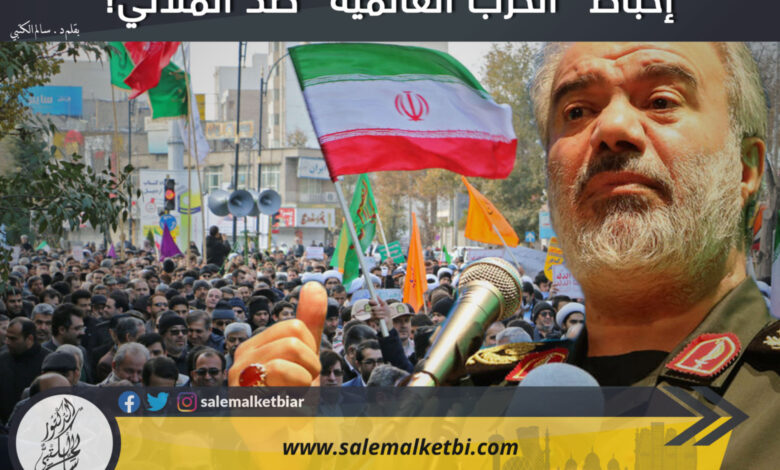
The Iranian people are angry with the mullahs’ regime’s decision to increase fuel prices. The spontaneous popular demonstrations, according to this regime, would be a “large-scale world war” against Tehran, for which the United States and Saudi Arabia are responsible. General Salar Abnoush, deputy chief of the Basij forces who repressed these demonstrations and turned off the voice of the Iranians, said so.
“A world war against the regime and the revolution broke out and, fortunately, the child died at birth,” said General Abnoush, ignoring the UN Human Rights Office’s comment on reports that live ammunition used by security forces to quell unrest has caused a large number of deaths.
Iranian officials deny that there are a large number of victims, indicating that only five were killed. International organizations have reported that more than 100 demonstrators have been killed and that the actual number of casualties could reach 200, which may be lower than the reality compared to Iranian ammunition sent to Iraq, which killed dozens of young Iraqis during the demonstrations.
The mullah regime also referred to “measures” taken to put an early end to the demonstrations. Public awareness, it argues, has helped. But in the absence of facts, the media blackout and the total shutdown of the Internet from all Iranian cities during the demonstrations, the regime is trying to hide what really happened. These “measures” simply consist in using the grip of the revolutionary guard militia against the anger of the Iranian people.
The Iranian Assembly of Experts drew up a fictional scenario for a foreign “conspiracy” plan against Iran, claiming that Internet networks instill “riots and crimes” in people. Today the most deprived population in the region in terms of life, development and economy, the Iranians reacted spontaneously to the decision to raise gas prices.
Iranian Supreme Leader Ali Khamenei accused Western countries, including France and Germany, of backing the protests. The US, he claimed, was the leader of the bad guys. Saudi Arabia has provided funding and media support, he added. But what he has omitted are the main causes of the unbridled anger that has been building for years among millions of Iranians. Worsening economic conditions are the main and only cause for protests.
The younger generations of Iranians cannot be fooled by the allegations of conspiracy, diversion of attention and export of crises, which the mullahs have been pursuing since they came to power. Iranian youth would not believe that the whole world is conspiring against their country, and that the whole world has told the mullahs to spend billions of dollars on a malicious expansionist project in several Arab countries for purposes that have nothing to do with the interests of the Iranian state and people.
Iranians need normal relations with their neighbors and the world around them. They want a decent education and jobs, instead of the state being reduced to the aspirations of the mullahs.
For the sole reason that it urged Iran to exercise “the utmost restraint” towards demonstrators, the mullahs’ regime accused the EU of interfering in Iranian affairs. Its direct interventionist practices in countries such as Iraq, Syria, Lebanon and Yemen did not come to mind, though. This regime interprets international law and the Charter of the United Nations as it sees fit; it takes what it deems useful and leaves the rest.
The demonstrators who attacked mosques and Islamic institutions belonging to the mullahs have only voiced their anger and despair at the regime’s policy, which controls their fate under religious flags and hollow slogans.
The bottom line is that the mullahs’ regime was normally expected to succeed in suppressing any popular movement against it. It was unlikely that the popular protests would put pressure on the regime, with its policy of brutality and terror against the demonstrators. But that does not mean that the regime will remain in power, because popular anger is like a snowball that grows day by day.
The time will come for this ball to roll and destroy everything in its way, no matter how hard. According to a study published by the US-based Center for Strategic and International Studies, over the past two years, the number of popular demonstrations in Iran reached about 4,200 between December 2017 and October 2019.
Iran is in a situation of chronic protest, many of which do not have media coverage because of the total media blackout on what is happening in Iran. There’s a big blowout coming, that’s for sure.