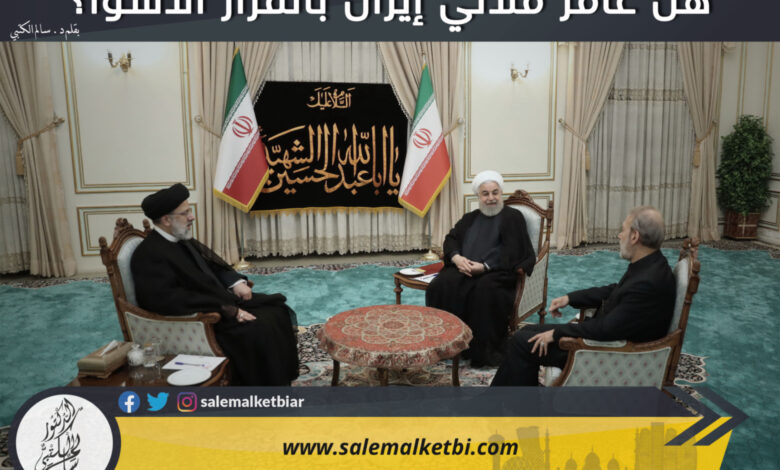
It is perhaps the worst time for the Iranian mullahs to decide to increase the price of gasoline by about 300%, with the approval of the Supreme Economic Coordination Council, composed of the heads of the three powers: Hassan Rouhani for the executive, Ali Larijani for the legislative, Ibrahim Raisi for the judiciary.
The decision was not limited to price levels. Instead, they decided to create a new mechanism to control the quantities consumed and set a certain quota for each citizen. The Iranian regime made this decision reluctantly because of the lack of resources to deal with the rapidly deteriorating living standards of the poor.
The government has provided justifications.
The aim was to persuade poor Iranians in particular that the objective of the resolution is to “create social justice for 60 million low-income Iranians, combat fuel smuggling, reduce corruption and manage fuel consumption, while also paying the financial revenues generated by this resolution to vulnerable groups as of next week, without increasing the price of diesel fuel” used as fuel for trucks carrying goods and food.
The attempt occurred to prevent them from joining the demonstrations because they represent the largest segment of the Iranian people.
The Iranian regime is trying to make it appear that the income expected from the increase in the price of gasoline will not enter the country’s budget, but will be used to support the poor.
But the ability of the Treasury to support these poor people has been eroded by sanctions and oil export revenues have declined due to the regime’s policies.
This decline is the real reason for seeking an alternative resource to replace the public treasury in favour of the poor.
The mullahs are clearly aware of the seriousness of the timing of the resolution, which coincides with demonstrations of anger against Iran in Iraq and Lebanon.
But the lack of alternatives precipitated this decision, which is a political adventure from every point of view.
It is interesting to note that the reaction of the security authorities to the anger of the demonstrators contrasts with previous repeated demonstrations.
The Internal Security Forces (ISF) have announced that they have “so far shown restraint.”
But initial reports indicate that some demonstrators have been killed and others wounded in several Iranian cities.
Popular protests end in many cases around the world with demands to bring down the ruling regimes.
But the situation for the mullahs may seem a little different. The composition of this political system is very different. The regime relies heavily on a theocratic hierarchy that gives the Wali al-Faqih the highest authority in the system. This system therefore has a last margin of manoeuvre.
We can sacrifice the head of political power, President Rouhani and his government, and reorganize the political scene by holding new elections. The Supreme Leader Ali Khamenei remains in place without causing much damage to the system as a whole.
The Iranian regime has allowed, within certain limits, demonstrators to express their rejection of President Rouhani’s policies. This includes the decision to increase the price of gasoline. The decision to dismiss him can be made in the office of the Supreme Chief in case of public outrage. This is not yet clear.
Khamenei may also consider sacrificing Rouhani and his government as a precious opportunity.
The swift and direct support of the United States for the demonstrations in Iran reduces the chances of an imminent dialogue between the Rouhani government and the Trump administration.
Thus, Rouhani’s presence and maintenance become a burden on the Supreme Leader’s policies and attitudes.
The Supreme Leader could kill two birds with one stone if protests and calls for anger against the decision to raise gas prices increase. He can ransack Rouhani and his government on the one hand and absorb some of the anger of the Iranian people on the other.
“Iran is neither Iraq nor Lebanon,” said Hesamodin Ashna, an advisor to the Iranian president. “The US Embassy in Tehran has also been closed for years,” Ashna wrote in a tweet.
This trust that the Iranian president’s adviser is trying to show against the demonstrators does not hold water. It is more likely that the language does not reflect so much a real trust as a strategic decision by the regime to confront the Iranian people at all costs.
The regime believed it could survive, since it had no US embassy in Iran and foreign media were totally absent. Of course, the mullahs want to divert attention from the causes of anger as usual. They talk about an American intervention.
Secretary of State Mike Pompeo, following the outbreak of the demonstrations, repeated a message of July 22, 2018, referring to the unrest in Iran. “As I said to the people of Iran almost a year and a half ago: The United States is with you,” he commented.
That said, the decision to raise the price of gasoline could be an adventure for Rouhani. But this is probably not at all the case for Supreme Leader Ali Khamenei.
There is no alternative to adopting this measure to provide financial resources that help reduce anger against the regime’s policies.