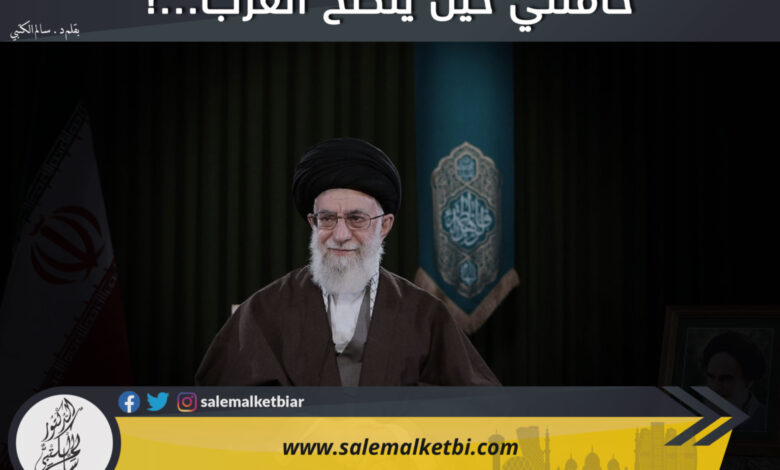
In a speech delivered Friday in Tehran, while receiving the leaders of the three Iranian authorities and participants in the Islamic Unity Conference, Iranian Supreme Leader Ali Khamenei said that the United States “does not hide its hostility towards Saudi Arabia, overtly looting its money,” calling on the Saudi kingdom to accept this as an established fact.
America is not only an enemy of its country, but of all countries in the Islamic world, says Khamenei. “The reason for the United States’ hostility is the Islamic identity of these countries,” Khamenei said, adding that Americans “oppose the notions and conceptions of Islam. They are mainly enemies of the Islamic Republic.”
Iranian leaders keep talking about the desire to cooperate with neighbouring Arab countries to maintain security and stability in the Gulf region, away from the major powers. The latter are keen to avoid any tension that could trigger a military conflict in the Gulf region.
Therefore, it is necessary to build trust on a clear and precise basis that takes into account all the elements of tension and disagreement between the GCC countries and Iran in recent years.
Articulating relations in accordance with the rules of international law and the Charter of the United Nations is very essential.
By violating all international laws, standards and conventions and principles as vital to international security and stability as good neighborliness and non-interference, Iran remains a source of regional tensions.
In all objectivity, the United States’ positions and policies are not the fundamental variable of the differences between the Gulf and Iran.
The United States also does not want the GCC to wage a war against Iran. Indeed, the Trump administration’s inaction and hesitation in the face of Iran’s repeated attacks have provoked criticism and surprise from observers who are aware of the particular nature of the strategic relationship between the United States and the GCC.
In this context, Khamenei’s comments seem rather like a deliberate maneuver of confusion and deception. Iran’s Supreme Leader refers to GCC’s relations with the United States as being in a “state of hostility.”
In order to create a climate of confusion, he asks this question: “Is it not hostile to say quite frankly that the Saudis only have money and that we must plunder them?” President Trump is using this approach with all US allies, not just one country.
To call this treatment hostile is like saying that the United States is in a state of hostility towards Japan and South Korea.
Recently, Foreign Policy reported that President Donald Trump has asked Japan to quadruple what it pays to cover the costs of the continued presence of American troops on its territory. The magazine quoted former American officials who said that the decision was part of the administration’s campaign to make its allies pay more for their defense.
According to the magazine, Washington wants to increase the amount paid annually by Tokyo to US troops in Japan, from about $2 billion to nearly $8 billion.
The Trump administration also demands that South Korea, which hosts 28,500 American soldiers, pay five times more than it currently pays, according to the magazine.
I cannot imagine that Iran’s Supreme Leader cannot distinguish between the Trump Administration’s short-term tactics and American long-term strategies. The Iranian regime is well aware of these differences, but we want to give the impression that the mullahs are more concerned about stability than the American ally.
This is refuted by the facts and Iranian behavior itself. The attack on Saudi Aramco’s oil installations in Abqaiq and Khurais is a recent example.
“Is there more hostility than that? This is a clear hostility towards the country and the people,” said Mr. Khamenei, referring to President Trump’s remarks about Saudi Arabia’s arms sales.
How can we trust Iran’s intentions, whose leaders boast of occupying four Arab capitals? They still speak, on different occasions, in a language peculiar to colonialist empires.
A few days ago, Major General Hossein Mortazavi, Commander of the Revolutionary Guards, made this statement: “The Iranians have only reached the Mediterranean shore twice, once under Cyrus and once under Imam Khamenei today. All Muslims take pride in this.”
Personally, I do not see how Muslims can be proud of what the Iranian mullahs have done to reach the Mediterranean coast. We all know about their attacks on the sovereignty of States and the practices that have provoked both the Shia and Sunni of these countries. Similarly, much is known about Iran’s interference in Yemen, in the internal affairs of the Kingdom of Bahrain and elsewhere.
How can Arabs feel that the mullahs of Iran are closer to them than any other international ally, be it the United States or others?