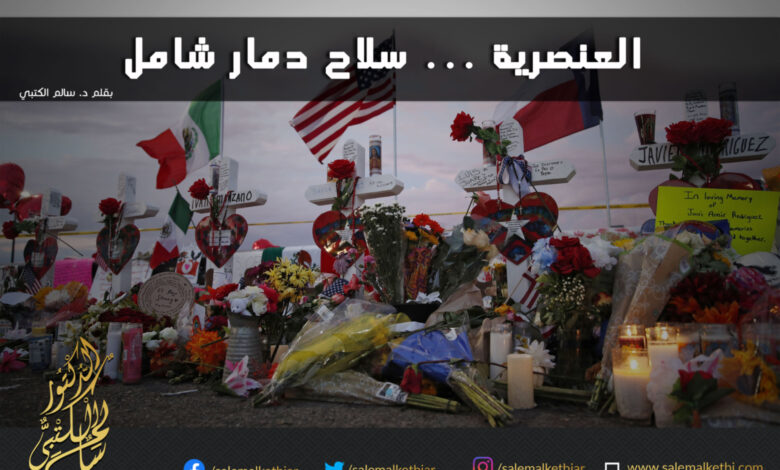
I recently read an interesting comment by a security official on a recent shooting in the US, saying if a “crazy” gunman launches such an attack, there is no way that law enforcement officers can be there to stop it. “The best way is to be prepared to defend yourself.
I’ve been thinking about it over and over again. I was wondering, how can you always be ready to defend yourself? How can you be in a position of permanent self-defense? What about women, children and the elderly? What would an armed confrontation between a terrorist and several people in a public place look like?
The truth is, I could not find a convincing answer. Self-defence along these lines would not be attained even if all members of society took up arms as a precaution. The attacker is always better prepared and ready, focusing only on his goal. The likelihood of multiplying casualties is also high in the event of a bilateral shooting. As such, there is no way out of the chronic menaceof racism but stricter laws. Carrying weapons should be limited to authorized security and protection agents. Hate culture must be eradicated in all its forms and shapes, be it racist, religious, ethnic or otherwise.
Escalating terrorism and violence against a backdrop of hatred and racism has become one of the most serious threats of the 21st century. To call it a weapon of mass destruction for societies is no overstatement. The problem is not just shooting incidents in the United States. It stretches to repeat attacks against refugees and migrants and mounting waves of hostility towards religions, whether against Islam or other religions.
Some may seek some comfort in their conscience by accusing President Donald Trump of stirring up racism, igniting hatred and emboldening white supremacists. Some accuse the extreme right in European countries of inciting against foreigners. But such charges must not prevent them from seeing the very factors that fuel hatred and racism in our world.
While it is true that minority ideologies and the views of certain ethnic groups in societies are sometimes politicized. But the whole issue is older and more complex than making a statement or declaring a political position on an ethnic or racial basis.
For starters, let us not overlook the fact that the United Nations’ policies in this area are weak. The UN celebrates the slogans of tolerance and the annual reminders of the principles enshrined in its Charter. It also made the Universal Declaration of Human Rights and International Humanitarian Law. It devoted the UNESCO-Madanjeet Singh Prize to promoting tolerance, non-violence and other initiatives and policies aimed at achieving global human coexistence. But all this is not enough.
On the upside, great efforts are being made at the state level. The United Arab Emirates, for example, is making serious efforts to spread the word about human brotherhood. The country strives to build common ground that guarantees tolerance and the foundations of human coexistence, to ensure acceptance of the other, freedom of worship, belief and thought, and to renounce intolerance, extremism, racism and bigotry.
What our world is witnessing is not bound to religious hatred and slaughter in the name of God. We are looking at a dreadful backslide to past-days racism, the results of which humanity barely managed to overcome.
Not a day goes by and we do not hear of an attack on refugees or migrants, or even on minority citizens in Europe and the United States. These attacks threaten all forms of coexistence, security and social stability in these countries and in other societies that are founded on cultural, ethnic, religious or sectarian diversity and pluralism.
Racist leanings in general cannot be stopped only by the legal approach. The law is not always effective in combating hate-mongering and fanning racism and bigotry. Politics and moral principles that guarantee social stability and security often cross paths, especially when national values are thrown into sterile debates that provoke controversy over nationalism and patriotism.
Racism, extremism, radicalism, and incitement are all symptoms of hate. These are practices that must be covered by the definition of terrorism. Sadly, the ongoing international controversy over the definition of terrorism is one of the main reasons for the persistence of racist and hate crimes. Many people still label any crimes committed by extremists pinned down on Islam as terrorism, while other racist crimes are dubbed hate crimes.
We must agree that the source of hatred, its causes and effects are the same, notwithstanding the many methods, practices and slogans used. All hate crimes undermine security, stability and community peace and undercut prospects for global coexistence.
They are not limited to the States and societies in which they occur. A sort of contagion and the reproduction of ideas and practices happens, more so with cultural and technological globalization.
The takeaway message is that every action will have a reaction. Hate crimes all have complex causes and antecedents. It is usually hard to determine is a hate crime is a purely personal or rather political one. But it is certainly a purely political issue. The impact of hate crimes can last and mark the politics of the countries where they take place.