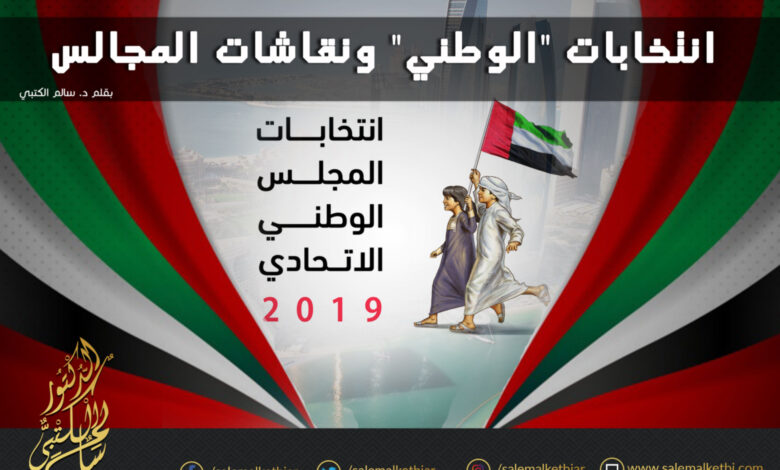
The upcoming elections to elect the members of the Federal National Council have taken up a large part of the time of debate among citizens in recent days. The electoral event created a beautiful social situation that soothed the heat of this summer.
In fact, elections serve as a springboard for discussions on national issues and challenges, which can strengthen the spirit of citizenship, raise awareness among new generations and encourage them to take part in shaping the nation’s future.
I find it quite surprising that debates sometimes suggest that we are trailing behind the other legislatures. It is as if a parliamentary experience born in February 1972 had not yet found its way.
But that is not true at all. I am not going to mention here the evolution of the Federal National Council in its last terms. Let us look back at the origins of the legislative practice introduced by the founder Sheikh Zayed bin Sultan Al Nahyan.
The council based its practice on a solid constitutional premise, being the fourth federal authority among the five federal powers enshrined in the constitution. Since its foundation, it has not been a formal council, but a real partner in decision-making.
The founder reminded the members of the FNC of the foundations of the parliamentary process. This is not an exceptional situation, nor a transitional situation in Emirati political life, but an institutionalization of a lived reality.
“We have lived the democratic experience in which we have lived for hundreds of years, on the principle of shura (deliberation),” he said. “What we are doing today is not new to this country. Your ancestors shared the government with ours and they all had deliberations. But manners change. In the past, there were different systems from those of our contemporary world.”
He also said, “Sitting and talking with our brothers members of the National Council is not new to us; it is the heart of our traditions and the heritage of our ancestors. They had the same way of discussing, of exchanging, but we have simply developed the method.”
The leadership was therefore well aware of the role of legislatures in building modern states.
In an interview in June 1972, he said, may God bless his soul, “We have established democracy and justice by creating the first modern advisory council in the history of the country.”
He also wanted to encourage board members to take on their role. On July 19, 1972, Sheikh Zayed made a historic speech to the CNF when he told members, “I ask you to express your opinion openly in all matters before you. Do not mind if someone is big or small, because you do not represent yourself. You represent an entire nation. Your Council is the Council of the Nation. You must examine things that are in the public interest with diligence.”
In the same speech, he advised them, “No one of us should be indulgent. Our nation wants us to make every effort. The fortune of life is work. Everything in this world is ephemeral, only your actions will last forever.”
These are the foundations and principles of real political participation. Honesty, sincerity and responsibility are the pillars of the legislature.
The founding leader attached parliamentary membership to the great national responsibility towards past and future generations. He affirmed that rights imply duties, and to preserve them depends on responsibility for the common good.
A member of the National Assembly does not represent himself, but an entire nation, as Sheikh Zayed said, and the State Constitution already provides for. The composition of the FNC is predicated on an awareness of national responsibility.
Shura is not about controversy and critical comments, but rather about the interaction of opinions and experiences. It focuses on the constructive criticism that is engaged with societal values and norms, guided by a compass of the public interest. The public interest is thus a safety valve that determines the right course of action for the shura.
There are well-established principles in our deliberations on the idea of running for election as a member of the FNC. However, the most important of them is the need to maintain fraternal ties and social peace. This requires mutual respect and appreciation and the avoidance of personal conflicts.
One of Sheikh Zayed’s principles is that it is natural that there should be differences of opinion. “We cannot all have the same opinion, the same position and the same way of thinking and working.”
When His Highness Sheikh Khalifa bin Zayed Al Nahyan, President of the State, launched the Empowerment Programme in 2005, he wanted to activate the role of the council and its empowerment as an authority that supports and advises the executive. It was to be a more competent, effective and committed council with regard to the nation’s issues and citizens’ concerns, through which a real shura would be systematically established.
We can assess the extent to which these objectives and roles are being achieved. We can measure performance, both for members and for the board as a whole, through this system of objectives set by wise leadership. Since 2006, has our council been a support and guidance authority for our Executive? What percentage of this objective was achieved? Are there any challenges and how can they be addressed?
This debate, for me, is rather a debate concerned with developing the electoral experience and enhancing it with good ideas, especially as we approach the next elections. In fact, women will receive 50 percent of the seats in parliament.