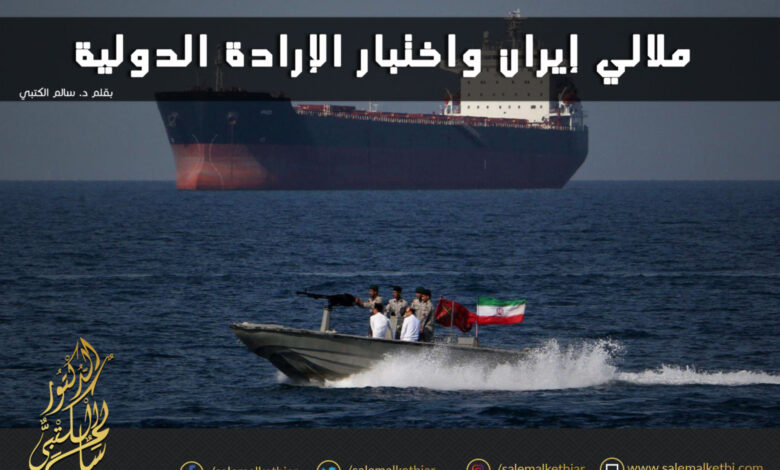
What is going on in the Hormuz Strait these days is nothing but a litmus test of the will of the international community. Since Iran detained a UK-flagged oil tanker, the international community has only been watching Iran’s actions.
Most major countries have been simply waiting for the outcome of the events. The issue here is not specifically about the UK, nor about the policies of the Trump administration. It is about the prestige of international law that guarantees freedom of maritime navigation in international waters.
It should go without saying that any lawless conduct is but a strike at the heart of international security and stability. The Ormuz Strait could become a dangerous transit area with everything that this means for oil prices and maritime safety.
The mullah regime, some might argue, was responding to the UK measure of stopping an Iranian-flagged tanker in the Strait of Gibraltar that it claimed was violating sanctions against Syria. However, the argument advanced by the mullahs confirms their daredevil and reckless regime does not respect international law.
Iran’s supreme leader, Ali Khamenei, has threatened to seize a British tanker as soon as he heard about the first oil tanker being held off Gibraltar. He did not take the time to deal with the matter through legal channels. He made a tit-for-tat response at once.
Such a response tells us that the mullah regime took the path of confrontation and adventurism in its relations with the major Western powers. The mullahs apply the same policy when dealing with GCC countries.
For many years, the regime has been driving a wedge between the Gulf countries and talking to each country individually so as not to face a unified Gulf bloc. The tendency of some Gulf countries to bark up the wrong tree was a catalyst to the Iranian divide-and-rule strategy.
This has been the case of the Qatari regime, especially from 2015 until now. Qatar did enter the Arab coalition, but only with a deliberate intention to pull out later. That is what really happened. Then came the ensuing firm decision to boycott Qatar after a long patience with this rebel without a cause.
The point is that the mullahs are doing to NATO partners what they have done in our region before. Here they are talking to Germany, France and Britain in different tones, taking advantage of the differences of interest between the EU three and the US.
Then the second phase was the break-up of the European trio itself. Paris and Berlin responded swiftly to the detention of the British oil tanker, urging the mullahs to release it immediately. Berlin considered the seizure to be “a further escalation of an already tense situation.” Understandably, France and Germany do not want to close the door to dialogue with the mullah regime on the crisis of the nuclear agreement. Although, the regime does not speak the language of diplomacy. Its political mindset takes it to calculated and uncalculated adventures.
To salvage their crumbling regime, the mullahs want to open a backdoor to war.
So the question now is, would it have been any different if the EU three had sent a strong joint message to the Iranian regime? My conviction is that the mullahs would have thought twice before pushing everything to the edge of the abyss. They would have taken the initiative to find a way out to secure opportunities for dialogue with the EU trio.
The mullahs see that, alone, the UK has very limited military options against the Iranian regime’s menace. But with the rest of the European powers on board, things would turn out a bit differently, although a military threat to Iran without the US remains strategically less effective.
No one wants to do thing the hard way in the Gulf region. But it is very concerning that Iran’s reckless behaviour is gaining more courage and testing the will of the international community. And as long as Iran remains unchallenged, uncertainty prevails as to the direction of its adventuresome behaviour on the short run.
How can the countries of the region live in peace with a reckless regime that always has its hands on the trigger? Does it make sense that the world’s most economically active and sensitive region has to put up with Iran’s recklessness?