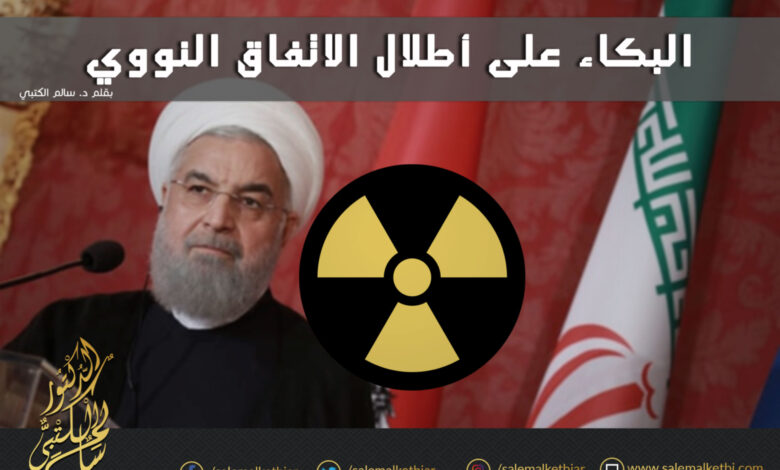
Nothing remains of the nuclear agreement concluded between the P5+1 group and the Iranian mullahs in 2015 other than its name. By failing to address all the issues of concern in Iran’s regional and international relations, this agreement is in its very nature flawed, truncated and distorted.
Now it has been flouted by a formal statement defying the will of the rest of the parties and the international forces that have joined until the end of this agreement.
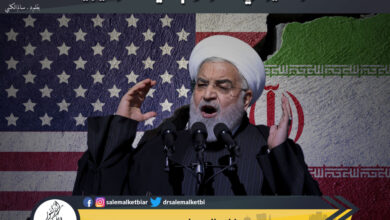
A few days ago, Iranian President Hassan Rouhani said that his country had reduced its commitments under the nuclear agreement in accordance with its terms. He called on the EU to assume its responsibility for maintaining the agreement.
If his comments are correct from a legal point of view, they indicate that the terms of the agreement have been poorly formulated since the beginning. In fact, the European countries that signed the agreement are still far from understanding the intentions of the Iranian regime.
President Rouhani and his regime recently spoke of a US-led “terror move and economic war,” of economic “bombardment” and “strikes.”
They are in a real war, the mullahs. So they feel that if the regime goes into a military war, it may have a lower burden than the effects of this devastating economic war on its future and its chances of continuing to rule in the near future.
Perhaps that is what the Iranian President meant when he warned, in his recent exchange with French President Macron, that “the continuation of this economic war would lead to other threats in the region and in the world.”
The Iranian regime has largely succeeded in playing on disputes between the P5+1 international signatories on the one hand, between the European countries concerned on the other hand, and all these parties – except the UK and the US – on the third hand.
In the face of these differences, it is not surprising that the French President Macron is concerned that European measures to overcome the US withdrawal have not been effective and successful. It is also not strange that he warned that the breach of the agreement will be a failure for all and a regrettable step.
It is also not surprising that British diplomacy should accompany all its statements and reactions to Iran’s flagrant violations of the agreement with an affirmation of its commitment to the agreement and its implementation to the end.
In fact, it is not so much an Iranian diplomatic success as a failure of the diplomacy of the other parties to reach a consensus, even a minimal one, on how to deal with the “Iranian situation.”
The collective use of pressure tools is very low and therefore not very effective. There is no unified collective international message or consensus within the international community.
Iranian diplomacy can easily exploit existing differences. It plays on strategic conflicts of interest and appeals to strong divisions between some global powers, as is the case with China and the United States.
The US also bears a large share of responsibility for the situation in dealing with the flagrant violation of the principles and rules of international law by the Iranians. US diplomacy cannot be absolved of all responsibility for the Iranian challenge to the international community.
The Iranian regime does not only understand the language of the “carrot.” This language is understood by States that are concerned about the interests of their people and seek to emerge from crises. But there are regimes that feed on crises, such as the Iranian regime, which has been feeding on the tensions and wars it has unleashed since it first appeared in 1979.
In such a revolutionary state, crises ensure survival.
The crisis guarantees that its leaders will avoid accountability to the people and that the obvious question on the return of oil and gas wealth to the people will be forgotten. Such a regime cannot be tempted by modernity or by maintaining normal relations with the United States.
It only answers if it perceives a danger to itself and its leaders. What history has taught us in the Gulf is that the Iranian regime only understands the language of force.
Looking back at how the Iranian regime cooperated and offered its support to the US army during the wars in Iraq and Afghanistan, we can learn one thing or two about the mullahs’ regime’s mentality.
As past experiences remind us, in the Iranian situation, the stick should come before the carrot, not away from it. Waving the stick is not always a war decision. What the stick can do is not often achieved through negotiation.
The message of force is only understood by those who fear it. Never mind the recent rodomontade, when the mullahs understood that the White House was not ready to use or even shake the stick.
It is now up to the world powers to respond to the facts of the crisis and to the requirements of global peace and security. Otherwise, we can only cry over the ruined nuclear agreement and watch the Iranians keep up their provocations, their stubbornness and their arrogance.