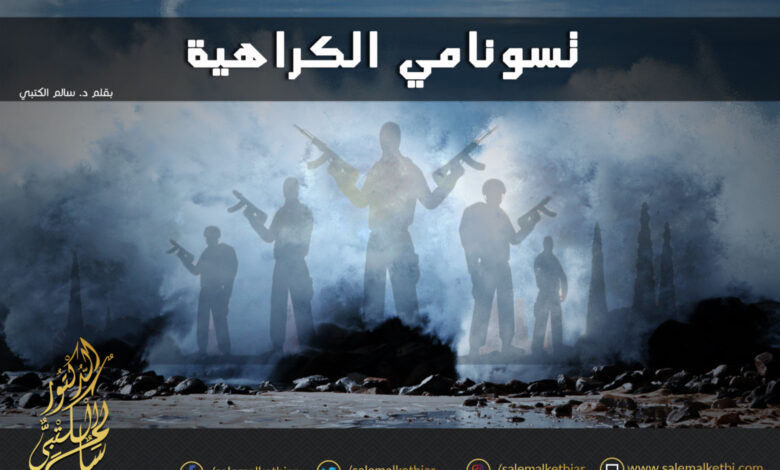
After the publication of my previous article, “Taking a stand against hate-speech” on the website Elaph, and the subsequent wide, varied and interesting reactions from the readers of the site, I became more convinced that our world needs nothing more than more coexistence and less hate.
The world as a small village, as popularized by philosopher Marshall McLuhan, is turning into narrow neighborhoods in a vast global village that we hope can accommodate 8 billion people of different religions, races, cultures and ethnicities.
There is no room for extreme zero-sum conflict in the alleys of this village. I see coexistence as the only option for all. I even see that the world is in a race against time to reach survival and move away from hate.
All these hidden grudges the internet allowed to surface still represent little of reality. Statistics show that about 55 percent of the world’s population does not yet have access to the Internet, and nearly one billion people do not have a mobile phone. What if all of them were to join globalization when it’s overwhelmed by waves of hate?
UN Secretary General Antonio Guterres did not exaggerate when he said that the “multi-headed monster” of intolerance, has created a visible and violent “tsunami of hatred” that is gathering speed across the world. “Hate speech is not free speech. It’s racism,” said President of the UN General Assembly Maria Fernanda Espinosa.
My own conviction is that the issue is not about social networking platforms or the Internet. We should not blame these platforms; we should thank them. They revealed to us the top of the iceberg of this globalized phenomenon.
What spreads through social networking platforms will not disappear if we are prevented from publishing it. This does not mean that I agree to the circulation of racial or hate content, but I fully support any legislative and legal effort to limit it in cooperation with technology companies. But I see this effort must be paralleled by a greater effort and a radical treatment to uproot hate.
Most of the ideas of hatred and incitement, and the new wave of intellectual and religious fascism, were not born online, though the web helped to spread and promote them, often without legal accountability on the grounds of freedom of expression.
But the biggest and most chronic danger lies in the sources of hatred that will inevitably find a way to reach minds, whether online or otherwise.
The whole world is discussing the challenges of spreading tolerance in the digital age and dealing with ways to address the spread of hate speech through social media. This is good and useful. But more effective is building a multi-term strategy.
On the short term, we tackle hate content through social media. Then, in the medium and long term, the global effort will crystallize into a binding international convention on the suppression of hatred.
Cross-cut efforts are necessary to address the gravity of the phenomenon, whose effects exceed the proliferation of weapons of mass destruction. While Most of the latter remain in the hands of states, hate speech is a weapon of mass destruction that may be possessed by extremist organizations and radical groups hostile to all religions, civilizations and cultures.
We should never associate hate to Islam, Christianity or Judaism. We should not reduce it to Islamophobia or anti-Semitism or any other bias. We must admit that hatred is not limited to religious animosity, but includes ethnic, linguistic, political and even gender hostility.
It is wrong to think that hostility is only raging between the West and Islam, or more precisely, between minorities of followers of Islam and Christianity. There are equally dangerous feuds among Muslims and among Christians.
The enmities are not limited to sectarian division, between Sunnis and Shiites, for example. Some animosities sometimes erupt between followers of a single sect, due to the practices of terrorist and extremist organizations that have employed religion in politics to sow division.
No wonder we find hatred within the same religious community, for political reasons stemming from backward ideologies. We have to admit that hate content is more serious, deeper and more pervasive than we all think. We must recognize that silence is not an option, because future generations deserve a safe life free from violence, hatred and grudges.