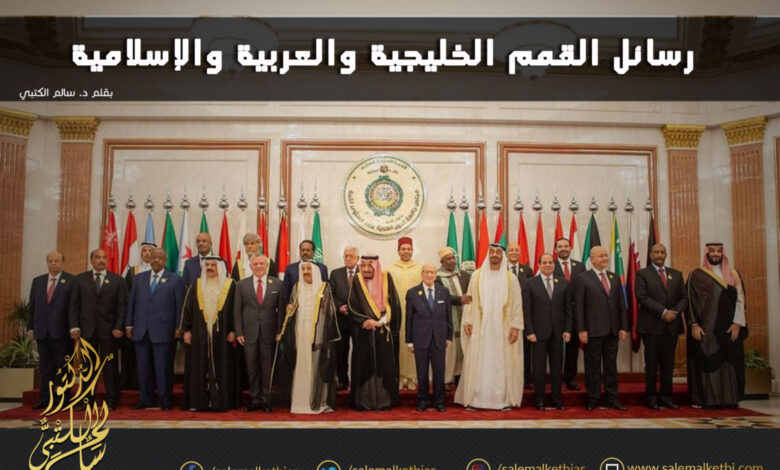
The Gulf, Arab and Islamic summits, held back-to-back in Mecca, have focused on the seriousness of Iranian political behaviour and practices, holding Iran accountable for the chaos and unrest in the Gulf and Arab regions and the threat to international security and stability through its targeting of maritime navigation and threat to the security of international shipping corridors.
The main objective of these summits, I believe, was very much accomplished. When he called for the summits to be convened, The Custodian of the Holy Mosques, King Salman bin Abdul Aziz did not seek to adopt a resolution or even to express any intention of war with Iran. He wanted the Gulf, Arab and Islamic countries to send a clear message to the Iranian regime to come to its senses and realize that they support the Saudi position in the conflict with the Iranian mullahs.
Mobilizing support against the practices of the Iranian regime is a very important political point.
Thanks to the hard work by the Saudis at the three summits, including with presentations such as Facts in Minutes, everyone now knows that the Iranian regime is deeply involved in what is happening in the region. Saudi Arabia has presented to the leaders of the Gulf, Arab and OIC countries with examples of missiles and drones used by the Houthis to target the Kingdom.
Gulf, Arab and Islamic countries’ support Saudi Arabia in the face of all threats to its security, stability and territorial integrity is an important strategic factor that strengthens the Saudi leadership’s margin of manoeuvre against Iranian threats.
The three Mecca summits were not intended for escalation. The summits have made a contribution to security and stability by setting the record straight on the rejection of Iran’s behaviour and practices.
As well as for all parties to respect UN principles, the sovereignty of States and non-interference in the affairs of other States, the summits called on halting all forms of militia expansionism and sectarianism, which have become a major cause of unrest in many Arab countries.
I believe that the Saudi strategy of pursuing summit diplomacy to show the facts and seek support from Gulf, Arab and Islamic countries has achieved its vital objectives. It has largely helped uncover Iran’s destructive behaviour and reflect Iran’s deep isolation in an Islamic fold that it claims it has an influential role in.
The enormous support that the Saudi leadership received at the three summits gives it considerable political capital that strengthens its ability to take appropriate action to defend its sovereignty and uphold its people’s right to security and stability.
The three summits also provided the appropriate political legitimacy for any measures that Saudi leaders might take to defend the country’s security, as Iran-Houthi plots multiply.
Isolating the Iranian regime and disclosing its use of proxy militia, coup and terrorist groups will hamper the Iranian regime’s ability to act at the international level. Isolation also revealed to the Iranian people the truth about their regime, and that their State’s policies are only endorsed by militia commanders.
Saudi Arabia’s calm politics against Iran’s recklessness has put the mullahs’ leaders in a tight corner. Thee mullahs were expecting a counter-intervention in response to their provocations and military harassment.
But the Saudi leadership understood the consequences and implications of the situation and made the interests and gains of the people of the region its top priority, so when they found a rational response from it, they tried to divert attention from the outcomes of the three summits. As they failed, they carried on attacking and making further provocations and hostile statements.
Running a State is not like running militias and failing political groups and regimes.
States are managed according to the rules of politics and international relations. They make moves according to precise calculations, taking into account all regional dynamics. Establising a well-presented, fact-based cause is more effective, influential and lasting than aggressive behaviour and emotional reactions.