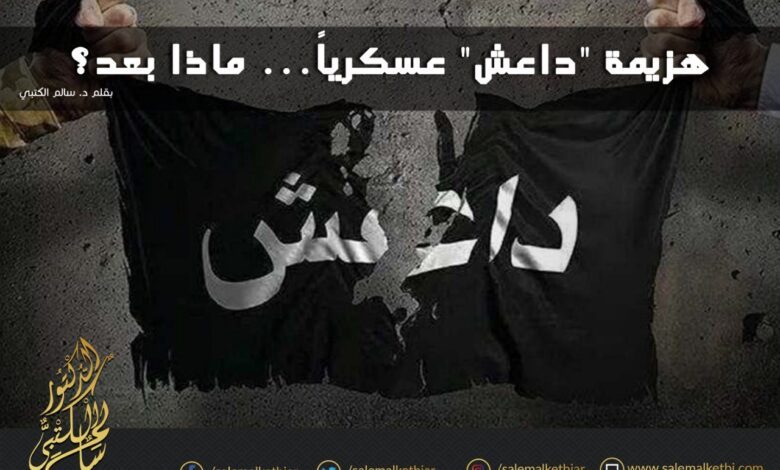
A page of terrorism has been turned after the Syrian Democratic Forces, supported by the United States, announced the liberation of the city of Al-Baghouz, the last enclave controlled by Daech in eastern Syria.
The event marked the official fall of the so-called caliphate proclaimed by Abu Bakr al-Baghdadi in 2014.
But, ideologically, the organization remains active. Dormant cells scattered in many countries and regions are still operating, as well as an unknown number of sympathizers and fanatics.
It is true that Daech’s defeat in Syria is an absolute military win. The organization dominated an area of about 90,000 square kilometres, with a population of nearly 8 million, that hold significant oil resources and lucrative crossing points.
The defeat of the leadership symbol can have the effect of a military defeat. The survival of leadership does not necessarily mean maintaining the strength of the organization.
Leadership has lost much of its influence in the eyes of its supporters after successive defeats. Supporters of these ideological organizations will be able to link defeats to mismanagement by the central authority.
It is possible that the difference in visions and plans for the reunification of the organization and competition between leaders, due to weakness at the top of the hierarchy, may lead to its dismemberment.
Daech could be divided into less powerful groups, more geographically dispersed, but more radical and brutal.
One of the possible consequences of ideological defeat is also the intensification of discussions and disputes between terrorist ideologues on operational priorities, such as the definition of the enemy and whether to attack the near or distant target.
The ideological conflict between Daech and Al Qaeda will intensify, especially that the idea of establishing a caliphate—as opposed to creating the conditions for the creation of an Islamic state as Al Qaeda believes—has been discredited.
The modern theory of terrorism suggests that the roots of extremism and terrorism, if they are planted in a country, will remain there unless they are uprooted. Long-term efforts are needed to get rid of them and to promote tolerance and coexistence.
What happened in Syria was the defeat of the idea, not its eradication. Its return and growth depend on the practices of the post-Daech phase and whether or not there is an atmosphere conducive to its return.
Contrary to what US officials believe, it is not just a matter of constant military pressure. Instead, we must solve the problems that Daech has exacerbated, such as poverty, unemployment and hunger.
Social injustices and discrimination against the population in areas that have been controlled by the organization must be stopped, as these problems can serve as a pretext for terrorist organizations to recruit and mobilize new elements.
Another question mark concerns the fate of the remaining members of the organisation in Syria and Iraq.
The transition to illegal employment is the main feature of this phase. The organization becomes a decentralized and sometimes individual units, known as lone wolves, due to the difficulty of communicating and transmitting commands according to the organizational hierarchy that has prevailed over the past five years.
Clandestine and decentralized terrorism is no less dangerous than organizational terrorism. Moving to mountainous areas, rather than to lowlands and residential areas, has its advantages. It will allow terrorists to mobilize and reorganize their ranks. At that point, they will be able to launch occasional attacks, destabilizing the population and diverting authorities from other activities, such as reconstruction. This will prolong the chaos and make instability an essential feature of these regions.
The Pentagon estimates that Daech still receives cash donations from abroad ranging from $50 million to $300 million. Funding ensures the continued operation of the elements of the organization and its activities.
It is therefore too soon to speak about the defeat of terrorism.
Between 14,000 and 18,000 fighters in Iraq and Syria, including about 3,000 foreign fighters, are still loyal to Daech, according to international estimates.
James Jeffrey, the U.S. special representative for engagement in Syria, estimates that there are between 15,000 and 20,000 Al Qaeda fighters active in the region. So many people, if they continue their terrorist activities under the cloak, can disturb any country.
A strategy must be developed on this subject in the next phase, because even after terrorism’s military defeat, terrorism is far from counting its last days.