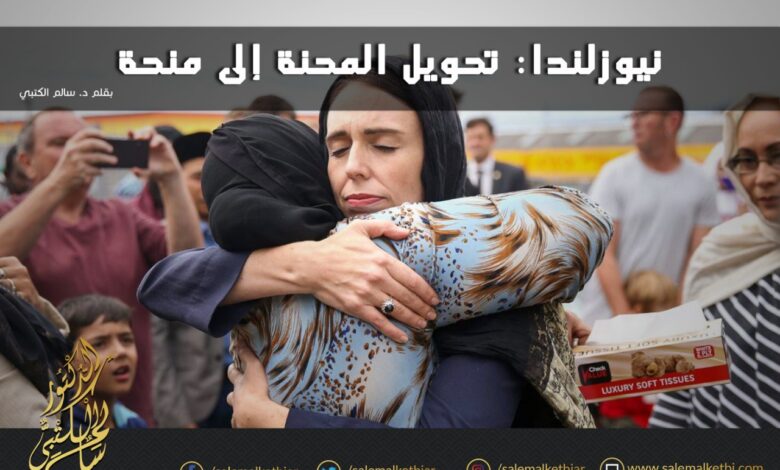
New Zealand Prime Minister Jacinda Laurell Ardern successfully managed the crisis provoked by the vicious massacre performed by a far-right terrorist in Christ Church, turning a major security challenge into one of the most successful government PR campaigns in history.
Ardern transformed the crisis from a tough test to the cohesion and unity of New Zealand into a major political achievement in two ways. At the domestic level, she used the opportunity to strengthen national cohesion and co-existence. At the foreign level, she promoted New Zealand as a model for co-existence and tolerance to millions of people around the world, while earning her the respect of global media.
The prime minister is obviously a challenge-minded politician who can cope with hard times. Critics had questioned her ability to rise to the challenge when she appeared in the very first minutes after the event and seemed to have difficulty controlling her feelings amid the gory blood scenes.
But she was quick to act tough and take a historical stance, owing to her experience. She is so far the youngest elected female leader, the third female Prime Minister in her country’s history and the second leader to take her baby to the UN headquarters.
Ardern’s attitude towards the crisis was not at all spontaneous. The late South African leader Nelson Mandela was one of her inspirations. She even started the session of the New Zealand Parliament with a recitation of verses from the Qur’an in a country where Muslims make up only one per cent of the population.
She knows that New Zealand is a nation of great diversity in terms of race, culture, language and religion and that this diversity must be carefully managed in order to remain a source of cultural wealth rather than an impediment for development.
Women wore the veil in solidarity with the victims of the terrorist massacre. Massive campaigns including women, men and children were organized where women covered their heads and men their shoulders.
What is interesting about the prime minister is that she is not a supporter of immigration and asylum in her country. She has pledged in her election campaigns to take measures to regulate and reduce immigration.
However, in her view, the politics of immigration is one thing, and the rights of immigrants who have or would become citizens of New Zealand are something else.
They are guaranteed protection, security and all human rights. This is an important message to many Western politicians and leaders who indiscriminately tackle migration and raise racial tensions.
The New Zealand Prime Minister established her policy based on economic facts such as unemployment, high rental costs and the impact of immigrants on employment prospects, not racist xenophobic attitudes.
Raising the slogan of “We are a people,” she wore the headscarf at a meeting with Muslim community leaders following the massacre and at the day of solidarity with the Muslim community in New Zealand. She quoted the Prophet Muhammad in her speech at the memorial of the victims as saying, “The believers in their mutual kindness, compassion and sympathy are just like one body.” Friday prayers were broadcast on national television and radio in Arabic and English.
The New Zealand leader has given world politicians a great lesson in crisis management, from a small country indeed, but one that is strong in its diversity.