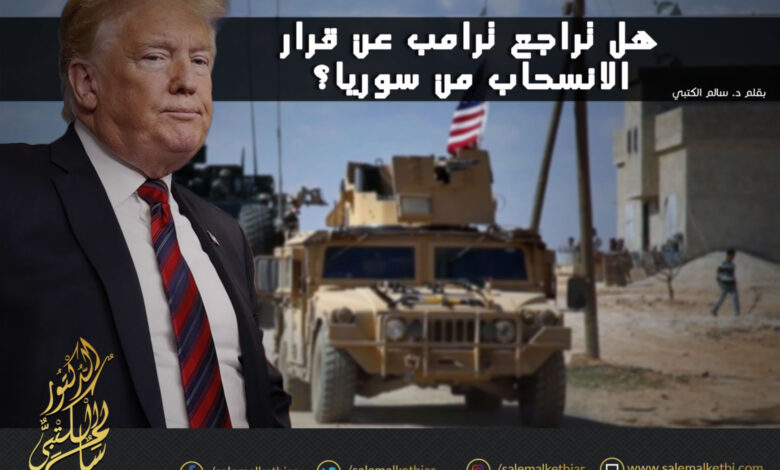
Sometime after President Trump announced US troops would withdraw from Syria, several leaks and statements suggested he might rethink his decision, modify the plan or perhaps completely cancel it.
President Trump became known to the political and media circles for being unpredictable and constantly changing his mind.
A few days ago, President Trump said that “Syria was lost long ago. We’re talking about sand and death.” The statement explains clearly his desire to withdraw from this Arab country despite enormous pressure to reverse his decision, especially from Israeli Prime Minister Benjamin Netanyahu. Insisting on his intention to withdraw troops from Syria, Trump said
“We’re not talking about vast wealth. We’re talking about sand and death. Look, we don’t want Syria.”
So far, President Trump has not set a timetable for the withdrawal, but the way he speaks about it suggests that the withdrawal is not imminent. Trump insists he has not decided to return troops overnight. “Yes, absolutely. But we are getting out very powerfully.”
Following pressure from military officials and politicians to reconsider the rapid pullout he announced in December, U.S. President Donald Trump has agreed to a gradual withdrawal of forces from Syria, which might cast doubt about the whole idea of pulling out.
At first, Trump’s decision to immediately withdraw was strong, so much so that Defense Secretary James Matisse submitted his resignation in protest of this decision. But now one might wonder if Trump responded to Netanyahu’s call to retreat gradually.
The answer is likely yes, because President Trump, who gave so much unprecedented support to Israel, cannot risk losing it all by withdrawing troops quickly and leaving Israel alone to face Iran’s strong presence in Syria.
However, how can two thousand US soldiers protect Israel with all its arsenal, army and hi-tech equipment? The US military presence in Syria is not measured by the number. The US is a superpower by its ability to influence and deter adversaries. Its strategic presence in Syria lies in the ability to quickly respond in the event of any crisis.
What might reveal the truth of President Trump’s intentions in Syria is a statement by senior Republican Senator Lindsey Graham. Graham said that US President Donald Trump had vowed to remain in Syria until Daesh is destroyed. The statement came after a two-hour meeting between Trump and Graham, who later said that the retreat “will be done in a fashion to ensure ISIS is permanently destroyed.”
Graham’s statement came few days after Trump said’ We have defeated ISIS in Syria,“ on December 19. The time frame between the two conflicting statement telld much about the amount of time the US is planning to remain in Syria.
Clearly, President Trump is growing aware of such concerns as protecting Kurdish forces (”If we leave now, the Kurds are going to get slaughtered,“said Graham referring to a likely Turkish intervention against the Kurds) and ensuring that Iran would not make much gains from the withdrawal which explains Counselor Kellyanne Conway’s statement that ”the president may be tweaking his withdrawal plans.“
The alternative option would be a gradual, even slow withdrawal by which Trump would respond to the concerns of US generals and Israel. President Trump himself confirmed tweeting about ”slowly sending our troops back.“
President Trump’s slow withdrawal plan confused all players in the Syrian arena.
Some observers believe that it was a trial balloon to check the reactions of influential powers in Syria—Russia, Iran and Turkey—and act accordingly in the next phase.