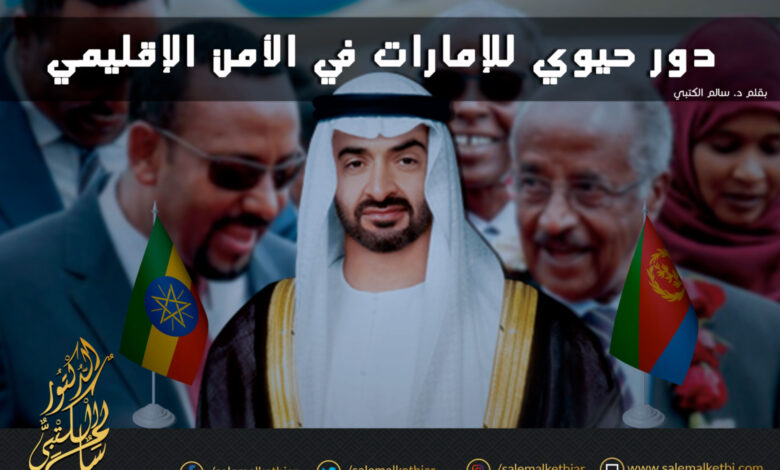
The UAE is keen to safeguard the regional stability and protect Arab and Gulf’s national security from all threats. The wise Emirati mediation, undertaken by His Highness Sheikh Mohammed bin Zayed Al Nahyan, Crown Prince of Abu Dhabi and Deputy Supreme Commander of the UAE Armed Forces, had a major role in solving the conflict between Ethiopia and Eritrea. The wise leadership intensified diplomatic efforts in recent months and weeks. His Highness Sheikh Mohammed bin Zayed Al Nahyan paid an official visit to Ethiopia. The UAE also received the two heads of States on official visits that led to establishing stability in the Horn of Africa.
The dispute between Ethiopia and Eritrea has lasted for more than two decades. It needed a wise mediation from a party that enjoys the two sides’ confidence to bring their views closer. Ending this conflict is in the interest of both countries.
On May 19, the Ethiopian Prime Minister paid an official visit to the UAE. In mid-June, His Highness Sheikh Mohammed bin Zayed Al Nahyan visited Addis Ababa. There, he held fruitful talks with the Prime Minister of Ethiopia. On July 3rd, The Crown Prince of Abu Dhabi received Eritrean President, Isaias Afwerki, in a series of talks that received the attention of the political circles regionally and internationally. None thought these visits were a possible UAE mediation between the two countries. Most of the expectations went in quite different directions. Hostile media circulated scenarios promoted by their financers. Fake news was based on the conclusions of holders of agendas with malicious plans. Holders of these agendas cannot think of a leadership working for the benefit of the Arab nation, a leadership believing that peace and stability is the only way to development and that stopping war and conflict guarantees regional security and stability.
Workneh Gebeyehu, Ethiopian Foreign Minister, said the rapprochement between the two countries was a result of the efforts made by His Highness Sheikh Mohammed bin Zayed Al Nahyan. UN Secretary General, Antonio Guterres, said the reconciliation was “illustrative of a new wind of hope blowing across Africa”.
Solving the Ethiopian-Eritrean conflict in a short time was unthinkable. The two countries fought a bloody two-year war (1998-2000). A Cold-War-like atmosphere has marked the tensions between the two countries for nearly two decades ago. But the hope for a settlement prompted the positive and vigorous mediation by His Highness Sheikh Mohammed bin Zayed Al Nahyan.
None has ever expected Ethiopia would ask the US to lift sanction on Eritrea. The conflict of yesterday has been turned into a desire to cooperate and compensate for what had been lost during the years of tension.
This positive step is important amid speedy developments, plans of conspiracy and the financing of terrorism. Expansionist regional forces deepen the differences and spread sedition among countries in the region. The reconciliation will have positive effects on the Ethiopian and Eritrean people. It was delayed but needed strong efforts of a sincere party seeking good, security and peace for all.
Ethiopia is seeking a developmental breakthrough for its people. It will achieve this only through peace with its neighbour Eritrea to end the conflict and tension and ensure Ethiopian trade ports through Eritrean ports. Eritrea itself needs integration with the world and neighbouring countries to revive its infrastructure and economy.
Combating extremism and terrorism is a key objective for the UAE and the Arab coalition. This is clear in diplomatic work. Achieving this vital goal requires military and security efforts but also a parallel work at cultural, political, diplomatic and media levels. One of the most important means to achieve this goal is eliminating conflicts. It demands also reducing the gray areas where there is no stability. These areas are exploited by terrorist organizations to exercise their criminal activities. Several conflicts between countries in the Horn of Africa, including Ethiopia-Eritrea conflict, were one of the most important factors in the spread of terrorism. Terrorist organizations exploited this conflict in stretching and spreading extremist ideas.
The absence of cooperation between the two regional countries hindered efforts against extremism and terrorism. Countries financing terrorism exploited the dispute to achieve their goals and interests.
The success of this mediation is a powerful blow to the plot of regional conspirators such as Qatar and others. Doha took advantage of the conflicts in the Horn of Africa to play malicious roles that harm many Arab and Gulf countries. The reconciliation has thus undermined Qatar’s plans to exploit this conflict and spread strife.