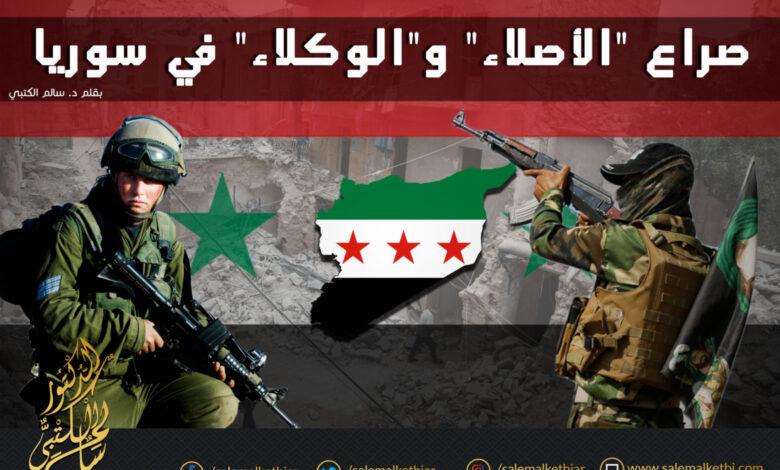
It is not expected that the ongoing missile conflict between the Iranian militias in Syria and the Israeli army will end anytime soon. For reasons and considerations, the two sides seem to have agreed that the Syrian territory should be the arena of the conflict. They are unwilling to wage an open war or expand the conflict. The two sides opted for unknown/known limited missile strikes. But these calculations may collapse under the pressure of certain conditions.
Israeli missiles hit Iranian targets deep inside Syria. Iranian missiles have been reportedly fired by mullahs-backed militias in Syria towards the occupied Golan Heights. According to the Israeli defence minister, the iron dome failed to repel some of these rockets. He said that some of these missiles were intercepted and some others did not hit their targets, meaning they escaped the iron dome.
The strategy of limited strikes predicts indirect agreement between Iran and Israel. Tehran does not want to escalate, fearing that its territory will be hit by a US-backed Israeli attack. The mullahs are aware that a direct war with Israel means an open confrontation with both the US and Israel, putting the mullahs’ regime in jeopardy.
Israel also does not want an open confrontation or a major military conflict with Iran. Tel Aviv is merely pressuring to improve the terms of negotiations about the Iranian influence in Syria. What matters to Israel is to get commitments from Russia to get the Iranian militias out of Syria. Israel is highly concerned over the RGCC’s geographical proximity to Israel, fearing strikes that threaten the security of Israelis.
The problem is that Israeli missile strikes, despite their limitations, produce uncontrolled strategic calculations. The attacks kill Iranians, most of them experts and advisers in the Iranian Revolutionary Guard. These strikes put the mullahs’ regime in a very difficult test. Iran’s is in the face of its false ideological slogans that have been traded since 1979. Tehran is becoming geographically closer to Tel Aviv. Supporters of the mullahs’ regime in Iran call to wipe Israel out of existence.
These calculations are a huge pressure on the mullahs, especially in light of the failure of economic policies. Iranian economic policies have drained the money of Iranian people and achieved only losses and false victories in Iraq, Syria and Yemen. The Iranian economy is severely affected by the withdrawal of the US from the nuclear agreement and the international sanctions on Iran.
Israel, for its part, cannot stand the presence of the RGCC militias in Syria and will never allow it at all costs. The Netanyahu government is ready to wage a full-scale war against Iran instead of accepting to live under the mercy of Syria-based mullahs’ strikes. Tel Aviv will not agree that General Qasem Soleimani walks near the Golan Heights and prepare the Lebanese Hezbollah to attack Israel.
Historical experiences tell us that Israel cannot live under the mercy of fear and anxiety. Tel Aviv has always initiated wars and moved conflict to foreign soil, preventing its people from danger. Israel is located in a narrow strategic depth that can easily be hit with rockets. The limited conflict is likely to continue. There is a high probability of turning this conflict into a broader and larger military confrontation in the event of certain conditions. For instance, any attacks leaving massive human casualties would trigger an inevitable direct confrontation.
There is also a possibility of implementing a strategy of attrition of Iran in Syria so that the Syrian territory becomes a new Vietnam for Tehran. Syria will thus be transformed into a quagmire in which the mullahs’ regime drowns. But the mullahs must be expelled or forced to withdraw from Syria. Iran’s presence in Syria is made up of financial resources, advisers, military experts and equipment. The mullahs rely on Shiite fighters brought from Afghanistan and other countries. Shedding blood there won’t be an effective pressure on the mullahs but the more victims will be among the Syrian people.
Days ago, Hassan Nasrallah, leader of the Lebanese Hezbollah, said that the authentic war has started after the defeat of agents. He might think of himself as an authentic party to act on behalf of Iran in its war against Israel. The upcoming period is full of surprises. Syria will be the starting point to redrawing the new Middle East.