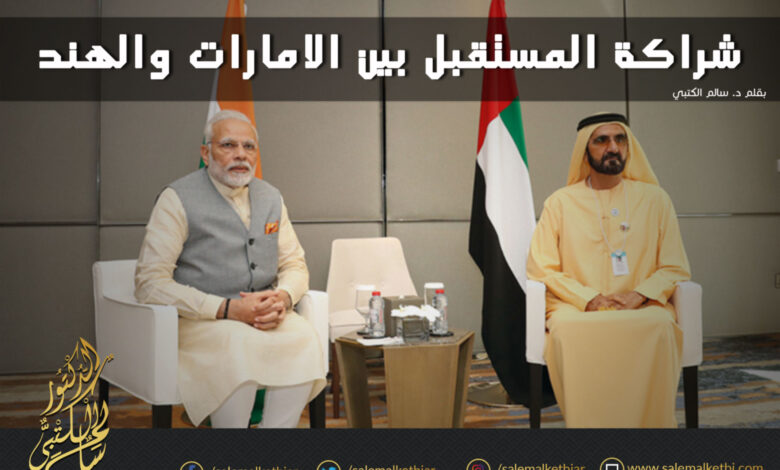
The final communiqué issued at the end of the Indian PM Narendra Modi’s recent visit to the UAE established the foundations of the strategic partnership between the two countries in the 21st century. The statement made it clear that this partnership depends on a precise and effective mechanism. The two parties rely on a continuous follow-up to the meetings of the leaders of the two countries to assess agreements and developments in various fields.
The recent visit of Indian PM tackled the results of the second term of the strategic dialogue held in Abu Dhabi last October. Both parties expressed their complete satisfaction with the current level of bilateral trade that accounts for around $ 53 billion during the period 2016-2017. They decided to enhance these relations by focusing on the diversification of non-oil trade.
The two sides also expressed their satisfaction with the ongoing bilateral cooperation in the fields of security and defence. They pledged themselves to enhance regional security, peace and prosperity. The two parties also agreed to deepen cooperation in the field of maritime security including combating piracy.
The UAE-India partnership is not confined to the economic fields but includes shared values and principles. The UAE and India agreed on promoting the values of tolerance and peace in the face of terrorism and extremist ideologies. The two countries are a melting pot where different cultures and races live.
This partnership is also reflected in the mutual visits between the leaders of the two countries. The Indian PM visited the UAE during August 2015. His Highness Sheikh Mohammed Bin Zayed Al Nahyan, Crown Prince of Abu Dhabi and Deputy Supreme Commander of the armed forces, visited India during February 2016. In January 2017, His Highness was a guest of honour at the 68th Republic Day celebrations in India. The text of the final communiqué pointed out that the frequent high-level visits between the two countries have facilitated rapid and regular implementation of comprehensive strategic partnership, a partnership oriented towards achieving mutually beneficial results.
The talks have reached crucial results. Both sides have agreed that all States are responsible to control the activities of the so-called non-State actors and to reduce all forms of support to terrorism. The two sides also made it clear that terrorist acts against other States must be reduced. They also agreed on the need to take credible steps to eliminate safe havens that provide shelter to terrorists and their activities. This is an extremely important point in achieving regional and international security and stability.
The two parties showed their shared values during the Indian PM’s visit to the UAE. In the final communiqué, the Indian PM thanked His Highness Sheikh Mohammed Bin Zayed Al Nahyan for allocating land to the construction of a temple. This act from His Highness is an implementation of the resolution adopted by the UAE Government in August 2015 to meet the demand of the Indian community. Narendra Modi pointed out that the temple would be an important symbol of the UAE’s firm commitment to the principles of tolerance. The UAE is trying to build a model State where different communities enjoy their cultural and religious freedom, said Modi.
India will participate as a guest of honour at the Abu Dhabi Music and Arts Festival in March 2018. Sharjah will also be a guest of honour at the New Delhi World Book Fair in 2019. The leaders of the two countries are keen to intensify exchanges of scientists, academics and cultural delegations.
The Indian PM congratulated the UAE leadership on opening the Louvre Abu Dhabi Museum. The two parties decided to strengthen cooperation between the National Museum of India and the Louvre Abu Dhabi, affirming the importance of the cultural aspect in the strategic partnership between the two countries.
UAE is a rising power seeking world competitiveness in various development indicators. Already a regional and global power, India is increasingly present in the multilateral global scene today. The two countries will benefit from the strategic partnership. This partnership will provide strong pillars for regional security and stability.