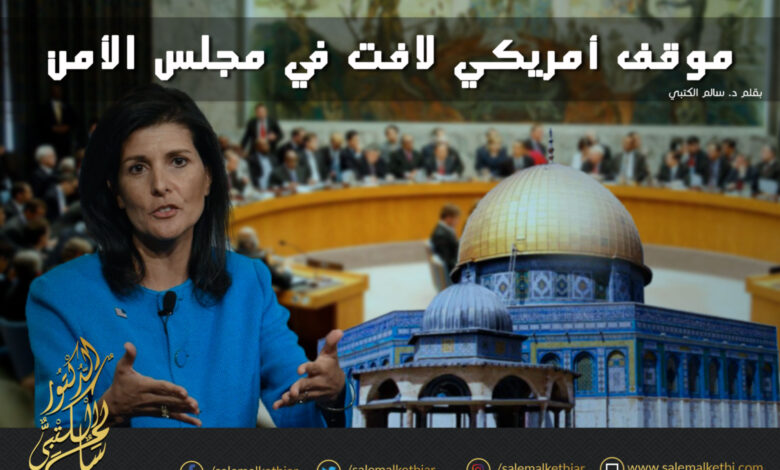
Last March, US ambassador to the United Nations Nikki Haley told the American Israel Public Affairs Committee (AIPAC) that everyone in the building fears her and, with her high heels, she will “kick” everyone who criticizes Israel.
Ambassador Haley thought that the UN is biased towards the Palestinians, but she could realize that the “bias” far exceeds what she thought. After a round of applause, “The days of Israel bashing are over,” Haley said. “What I can tell you is everyone at the United Nations is scared to talk to me about Resolution 2334 (on Israeli settlements),” describing Israeli settlements as a flagrant violation of international law and a major obstacle to the achievement of a two-state solution and a just peace. The resolution also states that any changes to the 1967 borders can only be recognized upon agreement between the two parties.
The US abstained from voting or vetoing the resolution, passed on December 23, 2016, at the end of the Obama presidency, despite president-elect Trump call to do so. For Haley, “the days of Israel bashing [were] over” and “the new sheriff in town”—the Trump administration—was going to treat Israel better than his predecessor.
Before the Security Council meeting on Jerusalem, Haley slammed the United Nations for “damaging” the prospects for peace between Israel and the Palestinians as being “anti-Israel”. “Israel will never be, and should never be, bullied into an agreement by the United Nations, or by any collection of countries that have proven their disregard for Israel’s security,” she advanced, before saying again that the US has enough credit to mediate peace between Israelis and Palestinians.
Haley apparently senses skepticism in the speeches of UNSC member states delegates in her country’s ability to mediate for peace in the Middle East. She wanted to close the door to any attempt to revive the United Nations role. And while she spoke of a supposed US mediator role, she only mentioned the position of Israel.
The strategic alliance between the United States and Israel is as old as the hills but Haley brought up a new tactic to defend her country’s allies. Her predecessors like Susan Rice and Samantha Bauer were also defending Israel but not at the expense of other allies or undiplomatically towards other international powers.
Nikolay Mladenov, UN Special Envoy to the Middle East, did not support the Palestinians at Israel’s expense but just warned of violent escalation regionally following ‘unilateral’ action in the wake of Trump’s Jerusalem decision.
Before Trump’s decision, his administration said it will not take steps or positions that could negatively affect the prospects for Israeli-Palestinian peace.
When Haley found herself swimming against the tide of isolation, she attacked the UN and showed more support for the Jewish State. The plan was to earn more points from the pro-Israel allies because the Trump’s decision was indefensible and unconvincing to allies in the NATO.