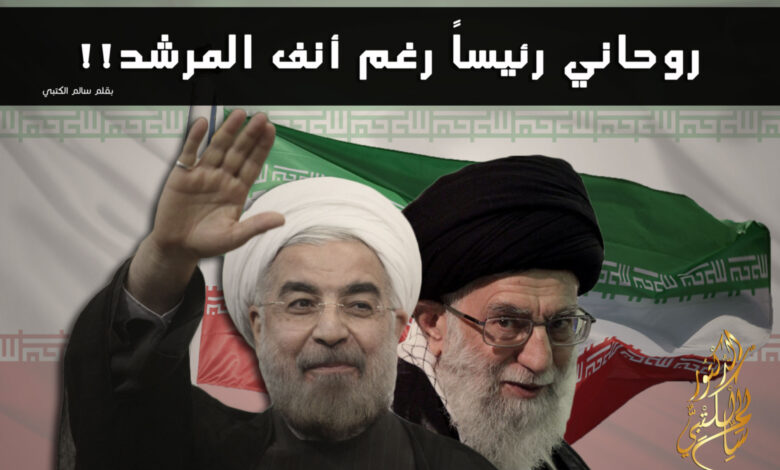
Following his second-term victory, Rouhani did not receive, the Arab media reported, congratulations from Khamenei who only tweeted that the election showed the steady progress of the Iran.
President Rouhani, with 57% of the vote, considered his re-election to show that Iranian voters reject extremism and want stronger relations with the outside world. Analysts believe that Rouhani’s decisive victory means economic reforms.
Rouhani’s victory is entirely in line with the wishes of the mullahs and their Leader. It is unreasonable for Iran to come with a hard-line president lacking the necessary political expertise at this very sensitive time. Iran is in a very difficult strategic position and faces unprecedented isolation. Here some might wonder: since the Leader wants to keep Rouhani, why then have Ebrahim Raisi compete? Everyone knows the consequences of the loss in advance and that Ebrahim Raisi, a strong candidate to succeed Khamenei, wanted to win The Presidency as a first step toward sitting on the chair of the Leader.
In his tweet, the Leader said Iran would prove to have dignity and “wisdom”— one of Rouhani’s campaign slogans—in relations with other countries. The conclusion is that there is a huge focus on foreign policy and the management of Iran’s relations with its regional context and beyond. It is not possible to bet on a president who lacks political experience. Rouhani seems the right president at this time to maintain the mullahs’ regime. It is hard to believe that the Leader, who is the decision maker in foreign policy files, can agree to push a new president (hardliner or not) to negotiate the Trump administration challenge.
It was not expected that Khamenei would seek to boost the chances of a hard-line candidate who would turn his back on the nuclear deal and give the US administration a valuable chance to break the deal, which it calls the worst agreement in history. It is difficult to believe this, especially as the agreement gave Iran the kiss of life to return to the international arena, at least in regard to the relations with European countries.
Rouhani’s re-election for a second presidential term represents Iran’s message to the White House on the same day as President Trump arrived in Riyadh on his first foreign tour as US president. Iran was placed on the top of the agenda of the tour. Secretary of State Rex Tillerson said that the United States hopes that Rouhani uses his new mandate to dismantle the terrorist network and put an end to the ballistic missile program.
The satisfaction in the European reactions to Rouhani’s victory is a strong indicator of the success of Khamenei’s strategy to send a message of reassurance to the outside world and to resume the nuclear deal. What was important to the mullahs in these elections was not only Rouhani’s victory but also the voters’ turnout. The biggest celebration, as the reaction of the leaders of the Iranian regime shows, seemed to focus on unprecedented voting rates. The Iranian regime was essentially seeking a popular approval, whoever the winner of the elections was. This is a testimony that supports the position of the regime in the face of increasing external pressure, which some believe targets the regime itself.
The mullahs got what they wanted in the elections, some credit from Iranian voters. Voters did not abstain from voting in response to Iranian opposition calls to stay in their homes on Election Day.
But how can the Mullahs sacrifice Ebrahim Raisi, one of their most prominent candidates to succeed Khamenei? The answer lies in the Leader’s calculations and what it considers appropriate for the future of the system as a whole. But Rouhani is a strong candidate to succeed the Leader. Khamenei may see him as a strong guarantee to maintain the interests of the regime. Khamenei might even think it is risky to grant the IRGC and their followers, including Raisi, full authority at home and abroad, bringing to Iran crises that could lead to the fall of the regime.
The man understands that to respond to the Iranian public opinion he must choose a president among candidates approved by the mullahs, to prevent any popular uprising that may receive support from outside at this sensitive time. It was the Leader who gave Rouhani the green light to sign the nuclear agreement despite the strong rejection of the IRGC, which means that each party has its own calculations in the interest of the regime. The current leader follows approach of his predecessor Khomeini, who “drank the cup of poison” by accepting to sign an agreement with Iraq in order to preserve the mullahs regime.
This is a continuation of the game of sharing roles in Iranian politics, both internally and externally. The chances of the Revolutionary Guard and its toughest men to sit on the Leader’s chair after Khamenei’s departure have diminished. Rouhani became president, but not against the Leader’s will.