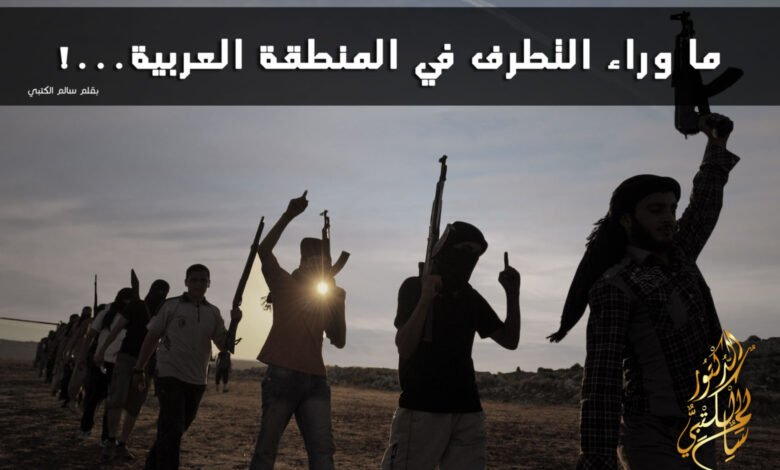
I believe that there are various complex and overlapping reasons that lead us to the situation where the challenge is not limited to the existence of terrorist organizations. The most serious situation is the spread of extremist ideology and the tendency to extremism.
Extremism is a state that can be seen in the content of social media, and I do not mean here religious extremism in particular, as it may be part of the general phenomenon of extremism. I prefer to generalize the concept of extremism to include every behavioral or verbal deviation from the socially set behaviors. Verbal violence against the other represents a degree of extremism, which in some circumstances may turn into behavioral violence at the individual or collective levels.
I have addressed many reasons and factors that fuel the phenomenon of extremism. I firmly believe that it is not limited to religious discourse. There are intertwined and complex factors such as the collapse of education in some Arab countries, unemployment, development and economic weakness, corruption, patronage, absence of role models and alienation, the disintegration of the family, the absence of a media compass and its work against the interests of States and societies in some cases, the change in the system of values and norms of social advancement, and the spread of material and commercial thought that overrides all religious and moral values in societies and destroy it completely, organized media attack on some of the values rooted in the community to attract attention and raise the amount of advertising and commercial television programs without any regard to the resulting destruction of the community.
Years ago, the concept of Creative Chaos, which is linked to politics and international relations, has been popular, but what we see in many areas in our Arab region goes beyond the effects of this creative chaos. We must admit that generations of millions now arise on immorality and tend to chaos in all its forms and manifestations.
The collapse of morality is an introduction to extremism. The fight against extremism is not achieved through nudity and pushing teenagers and young people to the other side of thinking, or rather to not thinking at all.
We must acknowledge that the threat of religious extremism is rampant against nations and peoples. We must also recognize that moral and behavioral extremism is no less dangerous than religious extremism and that it may contribute to the religious extremist ideology. The game of putting ideas, currents and ideologies against each other is corrupted, and it was experienced by our Arab region in the second half of the 20th century. It was one of the reasons for the rise of extremism and terrorism.
The UAE has its philosophy of dealing with extremism and terrorism and addressing whatever threats, which helps to maintain its identity and values. The UAE refused to deal with any terrorist groups regardless of their goals or tendencies. When countries opt to think like gangs and organizations they lose their influence. Those who seek to enshrine the concept of a National State should not work hand in hand with a terrorist organization, whatever the expected gains.
Religious discourse is problematic in the Arab region, but it is neither the only problem nor the most serious. I am not convinced that the deteriorating educational outcomes do not represent a threat to the national security of several Arab countries. Investment in education is much more important than strategic development projects. It is futile to plan, adopt and provide these developmental projects to generations who are distant from the current state of knowledge in the world. We have to recognize that education is the gate of reform in our Arab region. A good education is capable of confronting terrorism. It is not about changing curricula, but about changing the approach. Instead of rote learning, we must create generations that have a critical mindset. Then it would be difficult for terrorist organizations to easily attract sympathizers.
Members of the Muslim Brotherhood terrorist organization claim that followers of terrorism are of high levels of education and that most of them are doctors and engineers. I do not mean by education degrees but the approach and philosophy of education in many of our countries. Indeed, there are engineers and doctors who are used to memorizing. In our Arab countries, there are thousands of jobless PhDs and Masters, who were not well educated. If they were educated in the right approach the Arab countries would have another affair as long as they had so many true researchers.
We have to take a simple look at a list of the titles of the scientific researches, which are supposed to represent a strategic lever for our knowledge. Many of them, especially in the humanities, discuss issues that have nothing to do with the present or the future. They are only titles to get degrees.
What matters to me here is that recognition of the disease is the first step to treating the disease. Most of our countries are standing still and do not recognize their disease, they only take painkillers and stimulants. As long as the patient does not admit the illness, there is no benefit in any effort to monitor the imbalances.