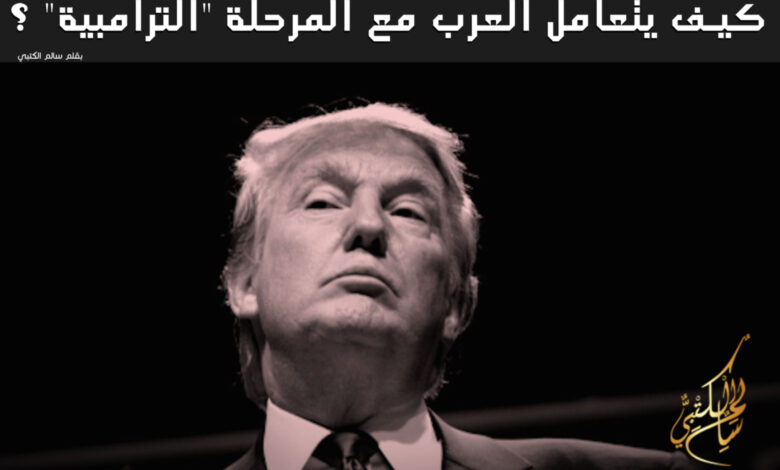
How should Arabs deal with the President Trump’s anti-Arab strategy? From my point of view, before we try to formulate a strategy to deal with Trump, we have to realize that this strategy is supposed to be already elaborated since the election of the new president in November 2016 and not now, because his positions were announced and did not change. But in general we must understand the Trumpian principles and premises, so to speak, whether towards Arab issues or other regional and international issues, in order to move on to preserve the Arab and GCC interests.
An inevitable Trumpian change is about what will happen in the US foreign policy. Trump and Barack Obama differ here on the personal level (intellectual and professional background) and the political level (Republican and Democratic).
The expected changes in foreign policy will focus mostly on tactics, not strategies. US interests both with the Arab countries or the world will not change overnight, and the US foreign policy is not made by the president alone, but there are other institutions of shared decision-making, as well as the fact that the president is restricted by the principles of the US Constitution, both in regard to the separation of powers and limits of the influence of the White House, or in connection with the principles under which the United States was founded, and this applies mainly to basic internal attitudes toward Islam and other issues.
Trump believes in the idea of business deals in politics. For example, when he talks about the provision of security protection for the Gulf Cooperation Council, this is not based on the existing strategic partnership between these countries and the United States, but on the fact that these countries must assume the material burdens for such protection. The budgets of the GCC countries have already borne the material burdens resulting from any US military intervention to protect the Gulf security throughout the past years and decades, but Trump is talking about cost calculations and the economic revenues, not strategic dimension. Only here lies the difference between him and his predecessors. The cost is certainly considered in the strategic partnership between the GCC and the United States, but what is new is that Trump is actually talking about it with unprecedented frankness that may surprise or even shock those who are not familiar with this dossier.
US relations with the Arab countries will not be the same. This is the case of the whole world, not only Arabs. He put “America first” and there is no exceptions to this. US relations with Saudi Arabia and Egypt will change; some will get stronger and some will suffer, according to the new calculations of the White House. All this will center on the American overall strategy that emerges from all decision-making institutions and not just the White House, in the sense that what happens next will continue to be subject to a ceiling of US strategic positions towards the Middle East. The Obama administration has begun in the last years the process of reducing the US role in the region. The Asia First strategy was taken by Trump to counter China’s growing role. The change is merely tactical.
We, as Arabs, must prepare for at least four lean years. The United States is not going to provide protection for any Arab country unless the cost is paid. This new reality opens the way to other countries such as Iran, Turkey and Israel to strategically stretch and fill the vacuum in the region in light of the decline of the role of traditional Arab powers with internal problems or unrest.
There are winners and losers with any new US administration, but the strategy does not change. We should avoid being the losers as much as possible, and we have to realize that the President Trump’s comments do not reflect new principles. We have to remember that Obama made a peace speech in 2008 in Cairo, and ended up with a series of disappointments and failures. It is not realistic to talk now about joint Arab strategy and collective work. But it is possible to crystallize common points between influential Arab countries such as Egypt, Saudi Arabia, UAE, Qatar, Morocco, Algeria and Tunisia, to protect what is left of Arab interests. This requires bridging the gaps between Egypt and Saudi Arabia, for example, and really settle every difference in views.
Trump may consider all Arabs and Muslims as having a religious ideology that feeds violence and cannot differentiate Islam and terrorism. He might take time to understand what is happening around him, and that depends on the developments in the US and the world and also on how terrorist organizations will react to Trump’s policies, and more importantly, how we behave, as Arab and Muslim peoples and nations and how we deal with Trumpian anti-Islamic sentiments, is it by giving up or building bridges of real communication with a man who knows Islam but is now playing the political game.