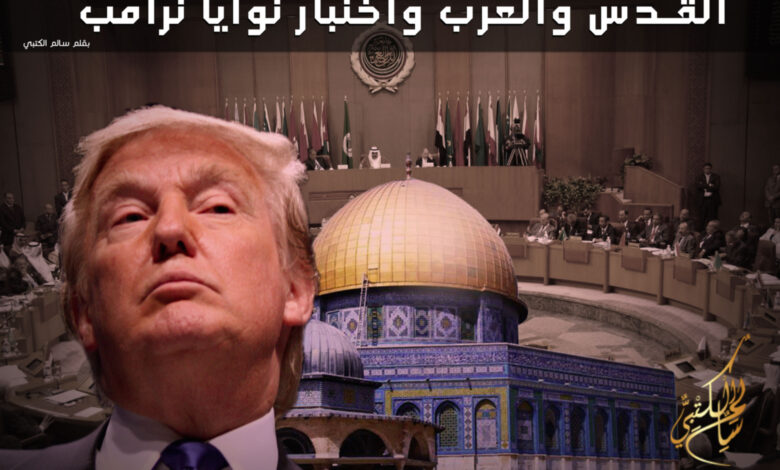
In response to the controversy over the new US president Donald Trump administration’s stance on the implementation of his promise to move the US embassy in Israel from Tel Aviv to Jerusalem, the White House announced recently that they are in the “early stages” of discussions on this topic.
Reactions varied between an Israeli welcome and a Palestinian outcry, while the Arab voice was completely missing as Arab governments are busy identifying the orientations of the new administration.
The status of the US embassy in Israel is a problematic in American diplomacy, which many administrations avoided dealing with. Such a move involves geographical but also political strategic dimensions. Trump has stirred the passion of Israelis as he promised during his campaign to make the decision.
Most probably, Trump will not make the move before meeting with Israeli Prime Minister Benjamin Netanyahu in Washington next February. Netanyahu announced accepting the official invitation to visit the United States to discuss the “Iranian threat” with the new US president. The Israeli Prime Minister said he would discuss a “common vision” for the region.
No dispute that the presence of Trump at the White House empowers the hard-line Israeli government, despite the adoption by the Security Council of a resolution calling on Israel to end its settlement policy. Empowered, Israel has approved the construction of more settlements in the East Jerusalem only two days after the inauguration of the new US president.
The transfer of the US embassy in Israel to Jerusalem would be a prelude to the transfer of many other foreign embassies to the city which has legal and strategic implications for Jerusalem and the Palestinian issue as a whole.
Palestinian President Mahmoud Abbas said in a statement that the US embassy transfer “will confirm to Israel that Trump is a friend to them,” as if Israel needed such a move to know that. Arab politicians should not just wave condemnation and denunciation. It is true Arabs do not have pressure cards or windows for political maneuver in this regard. However , they should know that the transfer of the American embassy is not just a formality but it means taking down the two-state solution and a green light for Israel to proceed in its settlements policy without worry of international reactions, and most importantly it means there is nothing to be negotiated in the future. The decision of Trump will be an enormous strategic shift and would open the door to a tidal wave of terrorism as terrorist organizations always feed on such negative practices.
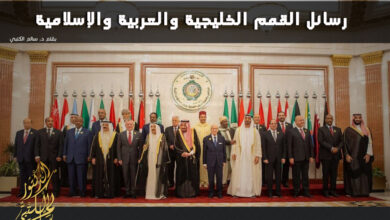
The US approach would be like a challenge, or difficult burden for the Arab summit scheduled on March in Amman, Jordan, especially if Trump’s administration has decided to move the embassy prior to this time and put the summit in the face of a fait accompli.
Before the Trump administration, the Arabic League Secretary described the Arab situation as pressing and that the “rough sea” imposes on Arab leaders to participate in the next Summit. However, should the decision to move the Embassy be implemented, the Summit itself should be canceled or expectations limited.
The miserable situation in the Arab world does not need analysis. the Secretary General Ahmed Abul Gheit said “I’m 74 years old, but even when I was 16 and called on Arab nationalism and for unity and freedom more than 50 years ago, I never thought I would see such loss of families and refugees and displacement and killing and emergence of groups that have lost the ability to control themselves.” Although he called on the Arab League to deal with this, I do not feel optimistic since scheduling the Summit in March was only done at the end of 2016. The Kingdom of Jordan is not blamed for that as they are engaged to take responsibility and decided to host the next Arab summit after Yemen was unable to do so. The Jordanians saved what can be saved in this area, but a source of pessimism stems over the shameful Arab scene. The latest Arab summit in Mauritania last July was attended by only seven leaders from the 22 countries.
The Amman summit is not divisible by two, and there is not room for fragmentation and absences. The challenges are not limited to the Jerusalem issue. The Kingdom of Jordan received an increasing number of Syrian refugees; has tensions looming over its borders in the north and east, not to mention that the summit will be held amid negotiating about dividing the Syria pie between regional and major powers.
The most important challenge for the coming Arab summit is the presence of Arab leaders. Absence means giving up and sends a negative message to the entire Arab World that the leaders are not able to deal with reality, let alone find alternatives or solutions.