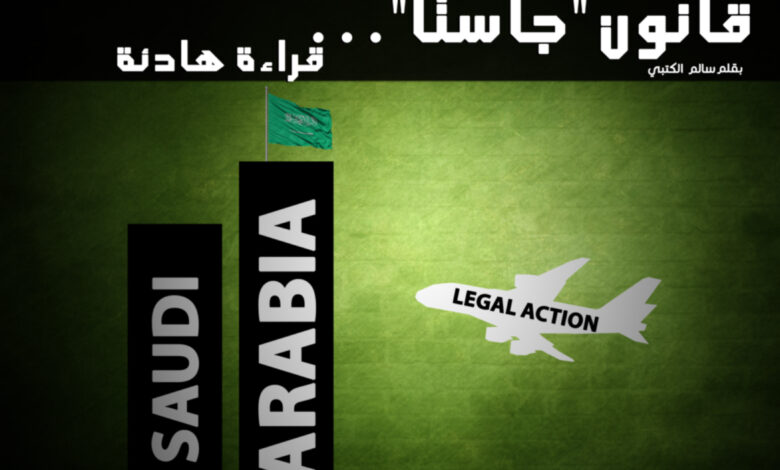
The Justice against Sponsors of Terrorism Act (JASTA) has a legal and strategic impact on international relations, which I discussed in the previous article. Furthermore, this act is no more than a ‘lynch law’ against any country that is targeted by US foreign policy, ‘indemnification mafias’ and possibly other decision-making actors in the US. Distinction between formal, media and diplomatic functions of these actors is nonetheless fuzzy.
Another problematic aspect of the JASTA is interpretation. Its formulation is elastic as if on purpose, rather than explicit and clear, which is the norm of such laws materially and morally affecting multiple parties. The law addresses, for example, ‘indirect support’, which can be interpreted in different ways depending on the legal process followed, now that the legislator has, intentionally or not, paved the way for such many interpretations. Moreover, how can one country be made accountable for the actions of an individual national?
In general, international law does not adjudge to heads of states the crimes they have committed, but brings them as individuals to international justice through specialized courts such as the ICC. Also, the master-servant rule is not applicable to states, otherwise it will open the door to endless prosecutions as past political miscalculations would result in a more complex mutual adjudications internationally.
Saudi Arabic is not the only party targeted by this act, everyone is: GCC states, Iran, countries in the Middle East and elsewhere. Although what matters more is how the subject is tackled by Arab media. Some see the JASTA as an opportunity for anti-American propaganda, accusing the USA of Anti-Arab/Muslim conspiracy.
For others, it is another open front to attack the KSA and the GCC countries, wishing they lose their investments in the US to the JASTA. Still, few media outlets did not comment on the issue, suggesting that Saudi Arabia and other states need to transfer their investments into—allegedly safer and neighborly—Arab countries as soon as possible.
Some stood with the United States and the West and accused the GCC states of supporting terrorism and made other unfounded allegations. It is well-known, especially to those who know the link between Iranian funds and certain Arab media mouthpieces, that this faction receives support from a capital promoter of sectarianism.
What also matters in this regard is the several authors and analysts who argue either for or against the idea that the JASTA will put an end to Saudi-American alliance and partnership. The result is a tense debate that overshadows the actual main issue.
As a matter of fact, the ongoing developments in the Middle East and the world can affect the strategical bilateral relations, whether between KSA and the US or other countries. Interests and relations’ fundamentals are undergoing major strategical changes. For instance, new equations are being considered as the US starts to make plans for shale oil exploitation. New sources of energy have emerged. Developed countries plans to exploit fossil fuel are only included in long-term strategies. Major strategic shifts were brought about by the US, such as the new ‘Asia First’ strategy that the media had, for the most part, overlooked, although it was published years ago.
In all respects, the JASTA, or any other law for that matter, cannot change the strategic direction of relations between two allies, but developing and promoting networks of strategic interests is crucial. Also of great importance is possessing alternative cards to play in counter-strategical bargains. To protect one’s interests, having alternatives and backing one’s position while negotiating with allies or opponents is vital.
Recalculating the situation can be central too. Although an enemy of the United States, Iran has succeeded in building a powerful ‘lobby’ that promotes its image in research and media agencies, even inside US decision-making circles. This has happened while some Arab countries only perceived the surface animosity between Tehran and Washington, and relied on personal contacts to manage their relations with the US. Personal relations cannot stand in the face of crises, though; whoever has strong networks of public relations can influence the course of events when necessary. Note that some influential political figures linked to the Iranian lobby in America have pushed for the JASTA.
The Justice Against Sponsors of Terrorism Act may be a useful wake-up call to the GCC countries that they must examine and restructure their relations with major countries like the US, with due and proper consideration of their own interests.