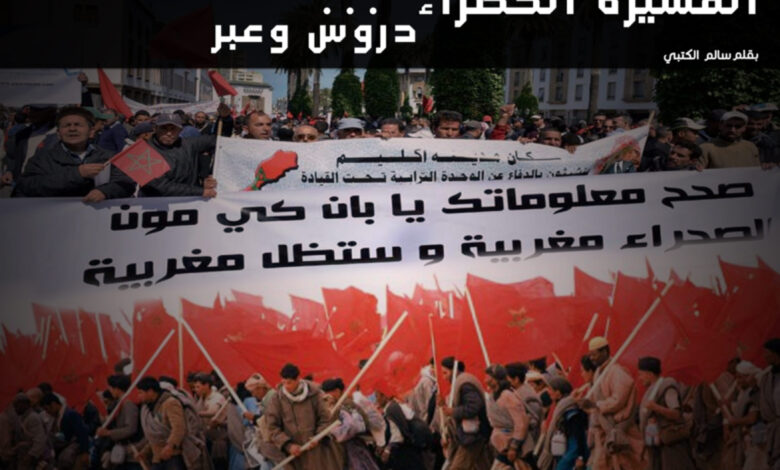
The ‘Green March’ remains a key event in Moroccan history, not only because of the valuable lessons it offers, but because it was revealing of the insistence of the brotherly Moroccan people and its wise leadership to stick to every inch of the national territory.
The Green March is a spirit that runs in the arteries of the brotherly Moroccan people, and contributes to deepen the feelings of cohesion and interdependence of all Moroccans for sovereignty over a dear part of Moroccan territory, and to end all kinds of the contrived conflicts over an issue which is artificial par excellence.
A few months ago, everyone has followed the deep tension between the Kingdom of Morocco and the Secretary General of the United Nations Ban Ki-moon, when he launched a statement in which he considered the Sahara as an ‘occupied territory’. The Moroccan diplomacy deemed these remarks as ‘unacceptable’, and the Moroccan Foreign Minister accused Secretary-General of the United Nations of turning into ‘a person who ignites fire’, and of being overtly biased towards the views of the other parties. This tension emphasized to everyone that the Kingdom of Morocco, with its leadership and people, will not give up its fateful case, and will not give up the sacrifices that abound in Moroccan history. This crisis was an important occasion for the gathering of all Moroccans around their Sahara, in mid-March, in huge marches that address campaigns that spread skepticism about the belonging of the Sahara to Morocco, which confirms the awareness of successive generations about the issue of territorial integrity and that the Sahara is in the heart of Morocco and Morocco is in the heart of the Sahara.
If His Majesty King Hassan II, may he rest in peace, has launched the Green March in 1975, His Majesty King Mohammed VI, may God assist him, has put a huge developmental plan for the Sahara, on the basis of the extended regionalization, a new administrative and territorial system asserting the unity and the sovereignty of the Moroccan Kingdom over its entire territory. This action is a translation of the national well-established principle that “Morocco will remain in its Sahara, and the Sahara will remain part of Morocco, until the end of time”.
When His Majesty King Mohammed VI, may God assist him, addressed the Moroccan people on the occasion of the fortieth anniversary of the Green March in October 2015, saying,
“The Sahara question is not the first issue Morocco has faced in its history. It has known siba (lawlessness) and confusion; it lived under the protectorate regime and it endured occupation. It also experienced periods of strife and contention upon gaining independence as it set out to build a modern state. Whenever it faces a difficult situation, Morocco invariably comes out strong and united, with its head held high. This is because Moroccans deeply believe in their common destiny, defend their immutable values and territorial integrity and are fully committed to the close bond and cohesion between the throne and the people,”
these words were reflective of the spirit and the national struggle of the brotherly Moroccan people, and also reflective of the authenticity of this people, which is reflected in the deep-rooted relationship that deepens over the years, linking this brotherly people to its leadership and its national territory.
Many are the lessons that I as a researcher and political observer can draw from the ‘Green March’. There is the peerless national spirit, which floats to the surface in such situations and calamities, to show the precious nature of an authentic people loyal to its territory and its throne. Arab peoples are certainly in need of such a spirit in this historic critical stage of plots and tribulations heaped on our land and our peoples from all over the world, targeting the division of the land and the undermining of the sovereignty of nations and the depletion of identities in endless cyber battles.
Another lesson is that the ‘Green March’ is a protector to the Moroccan identity, with all its civilizational, cultural, humanitarian, and historical aspects. This spirit is manifested in every situation or event related to the questioning of the affiliation of this dear part to the homeland, and is also manifested with every expression by Moroccans related to their sticking to this precious part of their homeland. This national spirit is a guarantee of safety that protected the Kingdom of Morocco from the flooding turmoil witnessed by the Arab region over the last years.