Since its founding by late Sheikh Zayd bin Sultan Al Nahyan on the 2nd of December, 1971, the United Arab Emirates has been adopting a well-established system of human and civilized values, which has been one of the pillars of the development process of the state throughout the past decades. Tolerance, moderation and the acceptance of the other are humanitarian and noble values which lay at the heart of this system, which the UAE commits to and works to spread and consolidate on regional and local scales.
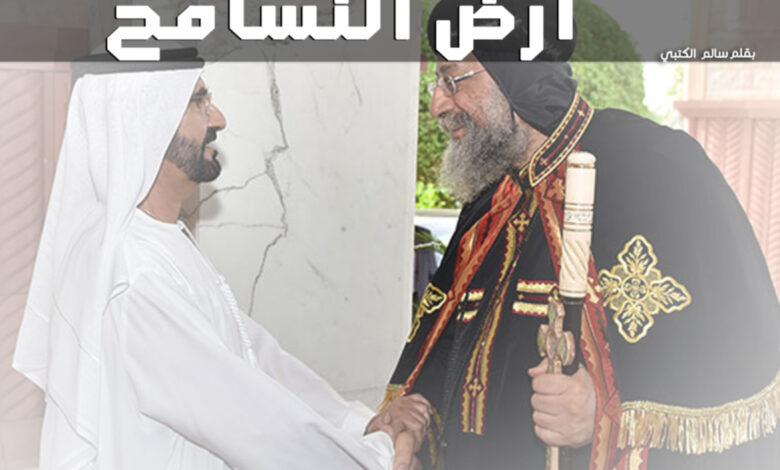
Yesterday, we witnessed the latest efforts invested on spreading the value of tolerance, as his Highness Sheikh Mohammed Bin Rashid Al Maktoum, state’s vice president, prime minister, and governor of Dubai, may God protect him, announced the inauguration of an international initiative on tolerance. The initiative includes honoring global symbols of tolerance in areas of human thought, and creative and aesthetic arts. His Highness also announced the creation of the ‘Mohammed Bin Rachid Tolerance Award’ to help build young Arab leaders and cadres in the field of tolerance, who are able to support intellectual, cultural and media productions related to consolidating the values of tolerance and openness to the other in the Arab world, under the same moral, humanitarian and cultural orientation.
In the same vein, his Highness announced the founding of ‘Tolerance International Institute’, which is the first of its kind in the Arab World. The institute is aimed to advise and offer necessary expertise in tolerance values’ consolidating policies between peoples, to publish studies and reports relating to the subject of tolerance and to work hand in hand with competent cultural institutions in the Arab World on the dissemination of tolerance related principles among coming generations.
A wonderful expression in his Highness Sheikh Mohammed Bin Rashid Al Maktoum’s speech on this occasion caught my attention as he said that ‘The Emirates and tolerance are two faces of one beautiful meaning’, that is the truth everyone from different spectra and different cultures realizes; people of more than 200 nationalities are living on a land of tolerance, enjoying its security, stability and welfare without race, color, religion or sex discrimination, as it’s known to everyone.
Tolerance initiative is the Emirate’s message to its nation, to the world and to humanity as a whole, which is the most powerful message against militancy, extremism, ostracism, racism, exclusion, marginalization and hatred. This is the strongest sustained human effort to resist destructive thoughts and to fight cultural and humanitarian conflict theories.
Tolerance in the Emirates is not a slogan uttered on special occasions, and is not commemorated only on annual ceremonies. It is an institutionalized system of legislations, laws, regulations, policies and plans implemented in real life situations. The establishment of a specialized institute in tolerance studies might be the best example representing a regionally pioneer initiative. The institute’s purpose lies in rallying research capacities which are both specialized and enthusiastic to jointly study the negative phenomena that have come to form a dilemma for the region and the world together, such as intolerance, narrow-mindedness and sectarianism, and to search for scientific solutions and alternatives to address and eradicate such phenomena.
The pairing interest in the values of tolerance and moderation between the regulatory and institutional framework and research and scientific framework reflects the deeply-rooted conviction among our wise leadership, led by his Highness Sheikh Khalifa bin Zayed Al Nahyan, president of the UAE, that the future expects the UAE to carry out its humanitarian and cultural duty towards the deployment of its moral values, which have contributed to the construction of a unique model of civilization and development.
‘The institutionalization’ of efforts to spread tolerance is what our Arab Region needs to get rid of the quagmire of terrorism where terrorist organizations are trying to sink it. The Arab Region needs an ‘intellectual and cultural reconstruction’ to consolidate co-existence, tolerance and openness values as his highness Sheikh Mohammed bin Rashid Al Maktoum said; his words carried a recapitulation of the UAE’s leading developmental experience when he indicated that ‘tolerance is a fundamental insurance for the stability of societies and for sustainability of development in every society.’ This recapitulation deserves to be considered deeply and studied carefully and accurately from all leaders and governments in the Arab World in order to convert it into practical plans to ensure the effectiveness of efforts aiming to achieve security and stability in our Arab countries altogether.
The UAE’s honoring of tolerance symbols is the perfect objective alternative to the commemoration by extremist groups of symbols spreading hatred and terrorism. We should not surrender to this thinking as we should not be contented condemning it, we should work to find an alternative to this thinking so that we can expel it, expose its ugliness and horror and speak to the wise who lost their ways following their battle against hatred ideologies and sectarianism which almost cover the face of the region and the world.
If terrorist organizations and states sponsoring them are investing considerable efforts to incite violence, conflict, sectarian and confessional conflicts, then states which were founded on noble humanitarian and civilized values such as tolerance, co-existence, the acceptance of the other, openness and moderation, must make their best efforts to save the world from risks threatening it, and to consolidate their humanitarian values. This is a moral and honest battle waged by the UAE in pursuit of a safe and stabilized world where the concept of a safe small global village is achieved on ideological, intellectual, cultural, and humanitarian scales.