In Iranian affairs, there seems to be no disagreement that President Hassan Rouhani was betting heavily on the nuclear agreement signed with the 5+1 Group to achieve the goal of rapprochement with the United States and openness to the West. It seems, though, that the dream is facing an uncertain fate in light of the recent Iran–Russia rapprochement.
It was not expectable of Iran to allow Russia to use one of its important air bases to strike in Syria. What else was unpredicted was President Vladimir Putin gaining the trust of the militant mullahs and leaders of the Iranian Revolutionary Guard. It is true that the mullahs hold a special relationship with Russia since the revolution in 1979, but they always made sure to keep relations with Moscow within set boundaries.
Certainly, Iran’s relations with Russia particularly reveal the true identity of the Iranian regime, exposing the ideology card that Tehran plays with in the game of politics.
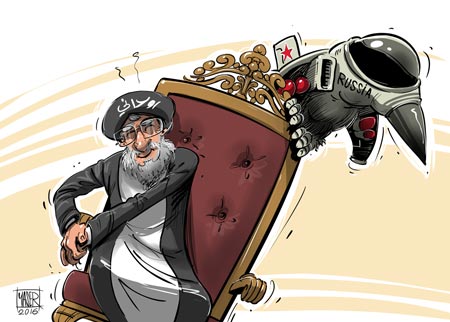
Iran’s decision to put the Hamedan airbase at the disposal of Russia, suggests that things in Tehran are moving in favor of the militants. Ali Shamkhani, Secretary General of the Iranian Supreme Council for National Security, said that his country puts ‘all its military infrastructure’ at the disposal of Russia in the war against ‘terrorism’. He means that the move is not a tactical but rather a strategic decision that implies more than just the Russian use of the Hamedan base.
Russia was not in urgent need of a military base to coordinate its operations in Syria. Russia was present in several military bases and areas in Syria. It has withdrawn most of its forces there for some time, willingly and without any regional or international pressures. so the use of an Iranian base in bombing targets in Syria seems much more like a ‘case confirmation’ and the declaration of a strategic marriage between Moscow and Tehran, particularly that Russian bombers are able to attack with operational efficiency whether launched from Iran or from Russian territories.
The connotations of the Russian–Iranian understanding go beyond providing military facilities for Russian fighter jets. The Russians presence in the Gulf region has become strong under these understandings, but there is a debate about the possibility of the use by Russia of the Turkey’s Incirlik base in which the NATO is also present.
What is puzzling about such strategic interactions is that Iran and Turkey compete to strengthen their regional and international alliances networks, while strengthening their bilateral relations. Syria will be the main arena to witness the results of the strategic competition in question.
Inside Iran, President Hassan Rohani seems disappointed of Tehran’s policy as United States delayed implementing certain parts of the nuclear deal, itself put into question in the eve of the coming US Presidential elections of in November.
Rohani is not in disagreement with or refusal of the Russian role, but he wants it to be active in countering the West. Apparently, what happened is that the Revolutionary Guards sealed the deal opting for an entire alliance with Russia, even if that means risking the relations with the West.
Rejecting political regionalism since 1979 with their ‘Not Eastern, Not Western – Islamic Republic’ slogan, Islamists in Iran were never actually convinced by their own motto. They engaged in secret deals with the East and the West, including with Israel which they send threats to day and night.
Now, the Revolutionary Guards feel close to achieving the pursued dream. They are preserving Iran’s influence in Syria, and earning international recognition for their role in the game of interests sharing and influence that remains, nonetheless, in the phase of bargains between different parties.
Some believe Iran has aligned with Russia in order to put pressure on the West to implement the terms of the nuclear deal. Although this seems logical from a political point of view, the coming period will reveal even more important aspects, especially regarding the consequences of these alliances on the regional order and security in the Gulf region and the Middle East.