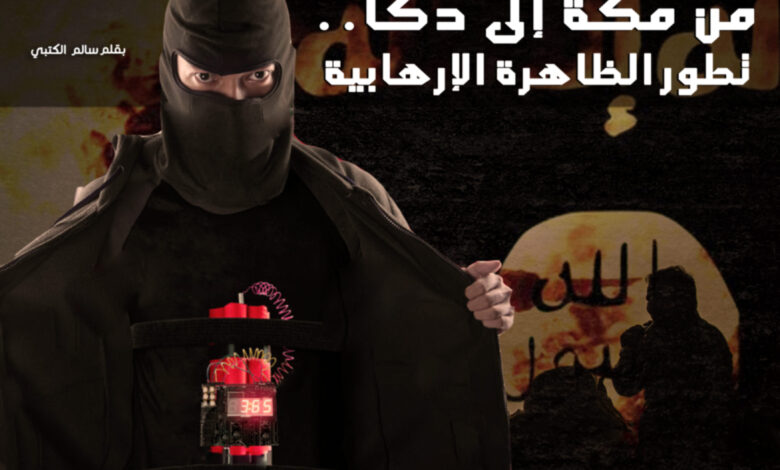
There is no doubt that the sinful terrorist attack, which took place on Monday before last, near the Prophet’s Mosque in Medina, Saudi Arabia, represents a pivotal point in the evolution of the phenomenon of terrorism, not only because it targeted one of the most sacred places of worship for Muslims, but also because the crime was carried out with a tactic that reflects the existence of a complete schizophrenia between the terrorists and the Islamic religion.
They did not take into account the sanctity of fasting and the feelings of the fasting people, and the suicide bomber blew himself up amid the security men at the time of the call for the evening prayer (Salat Almaghrib), a timing that a Muslim who possesses a sound sense of religiosity and an unaltered nature could not choose, or accept to be chosen for carrying out this heinous crime that rings alarm bells strongly so that we all wake up from our doze and so that the whole world, with its major states and powers, realizes that terrorism has no religion and no homeland, and also no borders and no ceiling to its sinful crimes. There is no difference between the sacred and the “profane”, according to the standards of these organizations, which consider the jurisprudence of the extremism imams a constitution to observe.
As for what I mean by the necessity for the Islamic world to awaken, it is the need to act seriously to pull out a lot of our peoples and nations of the crisis, and work hard to address extremist ideology through comprehensive and integrated and well thought out educational and community actions, and to call for the renewal of religious discourse, freeing it from the molds of pleas and self-addressing, and taking it to the space of work and renewal in research, idiosyncrasy and science with regard to religion, and enough of lost years and lost opportunities.
Bangladesh suffered the second day of July from an appalling crime that did not draw the attention of many, but it is very serious with regard to its analytical implications, and the dimensions it suggests in terms of the evolution of the phenomenon of terrorism. Terrorists attacked a cafe in the heart of the capital, Dhaka, and in the Gulshan area, which is characterized by tight security measures, as it hosts the headquarters of foreign embassies and non-governmental institutions, as well as apartment buildings inhabited by foreigners and wealthy Bangladeshi people. Reports indicate the difficulty of getting inside this area without being stopped at tight security checkpoints.
Apart from the issue of determining who is responsible for committing this crime, which was claimed by “Daesh”, while the government there denies this and says that the responsible for the crime are local extremists, it is interesting that the perpetrators belong to the political and social elite in Bangladesh, as among the suspects is the son of a government political figure, as well as students in one of the elite schools, as Bangladeshi Information Minister Hasanul Haq Inu said, “most of the boys who carried out the attack on the restaurant were students in very good educational institutions … some of them were in sophisticated schools, and their families are well off.” Indeed, one of the attackers is Rohan Imtiaz, son of Imtiaz Khan, leader of the Awami political movement in Dhaka, and Deputy Secretary General of the Bengali Olympic Committee. In his remarks, commenting on the crime, Imtiaz said something that deserves careful attention, which is that his son had no books or anything that shows his inclinations, and there were no signs of his extremism.
This means that extremism actually may not have signs or ominous indicators, and this is not the only confirmation on this, but there are many cases of adherents in “Daesh” that had no pre-emptive tendencies of extremism, which requires careful diagnostic studies to analyze personal traits of terrorists, as well as the study of the real reasons that push some children of all sectors of society, poor and middle-class and rich, to be part of terrorist organizations.
Further to the terrorist crimes in the Muslim world in recent times, there is something that must be said, which is that the danger of terrorism has exacerbated, and that danger is no longer confined to terrorist organizations or groups, but extended to the cover provided by these organizations and groups for all types of extremism and conspiracies and intrigues, which fall within the fourth generation wars and beyond, of which our region has become the scene in recent years. The threat of terrorism is not limited to the practices of its organizations and elements, including the hidden and the manifest ones and the kinetic ones and the sleeper agents, but terrorism also provides a vital area for intervention in the affairs of nations and for the destabilizing of its security and stability. So we are facing a devastating kind of confusion, between criminal and terrorist operations that may be committed by arms belonging to States and regional powers, namely state terrorism, and terrorist crimes committed by the various terrorist organizations and groups.
Therefore, the eradication of these organizations and groups has become a top strategic need for the countries in the region, for the sake of getting a clearer picture and so as to end the confusion stage, which haunted us over the past years, and made many people no longer differentiate between the different types of terrorism, to the extent that some have resorted to categorizing terrorism into good terrorism and bad terrorism, according to its gravity and effects.