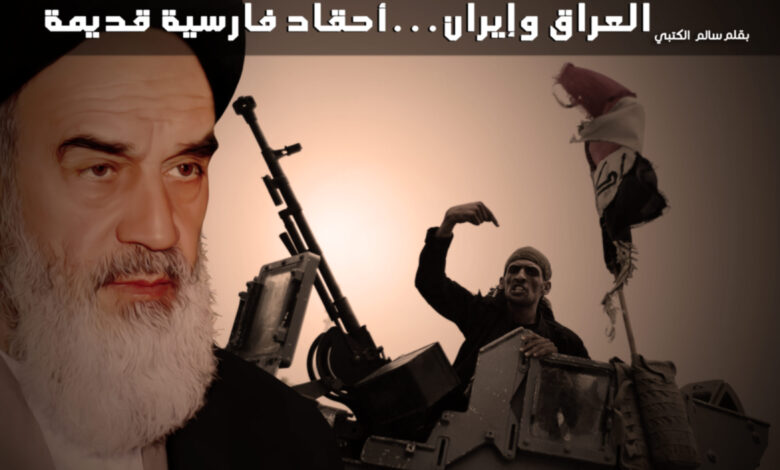
I have never been convinced that Iran is interfering in Iraq for strategic reasons related only to Iran’s national security, but I believe that there are religious sectarian reasons fed on the historical Persian hatred towards Iraq and its people.
Iraq’s history that goes back to the depth of civilizations since ancient times is well known to researchers and specialists in history and civilizations, and they also know that racial and sectarian tendencies remained throughout history the main driver of Safavid Iran towards the Arabs in general and Mesopotamia in particular.
As for the history and attitudes of Iran toward Sunni Arabs, and the Iraqis in particular, in the modern era, it is well known to everyone starting from Khomeini’s revolution in 1979, and the raising of the slogan of exporting the revolution and other actions.
The Safavid state was a Shiite state primarily, and was known for its hostility and extreme hatred for Arabs and Sunnis, and it is said that Safavid kings used to build pyramids of skulls after the brutal massacres they committed. They are the ones who knew Inquisition before Europe knew it in the Middle Ages, as well as what History recalls on the violation of women and other human tragedies and horrific abuses, the authors of which would have been would have, without hesitation, appeared before the International Criminal Court if these brutalities had occurred in the modern era.
Some Iraqi researchers refer in ancient history to the history of relations with Iran as a history written in blood and filled with hatred and the Iranian revenge complex towards Iraq and the Iraqis. They point out that Iran’s attacks on Iraq go back to ancient history, when the Iranian attacks were the hallmark of this stage until the defeat of the Persians at the hands of Muslim Arabs. And the dark periods in the ancient history of Iraq are the ones that were dominated by the Iranian invaders, so much so that a well-known Iraqi researcher says that during the ancient history the Iranians took advantage of every opportunity of invading Iraq.
History studies also indicate that the Iranians have caused the destruction of many urban centers throughout the ancient history of Iraq, and Iraq did not get rid of the Persian control until with Islam, where the Muslim Arabs defeated the Persians in the Battle of Qadisiyah in the era of Omar al-Faruq may Allah be pleased with him, to the extent that some specialists believe that the length of the historical periods of the Iranian occupation of Iraq has planted in the Iranian consciousness the notion that Iraq is an integral part of Iran.
Personally, I do not think that this interpretation is completely accurate because the Iranian ambitions are beyond Iraq regionally. There is an incursion into Syria, and there have been attempts in Yemen, and there are now illegal interventions in the internal affairs of Bahrain, which means that these interventions are not linked to history only, but have expansive dimensions wearing an ideological robe.
The above does not deny that Iran has ambitions in Iraq specifically, and these ambitions are newly feed on a deep-seated desire for revenge for what Iran underwent during the eight-year war period, during which it suffered at the hands of the Iraqi army, so it was no surprise that Iran had a deliberate plan to take revenge from all those who participated in the war from the Iraqi military. The plan even included the assassination of scientists, researchers and all those who can participate in building a strong Iraq able to stand on its feet after the collapse of Saddam Hussein.
In light of this complex history and the buried grudges of the Iranians toward Iraq and the Iraqis, it seems naive to believe statements by current Iranian officials that the military intervention in Iraq aimed at helping Iraqis achieve security and stability. This goal is not on Iran’s agenda and cannot be included at all, how can a state that harbors only hatred towards Iraq seek to achieve security and stability in it !, then if this talk is true, how can we explain the ethnic cleansing campaigns waged by the sectarian militias of the popular mobilization forces against Sunni Iraqis?