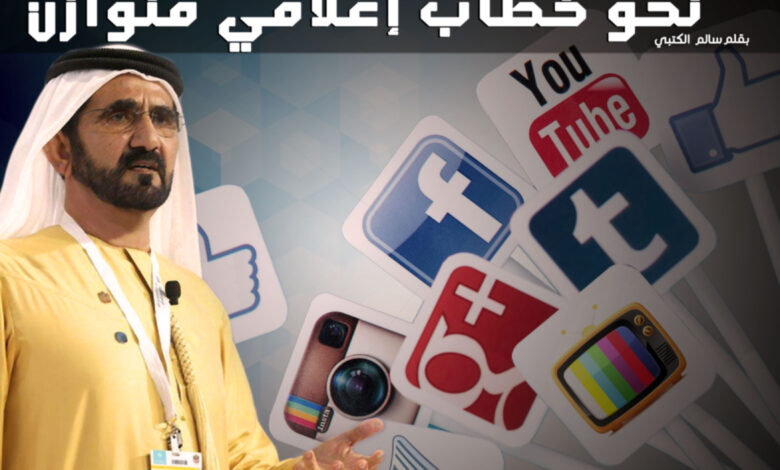
During a Ramadan soiree held recently and attended by a large number of intellectuals, writers and editors of UAE’s local newspapers and Arab and local media leaders, His Highness Sheikh Mohammed bin Rashid Al Maktoum, Vice President and Prime Minister and Ruler of Dubai, may Allah protect him, stressed the huge responsibility placed on the shoulders of the media in this historical stage as a “first line of defense to protect the gains and achievements of civilization, and an engine pushing in the direction of further development and construction, and a shield that protects from the risks and threats that lurk around the Arab and Islamic Ummah,” said His Highness.
In his speech, His Highness Sheikh Mohammed bin Rashid Al Maktoum also pointed out that at this important stage of its history, the region desperately needs a balanced media speech, devoid of overvaluation and characterized by moderation, a speech that elevates the values of integrity, impartiality and objectivity in the presentation and handling of issues, far from self-interest and personal goals that may make the media deviate from the righteous path to become a tool for segregation and degradation rather than an incentive to work, construction and progress. This subject, media discourse, is one of the most prominent topics and issues I am concerned with by virtue of the importance of the media’s role and enormous societal influence, as well as the fact that the absence of media Compass in many cases results in heavy losses for the homelands and peoples and nations. There is destruction or fragmentation of parts of the systems of social values and morals under the pretext of raising the ceiling of freedoms and dismantling the wall of silence and responding to the trends and the needs of new generations of young people, and other flimsy justifications in the name of which are committed much of what might be called moral and national crimes.
Often one feels that certain media seek segregation and like instilling divisions, deploying them and expanding their circle, and this happens, and it is even considered an unquestionable target in some situations of conflict and crises and wars in which the media are used viciously as a spearhead equivalent in effectiveness and impact to the destructive power of the deadliest and most destructive traditional and non-traditional weapons.
In his speech to the media, His Highness Sheikh Mohammed bin Rashid focused on an important idea, which is the access of the media to every home, and its ability to address the young and the old. He also warned against the declining role of the conscious media, saying that the disappearance of this role contributes to create a state of intellectual vacuum exploited by obscurantist forces and terrorist organizations, and sure enough, these “commandments” are the product of genuine concern for the future of our Arab countries and peoples, which are exposed to the worst and the most difficult historical test for long decades, threatening their identity, security and stability.
One of the dilemmas experienced by most of the Arab countries at the moment lies in the delay in recognizing the importance of the media and its critical role in building the collective consciousness of the people, as some Arab countries lived for many years, during the end of the Twentieth Century and the beginning of the Twenty First Century, under the false conviction that the traditional media are merely “entertainment” and a comedy to the peoples, and that it is just a tool to vent anger and ease the pressure on governments. More seriously, this paralleled with a lack of attention or awareness to the role of social media (Facebook and Twitter) in moving and mobilizing the masses behind political or social objectives or other objectives, as many failed to estimate the size of the expected impact of these means, and the result of all this was this vast amount of turmoil and chaos rampant in many parts of the Arab world.
After this mess, everyone became aware of the gravity of the media and its community and political impact, causing a rush of all towards the use of the media to achieve political and social purposes, which caused confusion in many cases, and the compass was again absent from the media, which caused many media to engage in sectarian and political conflicts that do not give any amount or consideration to the homelands, the peoples, or their security and interests.
The way out of that lies, as His Highness Sheikh Mohammed bin Rashid Al Maktoum, said, in a balanced media discourse and in putting the interests of the homeland and the countries and people above any other consideration, and in upholding the values of nationalism and loyalty. Balance in the media discourse is capable of building true and accurate pictures of reality.
There are also battles from which the Arab media are absent, and even if they enters them, they do so timidly or via tools and the entrances that do not achieve the desired results, or even correspond to the interests of the enemies. On top of these battles comes the battle of terrorism, covered by the Arab media as a spectator or an observer at best, without awareness of their role and without the exploitation of their tools and enormous societal influence.
If the holy month of Ramadan is the preferred month to most of the Arab media in terms of providing programs and other activities, it is rare, for example, to find an attractive idea for a program aimed at building collective awareness about the threat of terrorism and at working to reject extremist ideology and to consolidate balance and moderation, and you may, in this regard, only find direct verbal programs most of which are no longer commensurate with the competitive standards of the media at the moment.
The media is one of the most dangerous tools to those who seek to lift the Arab region and save it from the nightmare of terrorism that haunts it and that virtually ruins the future of millions of young people from the new generations, who are looking forward to a better tomorrow. So, would we respond to calls for reforming and correcting this vital sector?