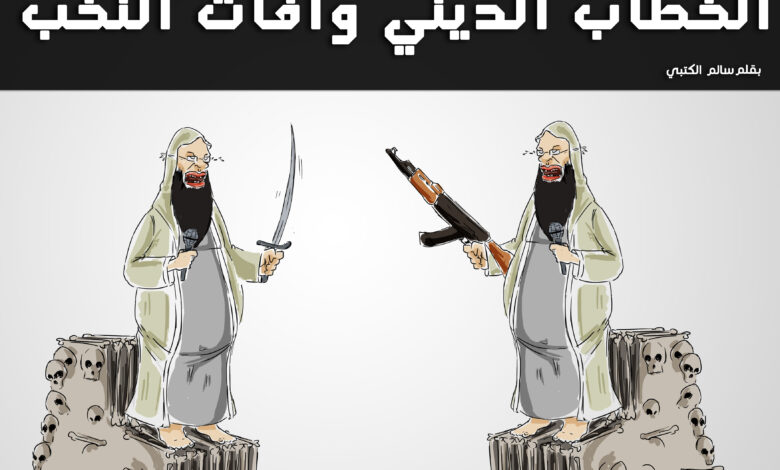
Do you remember the phrase “the renewal of religious discourse”? I think a lot of you remember it with all goodness. It has hovered in the space of debates and controversy, be they political, cultural or religious, over the last years as a necessary or even an inevitable way out from the state of cultural and intellectual deterioration experienced by much of the Arab and Muslim world.
At that time, I had expressed my views about the importance of moving from debate to the translation of ideas into realistic and feasible plans and strategies. I was afraid at the time that we remain bogged down and do no more than debating, as that is a recognized scourge in our region.
Now that what I and many others feared has occurred, and that the talk about the renewal of religious discourse has been secluded, and the crowd has dispersed, and the discussion pages have closed, and most institutions, universities and research centers have forgotten what I have already stressed about the urgency and priority of this issue, I can only express sorrow for the decline of intellectual, cultural and religious efforts to eradicate extremist ideology of Arab and Islamic societies that are experiencing a widespread epidemic of it, and whose efforts have become limited to the security and military fields!
Cultural and religious elites in most of the Arab and Islamic societies have only called for a doctrinal renewal and for opening the doors of ijtihad and… and … etc. But this did not happen, and no one, no institution and no group sought to develop a non-traditional plan in this context. All that is said is only a repetition of the perceptions and opinions that were said for decades and even centuries ago, and does not fit in its entirety as a base for a serious effort aimed at pulling the millennium generation out from the clutches of “Daesh” and “Al Qaeda” and other terrorist groups.
There is no doubt that one of the reasons that led to remaining in the intellectual chatter circle lies in the lack of a firm conviction about the role of science in the fight against societal phenomena. Had there been this conviction, the allocation of scientific research will not be enough to launch intellectual projects supposedly needing extended human effort and budgets and suitable environments that stimulate serious and real scientists to participate in such projects. Had all that be found you will not find political support to encourage this task and provide it with the desired environment for success and effectiveness.
The issue is not limited to the above, but includes an intricate package of reasons that combine to produce this absurd or emotional temporary situation, which deals with one of the most serious challenges and strategic threats to the future of the Arab and Islamic countries, and which is considered a deferred priority, or say, it has been removed from the list of priorities altogether, and has been replaced by petty debates the elites are concerned with from time to time.
The question now is: How do the intellectual and religious elites and the institutions concerned in the Arab and Muslim world keep silent on the fact of ignoring the issue of extremist thought, and forget it deserves serious doctrinal treatments? Then does not everyone realize that the danger is not in “Daesh” nor the “Muslim Brotherhood” only, but in the origins and roots of extremism? If “Daesh” is defeated, another “Daesh” will appear, and it will be fiercer and more sophisticated. This is what past experiences tell us. Perhaps a simple extrapolation of recent decades confirms this. From the “Takfir wal Hijra” group which had a simple terrorist thought to the “Al-Qaeda”, which swayed from the “near enemy” to the “far enemy” until it evolved into “Daesh”, which inaugurated in turn, the idea of “State” in all its dimensions and with all its dangers, while the “Muslim Brotherhood” terrorist group was seeking to seize power in several countries, aiming at achieving the “Daeshist” goal but through other means and mechanisms.
Over the last few years, we have witnessed what looks like a race and sometimes a rush to hold seminars, conferences, workshops and lectures, most of which were centered on the idea of the renewal of religious discourse and the ways and mechanisms to achieve this, with a repeated review of the manifestations of the intellectual crisis our region has been suffering from throughout history. I, and many others, realized that these races would likely not result in anything, they are just so much ado for nothing, unfortunately, because scientific research has in many cases turned into a kind of material “mercenarism”, and many gave up its noble objectives that serve the interests of communities and nations. Many also raced to search for the booties of the excruciating or even the disastrous crisis suffered by the Arab and Muslim world due to the proliferation of terrorist organizations and groups.
Now, everyone needs a serious stand with oneself. The epidemic is rampant in the body of many of the region’s countries, and after a certain period that may be long or short, we will face such phenomena as the Syrian Arabs or the Arab Syrians and the Libyan Arabs, and other similar things along the lines of those previously identified as the “Afghan Arabs.” And we will find that thousands of terrorists who relied on terrorism as a means to get money are now without a job and are looking for new sources for funds, and would turn into a real threat to their nations and their people. We may be surprised by their moving to other States and places. So, would we wake up? And when?
Are there clear strategies for dealing with potential sources of danger in our region at an intellectual level? I think the answer in most cases is a conclusive “no”. It seems that tackling extremist thought ideologically, religiously and culturally has turned into a flame ball everyone throws to one another and each institution throws towards another one. And everyone is contented on inviting each other to this crucial national task, or so I see it personally!