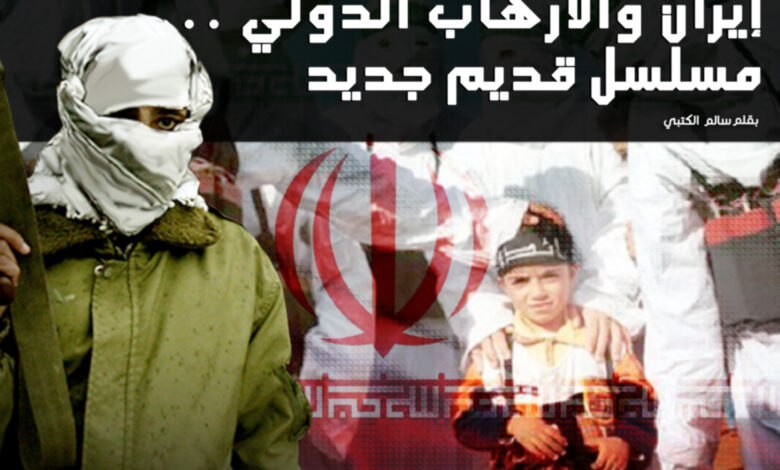
The mullahs of Iran are associated to international terrorism the same way you think Brazil when you hear soccer. No wonder reports were published to prove Iran is linked to terrorism. Besides, we cannot seriously talk about international terrorism without pointing out the role of Iran in spreading this despicable disease.
Some think Iranian terrorism began in Iraq and Syria, or with financing the Houthis in Yemen, but contemporary Iranian history suggest the mullahs’ regime was created through international terrorist activities since the Iranian revolution in 1979.
Regionally, the notion of revolution export attracted attention to the regime which, in fact, exported State terrorism. Faced with hesitation from major powers, Iran pursued a policy of bullying as Western agendas in the Middle East diverted the attention of the world from Iran’s growing role in supporting terrorism.
Recently, the US courts concluded that Iran is linked to the September 11, 2001 terrorist attacks. On that basis, the Federal Court in New York fined Iran US$10.5b for its involvement in supporting al-Qaeda elements involved in the attacks.
The court decision came somewhat late as there is abundant evidence that the Iranian Revolutionary Guards commanders and leaders of Al Qaeda were collaborating for years, which Tehran cannot legally refute. For many years, Iran sheltered Al Qaida members and their families.
The US intelligence services know about this information. The CIA found messages in Osama bin Laden’s house, after he was killed in Pakistan in 2011, and details of these facts were reported by US newspapers.
Many published documents and studies prove the relationship between Iran and Al Qaeda leaders and the fact that it sheltered their families after the attacks of September 11, 2001.
US court ruling is the second of its kind. A US court had fined Iran an estimated US$6b in 2012 as a compensation for the families of the victims of the 9/11 attacks. Iran is aware of the accumulated legal evidence and arguments about its support for Al Qaeda. It fears that these provisions would negatively impact the recovery of its frozen assets released under the nuclear deal. It is desperately trying to hold another country responsible for these attacks under the pretext that the perpetrators are nationals of that country.
Besides, there is overlap between political and legal aspects of this thorny issue. For years, the US authorities were sure Iran has a hand in international terrorism. Official lists issued by the State and the Treasury Depts. accuse the Iranian Revolutionary Guards of sponsoring terrorism for many years, and talk about a systematic terrorism-sponsoring policy.
In 2011, a committee from the Congress published a report accusing the Revolutionary Guards of supporting Al-Qaeda, citing a close relationship between the commander of the Qods Force, Gen. Qassem Soleimani, and Al Qaeda. The topic was covered in details in many Western studies and research papers. Iraq was the scene of indirect coordination and communication, through intermediaries, between Soleimani and the leaders of al-Qaeda, and the Ben Laden messages mention that. At the time, the report of the Congress noted that the Revolutionary Guards–Al Qaida links date back to 1990.
For years, the Americans were watching the interaction carefully. In 2012, the Treasury and the DoS have offered a US$12m for anyone who could help arresting al-Qaeda’s Mohsen al-Fadhli and Adel al-Harbi, residing in Iran, saying the men provide logistical and financial support for members of the group in Syria and help fighters and money move through Turkey.
All these complications leave no room to assume the good faith of regional and international powers. The United States is aware that Iran has deep sectarian influence in Iraq. It is also aware that the fall of Iraq in Iranian hands was a strategic error. Washington manages the relationship with Tehran cautiously, so it signed the nuclear deal to serve its own interests. The USA sought to avoid a military conflict with Iran after it got out from the Iraq and the Afghanistan wars.
Iran has a close link to Al Qaeda; however, the political and legal approaches to this vicious relationship remain subject to complex strategic calculations. Washington does not trust the intentions of Iran.
Interests often overwhelm enmities and grudges of history. Sponsoring terrorism, however, is a concern for decision-makers. Accomplices in terrorist programs transcend the conventional political rivalry into mean conspiracies against strategic opponents. They collaborate with barbarian groups and that is hard to turn a blind eye to. Iran’s intentions remain the subject of Western and international suspicions, but a clash is unlikely. The US–Iran relationship operates according to complex strategic calculations.
Iran’s involvement in international terrorism might backfire at the Iranian regime at some point, unless Tehran complies with the international will and tries to co-exist with regional countries according to the international law.