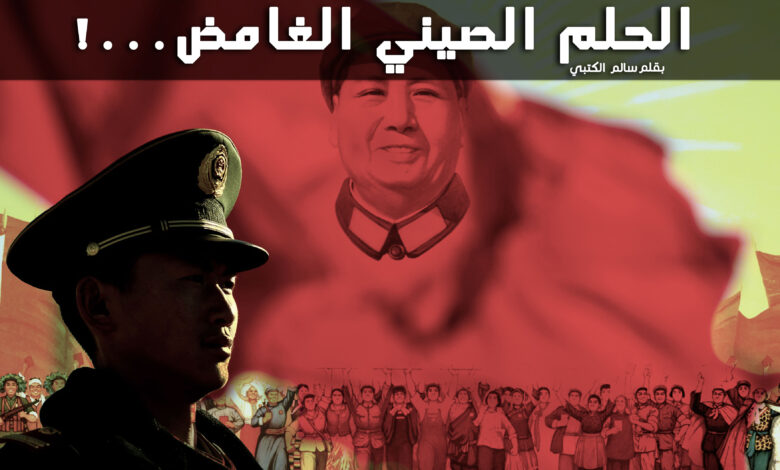
A few days ago, Chinese Foreign Minister, Wang Yi, said that his country does not aspire to replace the United States, nor to become another United States, and he advised Americans to study China’s history that extends for five thousand years and stop the blind application of American thinking to judge China and to find out how things evolve. The Chinese Minister’s statements came on the background of his talking about the Sino-US differences, and the striving of American presidential candidates to highlight their more belligerent positions about China, the strategic opponent. Wang Yi said that “some in the United States still have reservations about China and a concern that it may replace the United States.”
These statements, which may not draw the attention of many people, seem very important from a strategic point of view, because the Chinese Minister said literally, “we do not have any intention to replace any one nor to lead anyone.” Does this mean that China does not intend nor is already planning to lead the world in the coming decades?
Discussing this vital question needs a deep understanding of the culture and history of China. A State deeply rooted in history for five thousand years would not think in a similar way to the American strategic thinking, and this is an important issue because history imposes its mark on Chinese strategic thinking, and makes Chinese leaders run matters in their country differently than the Western pattern.
The idea of excellence itself looks different in the collective Chinese mentality than its American counterpart. China’s geopolitical status has been rapidly growing over the last years in a remarkable way, and the GDP of China has already surpassed its US counterpart, and its global economic initiatives leave milestone effects in the balance of global economic forces, especially the new Silk Road, which links the economies of China, South East Asia, Central Asia and Europe through a network of railways and highways.
What Chinese Foreign Minister said on China’s strategic ambition is not an emergency, China rejects US hegemony on the existing world order, and in parallel also rejects the idea of international leadership, and suggests an alternative vision based on the idea that all States have equal responsibilities and international obligations, with a total rejection of the idea of intervention in the internal affairs of States. Which means that China aspires to a multipolar system. But this Chinese vision does not prevent the growth of the US strategic concerns about China’s ascent, which has escalated over the last years and clearly manifested in the “Asia first” strategy adopted by the Pentagon a few years ago, and what is described as the Chinese challenge has become the focus of American foreign policy in the first term of President Barack Obama’s presidency, and the focus of attention moved from the vital issues that have been worrying American decision-making in the early years of the Twenty First Century, such as the fight against terrorism, to new issues such as how to address the “Chinese strategic challenge,” a concept that strongly appeared in the speech of President Obama during his visit to Australia in November 2011, where he clearly put the “American power” in the face of the “China challenge”, which launched a kind of intellectual storm among American researchers and experts to reach a strategic best alternative. Henry Kissinger wrote at the time an article in March 2012 in the famous journal Foreign Affairs, saying that the conflict with China is choice, not a necessity.
This US strategic concern is faced with unchanging Chinese strategic calm. China knows its way well, but the West does not understand its intentions, that is the strategic dilemma! About that, the British researcher Mark Leonard in his book, What does China think?, Published in 2008, says that “what is known about China is only a small fraction compared to what is unknown, because of the tremendous speed with which China changes, to the extent that the map of Shanghai, for example, should be re-examined every two weeks.” Leonard cites the accelerated pace of China’s transformation by saying that 300 million Chinese needed only 30 years to join the era of modernity, while the same number of Europeans needed 200 years to achieve the same result!!
I think that China has a deferred dream, it does not rush the moment of strategic clash with the great powers dominating the world at the moment, and sees that it has enough time to deal with the internal development difficulties that might impede its future march, and is confident that its enormous economic expansion is the real guarantee for a future role whose identity and borders are known to Chinese strategic thinkers only, about whom the world does not know a lot.
In the nineties of the twentieth century, China accurately applied leader Deng Xiaoping’s strategy, which raised the slogan “Let us hide our light and enhance our strength.” The accelerated Chinese ascent has resulted in anxiety on the part of the West and neighbors alike, but what is certain in this mystery is that China needs more international cooperation than conflict and competition. This huge country has a growing need to look for new markets and resources to ensure maintaining the level of economic growth, which explains the spread of Chinese people all over the world in search of new relationships, markets and opportunities.
Almost two centuries ago, Napoleon said that “China is a sleeping lion, but when it will wake up the world will tremble.” The lion has already woken up for nearly two decades, and the West is the one that is trembling from the rise of China.