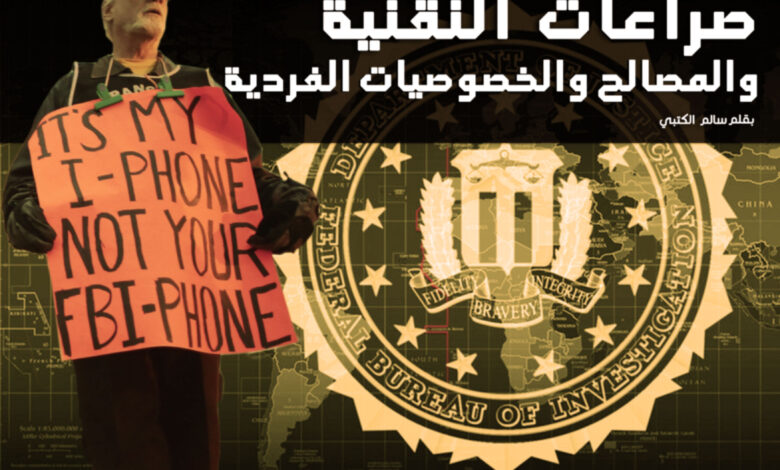
A unique conflict has recently erupted between the US Federal Bureau of Investigation, FBI, on the one hand, and the American firm Apple on the other hand. This conflict may seems on the surface as one of information security, but inwardly, it suggests a lot of connotations and carries many dimensions about conflicts of economic interests and political and security influence in the inside of America.
The story began by Apple’s rejection of an injunction issued by a US court asking it to assist FBI investigators to penetrate the retained data on the iPhone of the named Syed Rizwan Farooq, the gunman who carried out the San Bernardino attack, where he and his wife killed 14 people in California last December, before the police fired bullets on them and killed them.
Apple has justified its refusal to the request of the US government by the fact that it represents “an unprecedented step threatening the security of its users,” the company said, “we object to this request which carries consequences far beyond being just a legal case.”
The FBI wants to try a style known as “blind force”, which means trying all the possibilities until reaching the correct code consisting of four digits to open Syed Rizwan’s device, in order to identify the confidential data kept on its own iPhone device, an attempt fraught with the risk of failure of login attempts using an incorrect number of codes for 10 times, which means that the device would erase its recorded data automatically.
The company, for its part, fears penetrating the personal data of users, which threatens customers’ trust in its products. The conflict turned into a real crisis where also took part John McAfee, one of the most famous US programmers, and founder of the company, “McAfee” for cyber security, who offered to decode the iPhone device encryption of the author of the attacks, and help the FBI with its mission without charge, according to what was stated in an article by him published on “Business Insider.” It is interesting that McAfee said that decoding the device will take three weeks, an offer whose seriousness was questioned by other information security experts, which prompted McAfee to challenge everyone, and say that he would “lick his shoes” in a television program if he cannot decode the device code.
The matter was not limited to the debate between the FBI and Apple, but was elevated to high political levels. Indeed, the White House intervened and said that the Bureau asks for penetrating the data of only one iPhone and not all the company’s phones. Then, US presidential candidate, Republican Donald Trump, called for boycotting Apple if it does not respond to the FBI request.
The issue here is related to the economic interests of Apple, which is one of the largest US companies, and one of the world’s largest technology companies in terms of revenue, as it occupies the third position in the world in the production of mobile phones, and achieved in 2014 daily revenues estimated at $ 547 million, with an estimated daily net profit of $ 101 million. Also, its financial reserves outweigh the financial reserves for most of the Arab countries combined, with approximately $ 180 billion, which means many times the financial reserves for most Arab countries each taken alone.
In the overall case, the position of Apple will be a milestone station as far as information security is concerned. In fact, this incident has revealed that the United States, which spies on all countries in the world with the exception of only four countries, which are Britain, Canada, Australia and New Zealand, according to documents leaked by former US National Security Agency agent Edward Snowden, who said that these documents do not mean that the United States spied on all countries of the world, but that it had a license to do so, is tied in the face of the power of Apple and its enormous economic interests.
The incident confirms beyond any reasonable doubt that the specialized security agencies do not have the ability to decode the codes of modern phones that are sold in all countries of the world, despite the frequent rumors and speculation about the transfer by these phones of personal data of users in the whole world to centralized servers in the United States, then everyone discovers that the FBI is unable to access information registered on the phone of a terrorist because the encryption keys are stored on the phone itself and by the owner, and Apple or Google do not have a sure way to decipher this code!! The incident also revealed that the FBI did not resort to the court to force Apple to open the device, or provide its own cryptographic keys, as it already knows that Apple does not own it, but requested the assistance of the company in one of two things: either disable the feature related to the destruction by the machine itself of the data loaded upon it in the case of introducing wrong passwords for a number of ten times, and it asked to be supplied with a software that disables this property in the phone in question, so that it could try the largest number of passwords possible to reach the correct code, or provide it with a special program to be planted inside the targeted iPhone in order to break the encryption and to allow the FBI access to the information contained within it, and get a copy of the password registered; which means finding a back door to gain access to the data in the device, a solution that the company fears would be used to penetrate the rest of the iPhones and therefore would shake its users’ confidence.
Apple does not forget that Edward Snowden’s claims in 2013 about the penetration of American security services to portable phones has caused it heavy losses, both at the level of sales or at the level of spending in order to strengthen the means of protection and encryption in its devices, as the company is aware that its conflict with the FBI goes beyond its narrow framework to affect the future of the industry in the whole world and the competitiveness of the company with the giant phone makers in the world. Therefore, it takes advantage of this conflict in order to earn points in the promotion of its credibility and in the strengthening of the confidence of its customers, especially since the company has spent billions of dollars since 2013 to refute Snowden’s claims and build a stereotype based on trust and intense privacy of the users’ data.
Privacy here is the essence of the conflict of interests and influence, and the loss of any of the sides of the battle will be a sign for individual privacy spaces available for users of mobile phones ‘technology in the future, which is an area of conflict about individual privacy online and on smart phones in the Twenty First Century. What might come out of this battle will be a compass for the direction of the global freedoms in the next phase.
It is likely that the United States will reach a strategy that combines security requirements and the fight against terrorism on the one hand, and the requirements of preserving the American value and cultural system model, which considers Liberties as a pillars, on the other hand, as well as the interests of these large companies, which represent a tool for the promotion of the American cultural model and the spearhead of the American soft power, on the third hand.
This model is an example of the conflicts of the Twenty First Century about the economic interests and the political and security influence and individual privacy and personal freedoms, and the way the battle between Apple and the FBI will end, will draw the most likely road map for the paths of this conflict in the coming years and decades.