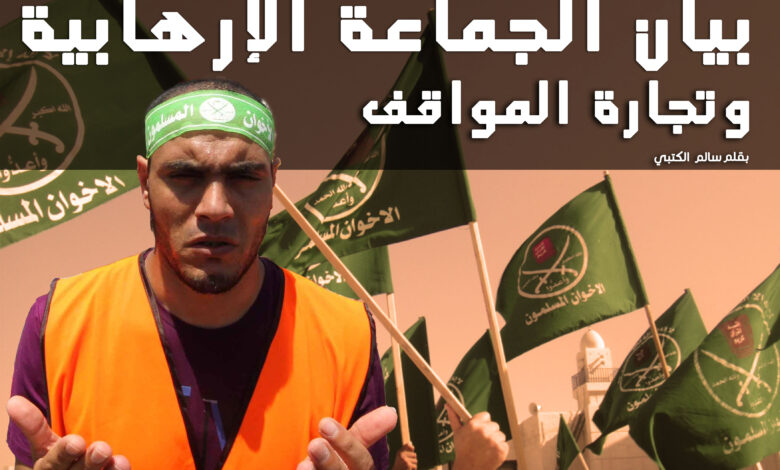
The group statement requests giving priority to ‘work for the benefit of the Islamic religion, identity and stability of the homeland on everything else’, a vague formula that seeks to avoid any offense to the Iranian position as the initiator of meddling in Saudi affairs.
I was not surprised when I read the statement issued by the Muslim Brotherhood terrorist group, commenting on the crisis between Saudi Arabia and Iran. The history of the group is a witness against it, as it is full of deceit and positions trading, and I may not be exaggerating when I say that the group is a professional par excellence when it comes to political stupidity. Some bet that tension with Iran is perhaps in the interest of the “terrorist group” in the sense that it could take it as an “opportunity” to come close to the Saudi official position. But my conviction about the stupidity of the group did not disappoint me, since the group has already issued a statement disavowing the position of Saudi Arabia, and its statement approached of being a declaration of abandonment of the “opportunity” (as some consider it), and worse than that is the group pretending excessive naivety in the wording of the statement, and approaching blaming the Kingdom for its honorable position in the defense of its sovereignty and its legitimate right to ensure the protection of diplomatic missions to Iran, under international agreements, laws and diplomatic norms.
Among the things that are at the same time funny and sad, is that in its statement, (though undone later), the group tried to continue the game of deception and to hold the stick from the middle, in a situation that does not permit this absurdity and liquidity in the reactions of both countries and individuals since everyone is in a genuine and serious test of citizenship and patriotism. But it seems that the group wants to consider itself “a big country”, so, it resorted to demanding of both parties of the crisis to exert what it called “self-control”.
The group’s statement calls for giving priority to “work for the benefit of the Islamic religion, identity and stability of the homeland over everything else”, a vague formula that seeks to avoid any offense to the Iranian position specifically as the initiator of meddling in Saudi Arabia’s internal affairs through incitement and threats against the Kingdom, following the execution of Al-Nimr, then came the attack on the headquarters of the Kingdom’s diplomatic mission in Tehran and Mashhad. The “terrorist group” placed both parties to the crisis at the same level and dealt with them equally, without supporting what is right and deterring what is wrong, as recommended by the Islamic religion, which the group is supposed to be among its supporters. The statement did not stop at that, but went further in directing implied blame to Saudi Arabia’s position by stating, “we had hoped it (the crisis) to be contained through pathways other than those that have been taken” in allusion to the Saudi reaction following the Iranian attacks on the Kingdom’s sovereignty and diplomatic missions, but the statement did not tell us how can a nation keep its sovereignty and the rights of its citizens, to whom it pledged to ensure the protection and dignity under the social contract, saying only that the group “does not have a solution it can offer to the parties to the crisis.”
There is an exposed ploy followed by the group for decades and years ago, which consists in issuing statements then disclaiming them in the event of the appearance of reactions that conflict with its interests. Therefore, its members have sought, through social networking sites, to claim that the statement was wrongly attributed to the group, after they saw its weaknesses and its abandonment to Saudi Arabia, which gave the group a lot of support and assistance historically, and after noticing the anger of many circles in Saudi Arabia on the reaction of the “terrorist group”, whom they thought it could provide support to the position of the Kingdom, even if it was as a matter of merely exploiting opportunities and political pragmatism, but what was missed by everyone is that the group is unconscious and does not even know how to seize opportunities, while it is so attached to its ideological maxims, including relations with the Iranian historical ally of the Muslim Brotherhood.
Some argue that the statement was characterized by what they described as “rationality”, but this false assumption raises several questions in the forefront of which is if the group has some maturity and rationality, how then to explain what is happening in its own country, sisterly Egypt? And why we did not notice an impact of rationality in stopping terrorism, violence and bloodshed against the State and its institutions in this brotherly country, the country of Al-Azhar, which is also among the “people of the direction of prayer,” as this absurd statement says?
What is strange is that the terrorist group statement was weak and can be likened to the position of the group at the time of the Iraqi invasion of Kuwait in August 1990, when Muslim Brothers of Sudan, Yemen, Tunisia and Turkey stood with Saddam Hussein and supported him in the occupation of a brother country. Some “Wikileaks” documents revealed a document issued by the Muslim Brotherhood’s Guidance Office on March 28, 1991, signed by the group guide in Egypt, at the time, Hamed Abu-Nasr, who considered that what happened was a “malicious conspiracy” from abroad, and attributed the problem to “the lack of an Islamic base.”
During that crisis, the exchange and ambiguity of attitudes and positions among the group’s leaders in several Arab and Islamic countries was intentional and aimed to leave the real position of the group ambiguous, which position sought to support Saddam at the expense of the State of Kuwait and its people, and to search for achieving the terrorist group’s agenda in that ill-fated historic moment regardless of sacrificing a whole country and its people, despite the support and aid they provided to the group.
In light of this similarity between the historical positions of the group, some of its elements have recently sought to clone the same game and to try to disclaim the statement and describe it as false or “from unknown origin” for being “out of tune with the context of the nation” as said by a media man who is affiliated to the group in a sister Gulf country.
Positions of the terrorist group cannot be defended by saying that the group does not know the ambitions of Iran in the GCC. The named Essam el-Erian, one of its prominent elements detained in Egypt, was trying to provoke the fears of the people of the Gulf Cooperation Council countries and to point at the Iranian threat if these countries do not ally with the group regime when it takes power in this brotherly country. Therefore, the group knows the Iranian danger well both by virtue of intellectual relationships and ideological connections with the Khomeini revolution, or by virtue of its cooperation with Iran over the past decades, and it is enough to know that the Islamic party that represents the Muslim Brotherhood in Iraq had supported Nuri al-Maliki during his premiership, where he was exercising an unprecedented sectarian repression against Iraqi Sunnis, and there is also the relationship of the group with the Houthis in Yemen then their turning against them for no other reason than that the rebels wanted to monopolize power, and Abdul Majeed al-Zindani has been boasting that the Houthi group was the Muslim Brotherhood group ally in Yemen.
For all the terrorist group’s fickle positions mentioned above and for other ones that articles cannot monitor, I did not feel that the last statement on the crisis between Saudi Arabia and Iran was “out of tune,” as someone said. The group has never been in tune, even if it ostensibly flies among the flock, it is mostly flying on the sides, waiting for the first opportunity to escape from it and search for its interests, even at the expense of its countries and peoples.