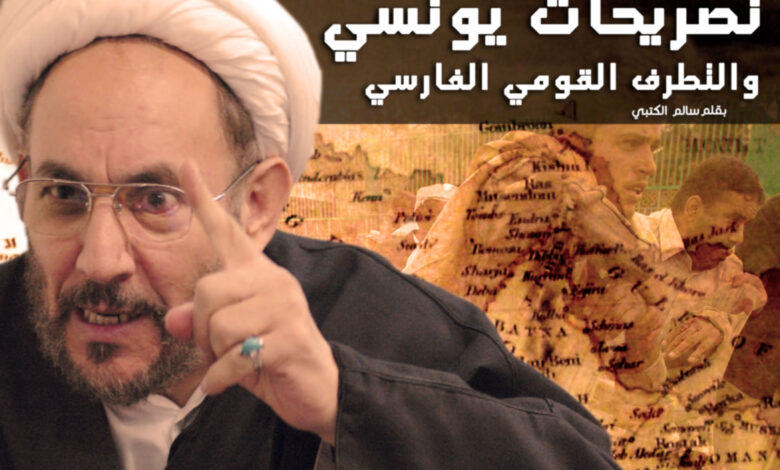
As usual, the statements of Ali Younesi, Iranian President’s Advisor for Nationalities and Religious Minorities, were controversial and provocative. “When the Iranians killed the brother of al-Mamum (al-Amin), they took power from the Arabs forever,” said Younesi. Highlighting the historical Persian racist hatred of Arabs, his remarks went back in time and reminded many people of wounds that have not healed. Strangely enough, threatening Arabs this way coincided with the ceremony marking the death of the eighth Imam in the Twelver Shi’ism, Ali ibn Musa al-Rida, who was of an Arab of origin. He was the son of Hussein, and the eighth grandson of Ali ibn Abi Talib, may Allah bless him, without whom, admits Younesi, “Iran or Islam would not have continued to exist.”
It is known about Younesi that he is a racist of character par excellence. In March, he sparked a big controversy by saying that “Iran has returned to be an empire, with Baghdad as its capital and the center of our civilization and our culture and our identity today as it was throughout history.” These statements have angered the Iraqis. After the Iraqi government protested, Tehran apologized for the remarks, but it seems that Younesi was looking for any opportunity to remind Arabs of the Persian nationalist hostility. Heedless of the sensitivity of his position, Younesi, a minister for security and intelligence, was acting out his whims. He already expressed his disquiet of the audience that referred to the Gulf as Arabian in Iran’s Azerbaijan province during matches between local teams and teams coming from Persian provinces, calling it a dirty and dangerous act by fools and agents. “These are neither Iranians nor Azeris, so we should put an end to such acts,” he added. Younesi did not hesitate to strip them of Iranian citizenship for their recognition of the Arab identity of the Gulf.
Younesi said that the Arabs feel ‘inferior’ to Persians and Turks. That is another political sin and violation of human dignity worthy of an official stance from Arab capitals and institutions of joint Arab collective action. He is not a media analyst or informal public speaker to not be accounted for the allegations he makes. He is a high-level adviser to the Iranian President, and his remarks should be taken as involving explicit denigration and insults towards Arabs. If only those who call, day and night, for the necessity to cooperate or ally with Iran see how Iranian leaders look at us Arabs and how they believe that we have an inferiority complex towards Persians and Turks. If only those who had welcomed the Iranian revolution, decades ago, hear these conjectures to realize that there is no difference between the mullahs and the regime of the Shah, as some thought the removal of the Shah regime meant the demise of the Persian supremacist tone but it wore a mask uglier, more aggressive and ferocious than during the Shah’s reign.
Younesi may come, days later, to apologize for the abhorrent and obnoxious anti-Arab sentiments, but no apology is to be believed, as he has previously apologized for his remarks on the occupation of Baghdad, only to express a political stance not a personal feeling. His racist views on the Arabs cannot be erased by his bombast speech, tactless apologies or diplomatic patter.
If the said leader of Daesh, Abu Bakr al-Baghdadi, broadcasted a video message about Persian Iran with the same odious racist tone and rhetoric, we would not hear the end of it; the media would generate endless analyses, interpretations of the Daesh rhetoric. But when an Iranian official goes and accuses all Arabs feeling inferiority towards the Turks and Persians, everybody keeps quiet.
Younesi and Iranian leaders are trying to use Daesh to justify their despicable policies in Iraq and Syria. The interests of Daesh and the Iranian projects intersect at several points. Terrorist organizations share interests with Iran which encourages and may have directly or indirectly contributed in founding them in order to jeopardize Sunni Islam and drag Sunni Arab countries into wars of attrition against these organizations.
Younesi said that Iran still undergoes the historical hatred of the Arabs, and that the Persians did not forget the defeat of al-Qadisiyah by Arab Muslims despite the fact that this battle was the gate through which Islam, they claim defending today, came. Filled with ugly accusations against Arabs, the Iranian literature refuses giving any credit to the Arabs for their contribution in civilization and sciences, although most Shia imams were Arabs, and all the mullahs of Iran inspire their ideology from Al-Hussein ibn Ali ibn Abi Talib.
The good thing is that as these anti-Arab statements were made, all the true intentions of the mullahs were revealed. Their hatred and false pretenses actually date back to their Persian origins of ignorance and disregard to the grace of Islam that was bestowed on them. The claim that they defend Islam is a front behind which they seek to achieve deplorable racist purposes.
It has now been confirmed to everyone that the conflict with Iran is not about doctrines. The issue is not a Shiite–Sunni struggle as claimed by many, but the fact is that it is a national historical conflict the Iranians do not want to forget. They are trying to ideologize it to polarize emotions of Shiite Arabs in various Arab countries, as the mullahs did when they spread panic, fear, discord between Shiites and Sunnis in Iraq to Yemen, Bahrain and elsewhere. The truth is what those that blindly follow the Iranian sectarian rhetoric are unaware of, forgetting that the conflict with Persian Iran is not one of sects or doctrine but of history and ideology. Speaking for the distasteful Persian nationalist extremism, Younesi and other Iranian officials threaten regional security and stability in the same way as Daesh and al-Qaida and other terrorist extremist organizations that the international community is working hard to eradicate and eliminate.