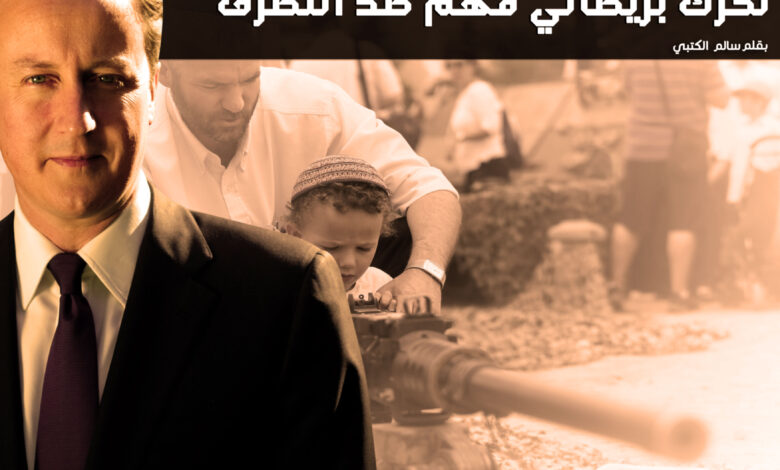
There is no doubt that the strategy recently disclosed by British Prime Minister David Cameron to combat “violent and non-violent extremism” is a very important step in order to contain the risk of the terrorist phenomenon, and work according to a strategic perspective to free communities from this phenomenon and to protect the new generations from extremist thought.
Aspects that caught my attention in this strategy were that it gives parents in Britain the right to ask the authorities to cancel the visas of their children who are less than 17 years if they are afraid they could adopt extremist ideology. The strategy will also include a ban on anyone showing signs of radicalization to work with children, adolescents and young people and groups whose ideas can be easily manipulated and influenced into changing religious convictions. In the statement on the announcement of this strategy I liked when Cameron was talking about the need to stop extremism from the outset and prevent the seed of hatred that grows in the minds of the people and take out the oxygen it needs to grow. This expression is simple and expressive but it needs work and huge efforts to be implemented.
Someone might say that these ideas are already present in many Arab and Muslim countries, but they are not effective in the fight against extremism, and I think that applying these ideas in a country like Britain is an important step on the path to combat this dangerous phenomenon, especially in light of the difficulties faced by the British government to balance between new anti-terrorism laws on the one hand and the freedoms of the other hand, as the widespread controversy arises about the impact of these laws and procedures on individual freedoms. Another thing I liked about this strategy was the idea of a strong community partnership between the parties concerned. It is important to work in this area, as this requires concrete efforts of all to defeat extremist ideology. What is new in this strategy is that it targets the Muslim Brotherhood group as a source ideology for extremism. The statement used the term “non-violent extremism”, which puts the Muslim Brotherhood ideology in real trouble at one of its main global centers. The Muslim Brotherhood members are good at disguising and dissimulating and showing the opposite of what they believe and employ existing laws to their advantage, but the British elites are positive about the strong intellectual relations between the group and extremism. The Brotherhood in Britain claim they are not sending extremists to “Daesh” but the new strategy puts them in the dock as an intellectual environment to foster this thought and allow it to exist and spread in a country like Britain.
The Quilliam Foundation specialized in the fight against extremism says that Daesh produces 388 propaganda electronic material of high quality daily it publishes on the Internet to target sympathizers around the world. More important is the report of the institution that indicates that the last year and a half has seen significant changes in the pattern of extremists’ use of the Internet for the transmission of extremist ideas into the minds of young people directly, and that means that this organization represents a high degree of risk, in light of its organizational ability, which allows it to develop electronic recruiting and mobilization methods amid this large amount of military air and ground strikes that it receives from the international coalition and antagonist organizations in Syria and Iraq.
Some experts were quick to question the feasibility of the new British action against extremist thought, but I think that any step in the direction of the fight against extremist ideology is an important step that should not be underestimated, especially in light of this painful reality, both in terms of Daesh’s media expansion and propaganda or its spread among young people, even in advanced countries such as Britain. Some of the published opinion polls say that one out of seven young Britons sympathizes with the organization. The Times newspaper published the results indicating that “Daesh” enjoys sympathy among young adults under 35 years of age and that one out of ten young people in London sympathizes with the Daesh thought. These are in fact extremely dangerous and terrifying results.
If this is the situation in Britain, we have to ask ourselves immediately about sympathy with “Daesh” thought in many Arab and Muslim countries experiencing awful outbreaks of extremist ideology, not to mention the direct support for this pernicious thought, as sympathizing is not less serious than adopting this thought, as empathy is the first phase of what is more dangerous than that, as the sympathizers of extremist ideology can mobilize and recruit the masses under favorable conditions.