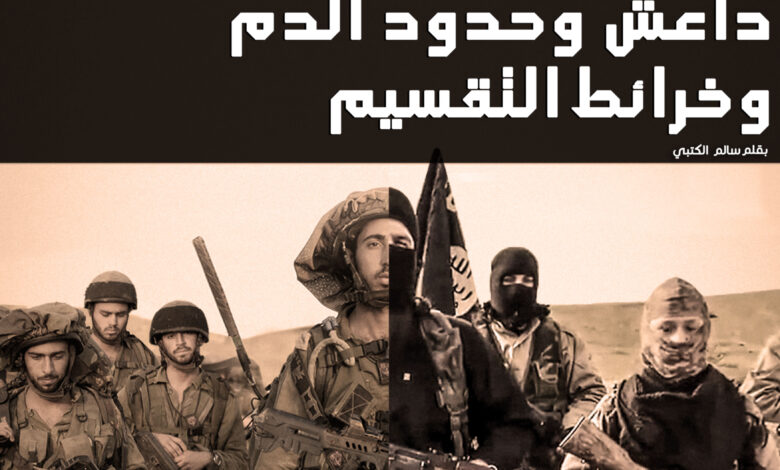
Daesh is moving in the same regions and countries of the partition maps that circulated in Western research and intelligence agencies and orientalists’ circles. Coincidence? The maps that are controvertial today actually date back to several decades ago. In the mid-twentieth century, many visions of the division of the Middle East were presented, including what was presented by Israeli writers in the eighties and the map of Jewish Orientalist Bernard Lewis in the nineties. “Blood Borders: How a better Middle East would look” was published in the AFJ journal in 2006. The author, former US Army Gen. Ralph Peters, concluded the need to redraw the map of the Middle East and divide it into new states based on what he called “blood borders”. He considered that the existing geographical boundaries are a direct cause of the hatred between peoples, and therefore are no longer “sacred borders”.
The partition ideas, plans and plots forcefully returned to the scene of discussions as Daesh published a roadmap towards establishing the “Caliphate”. Soon after, the interest went down as events and developments in the region succeeded. But it seems that the fire in some areas drove many observers and analysts to revisit partition plans. They observed that Daesh moves on “blood borders”, which is a common denominator that marks a striking similarity between maps of Daesh, of Bernard Lewis and of Ralph Peters.
Daesh had declared the fall of the Sykes-Picot borders, set nearly a century ago, but did not put limits to states but to provinces and these limits are not final and conclusive according to the ideology of Daesh. The alleged Caliphate should not stop expanding geographically, and this is echoed in the motto of al-Baghdadi’s State that it is “remaining and expanding”. This is the fundamental difference between Western and Israeli division plans and those of Daesh. The first draw new geographical boundaries of the Middle East while the second do not draw borders for separate countries as Daesh only recognizes the map that includes parts of Arab countries.
Is Daesh a tool for a Western partition plot used to demolish these countries so that the West can pick up the pieces?
Does Daesh serve the Western partition plans? Is there any coordination between Daesh and the West or a tacit agreement on any schemes of this kind? What are the limits of understanding in this matter?
What raises skepticism about the relationship between Daesh and the West are the mechanisms and circumstances of the geographical expansion of the organization. The fall of the cities and provinces of Iraq in the hands of the organization seems suspicious. When the Iraqi army flees, leaving behind weapons and even armored vehicles instead of protecting people, when thousands of soldiers on which were spent hundreds of billions of dollars to “train” and arm with new weapons flee, doubts certainly arise.
Libya seems divided into states under the control of each faction, Iraq is on the same path, and Syria implicitly, as alluded to by President Bashar al-Assad, accepts the de facto expansion and withdrawing from some areas in order to preserve the most important regions. There are some talks about a Kurdish state, and there are tensions in other Arab countries. Daesh is in every point of tension. The group controls parts of Iraq, Syria, Libya and Sinai in Egypt.
We cannot rule out a link between the emergence of Daesh and plans to divide Arab countries. Each scheme has tools and entrances so that it looks convincing to the world. Partition seems like an alternative to save the victims of ongoing military conflicts of the quagmires of blood. Daesh may be a creature of Iranian or American or even Israeli plans to serve their objectives. The organization in fact serves the interests of these three forces, not those of the Arab and Muslim countries.
Arabs are deeply immersed in the search for how serious the division plans are and who stand behind Daesh, and the time required by the international coalition to eliminate the group. Is it twenty years as estimated by the US side, or much less according to Arab and other analysts and specialists? Even if partition were a real plan, the reality is that the Arab body is in chaos and that should top the agenda of joint Arab action today.