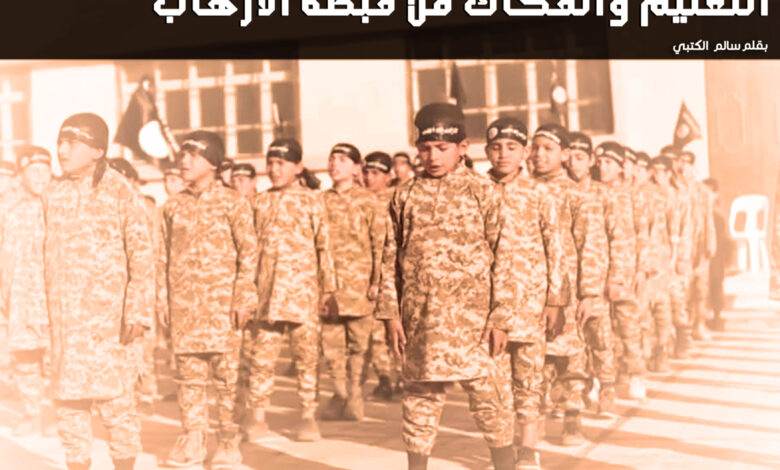
Countless views were expressed and many discussions have been held about plans to save the Arab world from new obscurantism clutches and extremist thought. These efforts and discussions have not helped anything yet, as they are still confined to controversy and intellectual and rhetorical spar far from any serious and precise strategies or tactics to deal with the problems of extremism.
There is also a large emphasis on the idea of developing a religious discourse as some scholars that were referred to as ‘pious’ are now coming out every now and then urging for reinventing the religious discursive practice. Still, many people—including myself—no longer have an idea about who will be charged with this mission while what everyone does is call for it.
Although of great importance, developing religious discourse cannot safeguard communities against extremist thought completely. It is a step that projects to go in parallel with other projects such as the real development of educative content in the Arab world.
Likewise, developing education became a hackneyed phrase resonating in most political and academic conferences and debates. Serious efforts in this regard are still limited or do not produce the desired effect.
The Arab region is now a geopolitical red zone on the modern world map. Obscurantism, cultural and intellectual degradation and decadence suffered by regions and countries fraught the future with fears, obsessions and catastrophic scenarios. To introduce moderation, tolerance, coexistence to the coming generations, realistic steps ought to be taken, otherwise these notions will remain a phraseology deprived of their original meanings.
Spreading positive values throughout the Arab world is not only essential to the fight against extremist ideology, but is also an investment in the future to overcome the climate of frustration, pessimism and refraction that are dominating many parts of our region. The present societal climate offers a ripe environment for the proliferation of terrorism, which is betting on the failures or the absence of the role of the State, turning the territory into non-sovereign zones where cultural values, as well as security and geopolitical stability, are lost.
Amid the chaos and confusion, the role of education to counter the ideologies of terrorist organizations seems crucial. Some strategic calculations suggest that the fruits of investing in education are only collectable in the medium term. Many Arab countries do not do more than echo the regional and international mainstream ideas on the development of education without implementation. This shows a default of planning at multiple time phases to address the problems and strategic challenges facing the national security of Arab countries today.
A few Arab countries put the development of education in the forefront of strategic priorities, including the United Arab Emirates. Individual efforts can safeguard society to a certain extent, yet reaching total immunity requires a safe geographical environment in which the extremism/terrorism virus cannot be transmitted. Getting rid of the terrorist ideology requires regional education development as revolution in transport and communications leaves no place to isolation and the search for a safe environment in a dangerous geographical context is certainly an absurd idea. The extremist contagion even affected developed Western societies as some of their nationals are now fighting in Iraq and Syria.
Scientific research in the Arab world is suffering an appalling reality. For the most part, the responsibility for this rests on governments. It is a question of the budgets allocated to scientific research and education, as this pretext has been used to justify the errors and fails of the past. It is about the absence of the very plans and strategies to enhance various educational levels.