The United States has no choice but to accept the presence of its strategic partner, France, in anticipation of Iran’s strategical expansion and the Russian and Chinese influence.
The US has been openly re-prioritizing its strategic interest worldwide. The new ‘Asia First’ strategy, declared by President Barack Obama in the Priorities for 21st Century Defense document published in January 2012, can explain the ongoing shifts of the American positions in the Middle East region. The document holds that the ‘U.S. policy will emphasize Gulf security, in collaboration with GCC countries when appropriate, to prevent Iran’s development of a nuclear weapon capability and counter its destabilizing policies.’ Further detailing this stance, President Obama, in his interview with the columnist Thomas Friedman last month, said ‘the US’s core interests in the region are not oil, are not territorial, [but] that everybody is living in peace, that it is orderly, that our allies are not being attacked[.]’ Three years earlier, Obama spoke of that very strategy, saying that ‘our nation is at a moment of transition.’
There is no doubt that part of this transition was the strong and vehement US support for the so-called Arab Spring and the groups and organizations that took power in several countries. Like his predecessor, former President George W. Bush, President Obama was haunted by the idea of putting pressure on the Arab governments to conduct internal reforms; they only differed in the way they said and done things. Obama said, in his interview with Friedman, that the US’s Arab allies face real external threats:
‘Populations that, in some cases, are alienated, youth that are underemployed, an ideology that is destructive and nihilistic, and in some cases, just a belief that there are no legitimate political outlets for grievances. […] I think the biggest threats that they face may not be coming from Iran invading. It’s going to be from dissatisfaction inside their own countries. That’s a tough conversation to have, but it’s one that we have to have.’
Moreover, the White House has strenuously sought to sign a final nuclear deal with Iran. Washington seems set to wash its hands of regional security equations in the Gulf, albeit continuously trying to reassure its GCC allies.
Meanwhile, France is stepping up to the scene in the Gulf region, recognizing that the United States no longer has the same desire for complete control over matters in the region. That being said, France does not compete with the American influence, undergoing a restructuring in this vital region of the world; it is one of the US strategic NATO partners, whose presence in the Gulf is approved by Washington to curb Iranian aspirations and the consequential increase of Russian and Chinese influence.
Approved and backed by the US, the role of France in the Gulf centers on protecting European interests. Europe imports roughly 25% of its oil from the Gulf countries, while their markets are an outlet to European economies still suffering the consequences of the ongoing financial crisis. France, in particular, has made a priority to develop its relations with the GCC countries for years. Paris maintains strong military ties with the United Arab Emirates and the rest of the GCC states.
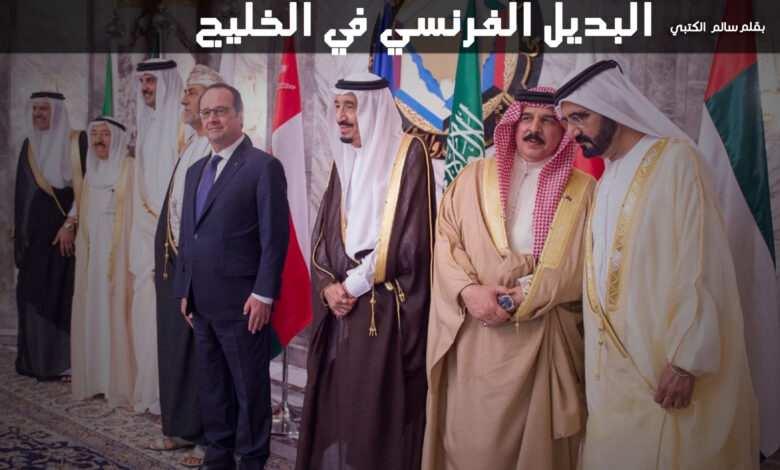
France has shown interest in the developments in the region, especially in participating in the ten-country coalition for security and stability in Yemen, as French Foreign Minister traveled to Riyadh on April 11, which was followed by an unprecedented visit of French President Francois Hollande in the recent consultative summit of the GCC in the Saudi capital.
The French move is not only concerned with military deals. Although arms supply is important for countries like France, the UK and the US, historical analysis of French interests internationally indicates other benefits. On the one hand, the gradual withdrawal of US influence from the Gulf region makes it possible for Paris to especially assume a role that will later translate into a strategic influence and partnerships along with arms and business deals. It has already singed a Rafale fighter jets sales with Qatar, and an estimated USD3b supply of weapons to the Lebanese army, as well as a huge potential weapons deal with Saudi Arabia.
On the other hand, The GCC countries will play the French card in the face of US blurry positions that would fall in the interest of the Iranians. Washington would then realize the emptiness it has left in a region that had been under its influence for a long time.
The context of the GCC relations with major powers is constantly determined by regional and international interactions. The Camp David summit, to be held this month, will be an opportunity to revisit how these relations are going to be in the foreseeable future. The summit will witness a face-to-face dialogue between the GCC leaders and the US President.
Despite speculations raised about this summit, the results depend on the discussions. Nonetheless, what is quite sure is that the US strategic transition somehow resulted in a shift at the GCC from a reactive to a rather outspoken proactive policy. Put differently, the Gulf Arab countries have broken a long-time barrier of silence in the face of threats and challenges affecting their national security, imposed by expansionist regional powers supporting sectarianism and guerrilla groups.
What is also sure is the coming of new players in the field of political strategy in the post-US transition in the Middle East region, notably France. The historical interest in and the strengthening of relations with the Gulf and the Middle-eastern countries allow Paris—even in the presence of other players—to counterpoise the US role in the region.