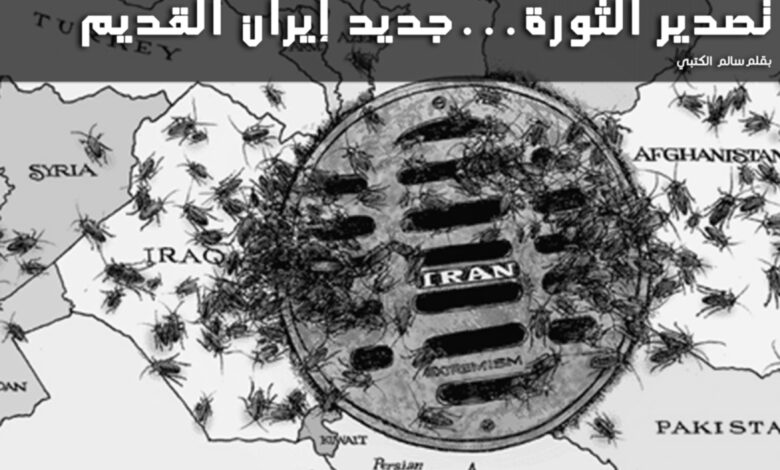
It is not true that Iran reached political maturity after the nuclear agreement with the West, nor that did its regime move from revolution to State. It is still a theocratic regime based on ideologizing and revolutionizing.
Those who have followed the political and media Iranian rhetoric lately would have noticed the return of the concept of “exporting the revolution” strongly to the forefront of this discourse. The talk about old political concepts is associated in the minds of observers and specialists with the era of the eighties, particularly during the height of Iran’s political upheaval, and the accompanying vigorous efforts at the time to export the revolution and its ideological and political line to the neighboring countries.
The concept or “exporting the revolution” has been one of the problems of the complex relationship between Iran and its neighborhood since the revolution in 1979. The term denotes the transformation of Iran from a civil state into a theocratic religious state. This implied shifts in the established international relations after the disappearance of religious states that are linked in the minds to the bygone ‘Dark Ages’ in Europe.
More recently, indicators have emerged about the growing Old Iranian political line, and the rise of the term “export of the revolution” to the front of this discourse. In the context of the celebrations of the anniversary of the Iranian revolution, the commander of the Qods Force of the Revolutionary Guard, Major General Qassem Soleimani announced that “indicators of the export of the Islamic revolution are remarkable in every region; Bahrain, Iraq, Syria, Yemen and even North Africa”, recalling the term that has disappeared from the political discourse of Iran for nearly two decades or more. What makes this more serious is that many senior Iranian officials speak about it. Among these is Major General Mohammad Ali Jafari, commander in chief of the Revolutionary guards, who said that “the resistance of Yemen” (referring to the Houthi group) is today the latest achievement of the Iranian revolution and that “the rebels have taken the Iranian revolution as a model for resisting the tyrannical regime,” adding that, “the project to export the Iranian revolution abroad is going well, and we are witnessing the awakening of Muslim nations and resistance.”
Some may see there is nothing new in the statements of Iranian officials, and that such statements also emerged after the popular protests that toppled former Egyptian President Hosni Mubarak in 2011, and here we refer to the fact that the Iranians tried in 2011 to exploit the wave of change in Egypt to their advantage, without talking about exporting the revolution, considering the change as simply going on the footsteps of the Iranian revolution, or cloning it, which was rejected by the Egyptians at the time. Many mention the famous visit by the People’s diplomatic delegation to Tehran, where it was warmly welcomed by former president Ahmadinejad; then, as he received the Egyptian delegation, the head of radio and television Ezzatollah Zarghami revealed the true intentions of Iran and put an end to any potential convergence. Addressing the visiting delegation, he said, “The West wants to buy your revolution with $ 40 million and we will pay more, do you accept to sell?” An Egyptian journalist from the People’s diplomacy delegation replied to him immediately denouncing this speech. But the visit itself revealed the Iranian supremacism and lack of understanding of the history of the region. Egyptian delegation further resented Zarghami’s statements as he spoke of mechanisms of writing constitutions and how to constitute a government and to build systems of governance à la Iran. That raised the ire of the Egyptian delegation and they had every right to be mad because the Iranian side did not take into account the Egyptian background and history-long political experience.
The political discourse of Iran over the past years did not use the term “export of the revolution” in its abstract sense that was notorious in the contemporary history of the Gulf. Back at the time, Tehran was considering Saddam Hussein’s Iraq as an extension of the Iranian revolution, but these dreams have collapsed since the end of Iraq-Iran war.
Senior military leaders such as Major General Mohammad Ali Jafari, Commander in Chief of the Revolutionary Guards, and Qassem Soleimani have an overwhelming presence in Iran’s foreign policy, by virtue of their proximity to Iran’s Supreme Leader Ali Khamenei, so when they use this threatening tone of hostility, this has striking implications. Qassem Soleimani is like a legendary hero in the eyes of conservative Shiites in Iran. He also has a role in directing Iranian foreign policy all over the world, not to mention the impact of his role in the Revolutionary Guard in control of the Iranian economy.
His statements cannot be overlooked words. They are not words for domestic consumption and to fuel feelings and manipulate emotions and other purposes related to the psychological charging and mass mobilization.
The implications of the official speech of Qassem Soleimani and Jafari cannot be underestimated, especially in light of similar comments by Mohammad Golpayegani, the director of the Office of the Iranian Supreme Leader Ali Khamenei, in which he vowed that Saudi Arabia will fall soon because of Operation Decisive Storm, threatening that “this war will not go easily for the Saudi regime and if it continues it will have repercussions,” adding that “soon the name of Al Saud [House of Saud] will change to Al Suqut [falling house].”
These statements are dangerous because they caress the emotions of Shiites in several Arab countries. They directly incite unrest to provoke clashes with the ruling regimes.
Some may believe that Iran is moving into a kind of political rationalization on the background of the signing of the nuclear agreement with the major powers, but the analysis is based on a false premise, namely that the system has already moved from the revolution to the state, while reality is that it never left the revolution phase. It is still a theocratic regime based on ideologizing and revolutionizing.
Iran is an exceptional case in terms of the historical heritage of such systems. Iranians suffer severely from the inside. There is also a growing large gap between the Iranian regime and the people. The people suffer in their living due to the regime’s policies and international sanctions against the ambition of possessing nuclear weapons. The system is likely to play the card of export of internal crises. It only needs openings and gates to provoke crises and engage in them. At this level, many openings seem available and accessible for Tehran. The easiest would be sectarianism and playing the card of persecution of Shiites in neighboring countries.
To conclude, Iran may seek to provoke regional military confrontations in the coming period. This can only be prevented by a GCC policy of restraint and not rhetorical escalation with Tehran so as to avoid falling into the trap of confrontation.