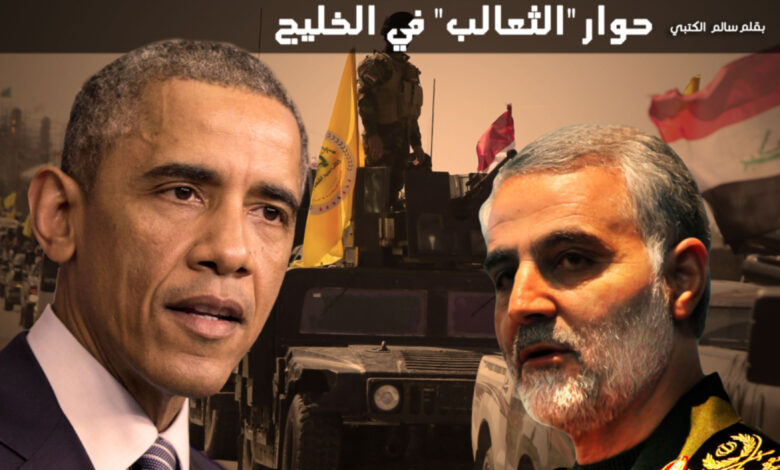
Intense military presence of Iran in Iraq during the current phase raises many questions, especially after known US experts said that the influence of Qassem Soleimani, commander of Iran’s Quds Force, is very large in Iraq, and that the Saudi Arabia foreign minister, Prince Saud al-Faisal’s remarks on the control of Iran in Iraq, are correct.
There are two views on the analysis of the US strategic vision of what is happening in Iraq. Some believe that Washington is trying to implicate Iran militarily in Iraq and then transforming the Iraqi conflict into a swamp that drains Iranian military capabilities directly so that Iran cannot get out of Iraq without a military ignominious defeat that would make refrain from future interfering in any neighboring state. The opposite view is that Iran is seeking to strengthen the strategic cards it owns by taking advantage of the confusion of the US strategy in the Middle East during the current phase, as Iran does not expect the continuation of any agreement that has been reached by the Obama administration because of Republican opposition to this agreement, and as it also considers the possibility of not reaching this agreement in the first place. Therefore, it strives to expand its influence in every way in the various files of conflicts and regional tension in order to compromise on these files later in any negotiated settlement with the US side. These interventions may even prevent the exposure of Iran to US military attack because of Tehran’s ability to inflict damage to the interests of the United States in many countries of the region.
In fact, it seems that both analyses can be subject to investigation. The situation in the Middle East is open to all scenarios, but the real problem is that the Arab side has no place in the strategic calculations of both sides of the ongoing strategic conflict (Iran and the United States) Otherwise, how to explain what is happening in Iraq and how to explain the US ignoring the role of Qassem Soleimani in leading approximately 25 000 fighters that took part in the battles for the liberation of Tikrit, two-thirds of whom are from the popular mobilization Shiite militias sponsored and funded by the Iraqi government, while Tehran provides them with arms and military advice !
A legitimate question arises at the Arab and Gulf level against the backdrop of the foregoing: Is there an Iranian-American understanding on what is happening in Iraq? Is what is happening in Iraq a translation of strategic understandings that took place within Iran’s nuclear program talks?
To understand part, even if minimal, of what is going on around us, we have to think about Iran’s situation in this complex scene. Towards the dialogue with Washington, Tehran adopts the same outlook that has already been adopted when it agreed on the end of the war with Saddam Hussein’s Iraq, in accordance with Khomeini’s principle of “drinking poison”, meaning that Tehran negotiates reluctantly with Washington about the Iranian nuclear program, knowing that the United States will not become an ally of Iran overnight, so it seems closer to a foxes dialogue, as each side is plotting against the other, and the winner in the end will be the most insidious among them.
What confirms that are Iran’s Supreme Leader Ali Khamenei’s remarks, in which he said that “Americans are known for being treacherous”, he added yesterday at a meeting attended by President Rohani and other senior Iranian officials “Whenever we approach the deadline of the end of the negotiations, the tone of the opposite party and especially the Americans becomes more violent, and this is a manifestation of their deceiving nature.” He reportedly said “Of course I am concerned because the other party is known for being treacherous.”
From here is difficult to assume that any agreement that may be reached between Tehran and Washington can turn the two sides into strategic allies, although they may reach understanding on interests as it has already been happening for years and even decades ago.
What is new in this agreement? What is new is a high probability for granting Iran freedom of movement regionally and ensuring its assistance in the face of terrorist organizations. President Obama has a chance to say that he has succeeded in countering terrorism through an international coalition and without fighting new wars, and to add the nuclear deal with Iran to his political achievements that lack so far a huge accomplishment in terms of foreign policy that may make the American voter to re-vote for the Democrats in any future elections. Iran, for its part, reads the scene in all its details, and is trying to exploit the predicament of President Obama in achieving its expansionist aims at breakneck speed and before the expiration of his term.