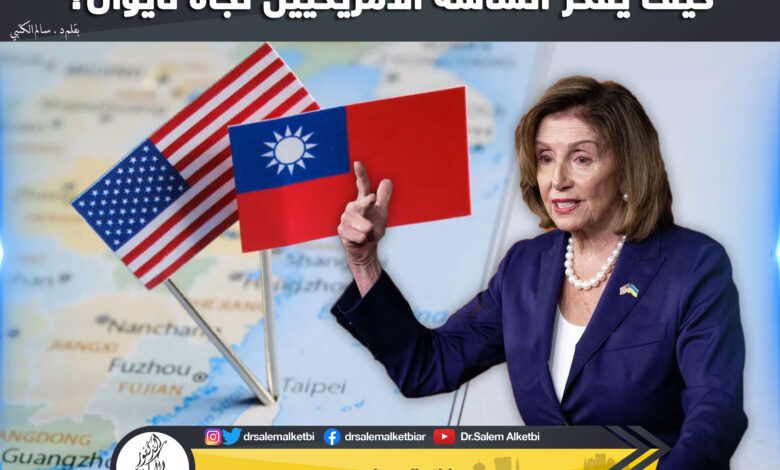
Nancy Pelosi, the Speaker of the US House of Representatives, visited Taiwan in what many countries and organizations called a provocation. About two weeks later, a five-member congressional delegation led by Senator Ed Markey, a Democrat from Massachusetts, visited Taipei and met with Taiwanese President Tsai Ing-wen. This further fueled tensions across the Taiwan Strait.
Of course, China handled the crisis triggered by Pelosi’s visit diplomatically.
Those who think that the failure to implement the threats made on the eve of Pelosi’s visit is a deduction from the balance of China’s world prestige are mistaken for the simple reason that the experts know well the character, culture and ability of the Chinese people to carry out such political maneuvers without getting into conflicts they do not want, at least not yet.
One of the most notable benefits China derives from visits by American delegations is the world public’s support of its diplomatic posture. Countries and governments diverge in their support for China’s position on Taiwan. The position of Pelosi and congressional delegates has received timid support from Western capitals that support US policy toward China, especially NATO members.
After Pelosi and the Congressmen’s visit, China’s position on the Taiwan issue was further supported. The issue is no longer limited to supporting a “one China” policy, but has expanded to exposing US policies that threaten world security and stability and almost provoke a new major war, at a time when the world is sore most from the ongoing war in Ukraine.
Many in the world no longer doubt the lack of responsibility that such a world power should have. Washington has chosen to heat up the conflict in Ukraine with various claims and arguments. Now it is trying to repeat the same scenario in one of the most sensitive and tense regions of the world, East Asia.
There is China, the rising international power. Then there is Korea, Japan, and other nuclear powers like India.
The outbreak of war would present the entire world with an inevitable disaster scenario. The US is aware that the visit of its top officials to an island that China considers its own, as well as the exercises it regularly conducts with Taiwan and the other military activities, constitute an endless cycle of provocations for China, which also runs large-scale exercises in the Taiwan Strait, laying the stage for any mistake that would lead to a ruinous conflict.
The constant US provocations could make China reconsider its plans to regain sovereignty over the island of Taiwan. That seems to be the goal of US strategists. China’s growing power is pushing these planners to fast-track a full-scale confrontation with a constant strategic adversary before its military-strategic power grows stronger and becomes harder to resist in the future.
Although China is certainly aware of these signs of temptation or implication, it is expected to work to prevent this Western scenario. However, it may not be able to forestall it because Washington has focused on this goal without considering the grave consequences for the rest of the world.
From a realistic point of view, these constant American provocations also make it difficult to understand the orientation of the Biden administration, which always talks about diplomacy as a means of resolving disputes and crises, as it tries and repeats on the Iran nuclear issue.
But everyone is watching how he is putting sustained and intense heat on a multi-billion dollar war in Ukraine and how he is leaving the door open for his ally Nancy Pelosi, a prominent Democratic Party leader, to visit Taiwan without trying to convince her to resile, a dangerous gamble with US strategic interests.
Judging from the White House’s reaction to Pelosi and others’ visit to Taiwan, it is safe to assume that Biden disapproves.
But it seems that Biden wanted to strike a middle ground by saying that the visit was parliamentary in nature and that China’s concerns were unfounded, well aware that playing on this particular point would not be accepted by China, very sensitive to the Taiwan issue, which it sees as a matter of national pride.
In my opinion, Biden failed to stop Pelosi’s quest for personal glory before her political story fades, and to strengthen the Democrats’ position in the run-up to the November midterm elections. All of this means that, despite Biden’s claims that the US is “back,” US foreign policy is falling into a new isolationist trap as Washington is being squeezed in its traditional spheres of influence.
Russia and China are rapidly and effectively expanding their influence in Africa, the Middle East, and Asia. US influence, role, and prestige in these regions are meanwhile waning, meaning Washington must rethink its entire foreign policy to preserve what is left of its global presence.