“We have no lasting friends, no lasting enemies, only lasting interests,” British Prime Minister Winston Churchill once said. On this basis, as observers, we should not be surprised at the qualitative changes in relations between states, especially the gradual or even sudden transition from tension and rivalry to dialogue and cooperation.
The rule of seeking and pursuing interests applies in relations between states. The dispute between Saudi Arabia and Turkey should be seen in this context. The same scenario took place at an earlier stage of relations between Ankara and Abu Dhabi.
It was part of movements that could be called a strategic repositioning of all regional and international powers, based on the current state of affairs and rapid changes in the structure of the world order (especially after the coronavirus pandemic and the start of the war in Ukraine), as well as possible agreements in Vienna to resume the Iran-P5+1 nuclear agreement over its negative consequences observed since 2015.
One could say that dialogue and cooperation are always desirable. Even if the conflict is rooted in geopolitics and the difference of interests and views remains the rule, cooperation remains the hoped-for exception or the optimal mechanism in international relations. Everything revolves around interests that are not necessarily limited to economic or commercial interests.
Other interests may be less or more important than economics and trade, depending on circumstances and variables. Personal animosity in politics does not exist, at least presumably, although “personal chemistry” between heads of state goes a long way toward enhancing cooperation between nations. Therefore, there are no strange things or absolutes in the world of politics.
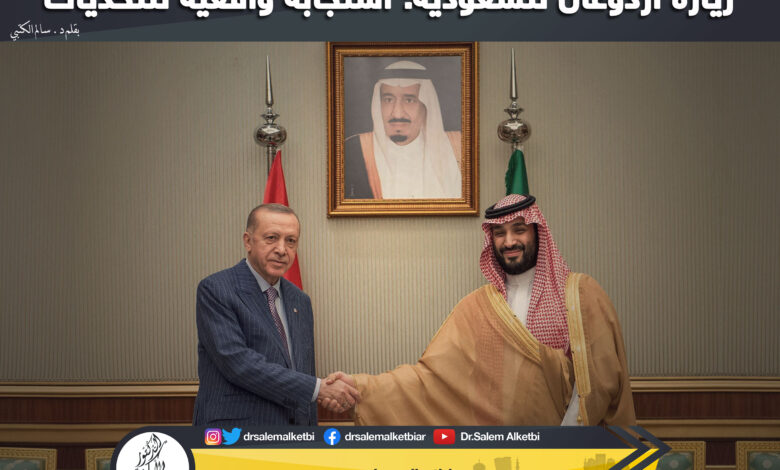
It is about the interests of states and peoples. These interests are not subject to immutable laws, but to changing factors. From this point of view, we look at the recent trip of Turkish President Recep Tayyip Erdoğan to Saudi Arabia, which many observers call historic.
President Erdogan’s visit to the Kingdom is well deserving of media attention. The visit reflects a significant paradigm shift in relations between the two regional powers, influential in their respective fields and in the world at large. There is speculation that the visit may indicate further breakthroughs in relations between Turkey and other regional powers.
This historic visit is significant in many ways. First is the status and weight of the two major regional powers, Saudi Arabia and Turkey, economically, politically and religiously. Overcoming tensions between these two powers is of great importance at these levels.
Their cooperation is as analytically important as their differences. The second of these aspects is the time factor. This visit is a formal announcement of the closure of the Saudi-Turkish disagreement.
It is of exceptional importance, both in terms of reshaping relations in light of the changes taking place and in terms of the impact of all this on regional crises. It gives reason to hope that the early resolution of these crises will reduce tensions, especially in Syria, Libya, Iraq and many other regional problems between the two countries.
The significance of Turkish President Recep Tayyip Erdoğan’s visit was certainly reflected in the increased media interest and many analyses and articles with different opinions depending on intellectual and political orientations. But everyone agrees that this visit opens the door to a new stage — not only in Saudi-Turkish relations.
The visit also is a major breakthrough for Turkish-Arab relations as a whole, ending the tensions that have marred relations between Ankara and influential Arab capitals such as Riyadh, Cairo and Abu Dhabi over the past decade.
Beyond the details of the visit and the joint agreements and understandings it could bring about on numerous issues of cooperation, many have questioned the possibility of ending the Saudi-Turkish dispute once and for all. The answer to this, on a theoretical level, is previously outlined in this article.
On a factual or practical level, we can say that the background of the visit reflects a shared belief in the need to overcome the dispute and focus on the interests of both countries. This echoes the conciliatory atmosphere and the prevailing recent belief in the region that continued conflicts and crises are not in the interests of either side.
On the contrary, the goal is to develop approaches that ensure that the interests of both sides are pursued in accordance with the rules of the political game, encourage compromise, emphasize common ground, and eliminate points of contention in flexible diplomacy.
We must be clear that this historic visit is not a declaration of victory for one side or the other, as some analysts believe, because such significant steps are usually carried out according to a complex win-win game, as assessed by decision-making leaders. What interests us is that the two powers, Saudi Arabia and Turkey, can solve many regional problems through their cooperation.
Our region needs enhanced regional cooperation that does not prevent anyone, including Israel, from dealing with existing and potential challenges and threats. The US and other major international powers face conflict scenarios that leave all possibilities open, including a third world war whose casualties and consequences no one can reasonably estimate should it, God forbid, occur.
This conciliatory atmosphere and significant breakthroughs in Turkey’s relations with Saudi Arabia and the UAE will have a positive impact on other contentious issues, whether it is the relationship between Turkey and other influential Arab powers such as Egypt, or what is happening in Libya and elsewhere. This is crucial for the security and stability of the Middle East and the Arab region.
It is no secret that the capitals of the Arab troika (Riyadh-Cairo-Abu Dhabi) coordinate and cooperate intensively, and that these capitals play an influential role in addressing Arab problems and crises and finding ways to address the causes of threats to Arab national security.
In conclusion, President Erdoğan’s visit to Saudi Arabia reinforces Riyadh’s central and influential role and serves Turkey’s economic and strategic interests. Overall, it is about striving for stability in a region that is full of triggers and factors for chaos and turmoil.