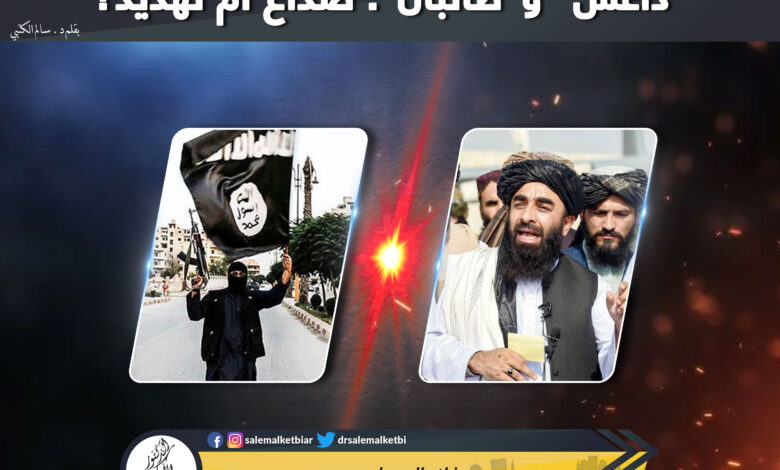
Some Taliban elements have been repeatedly targeted by Daech suicide bombers of late, while others have targeted mosques belonging to Afghanistan’s Shiite Hazara minority.
According to the United Nations Assistance Mission in Afghanistan (UNAMA), Daech Khorasan carried out 77 attacks in the first four months of this year. Zabiullah Mujahid, Taliban spokesman and minister of culture, said the group would be “eliminated soon.”
“We do not classify Daech as a threat, but as a headache. They have been expelled and their shelters have been found,” Mujahid said, raising important questions about the nature and extent of the danger posed by Daech’s deployment in parts of Afghanistan.
Is this really just a “headache” for the Taliban, or an existential threat to the movement as it struggles for dominance and control of Afghan territory?
In absolute terms, the capabilities of Daech in Khorasan appear to be significantly inferior to those of the Taliban, both in terms of numbers and equipment and in terms of combat experience and knowledge of the nature of Afghan territory, of which the Taliban has considerable experience.
None of this, however, diminishes the magnitude of the threat posed by Daech, particularly with respect to specific issues.
First, there is the potential for al Qaeda elements to be deployed in remote areas and groomed as centers of attraction, training, and planning for terrorist operations outside of Afghanistan, as was the case for al Qaeda up until the 9/11 attacks. Second, we cannot really compare the capabilities of Daech in Khorasan with those of the Taliban.
Deach draws on a wealth of experience, which actually exceeds the capabilities of the Afghan movement, thanks to the transfer of experience from the parent organization after its so-called state in Iraq and Syria collapsed under the weight of the blows of the US-led international counterterrorism coalition.
Indeed, Daech in Afghanistan can only be a serious problem for everyone, both for the Taliban and for the countries targeted by Daech in general, primarily the United States and, to a lesser extent, Russia and Iran.
However, experts are almost unanimous in their view that the continuing chaos in Afghanistan serves the interests of terrorist organizations in general and the regional branch of Daech in particular.
This poses a greater security risk than the rise of the Taliban itself for several reasons and considerations, chief among them the movement’s tendency to avoid the mistakes of the past and seek international recognition. The two sides also have very different priorities. The Taliban seeks first and foremost to rule Afghanistan.
In this phase, the Daesh seeks to strengthen its positions and restore the confidence of its supporters by expanding the target of the Taliban and Western interests in Afghanistan. According to Western strategic assessments, the Islamic State in Khorasan has approximately 800 terrorist elements. However, these estimates are from 2018.
This makes it difficult to get an accurate analytical picture of the operational capabilities of the specific Da’ichi organization. Since 2014, the group has learned to expand its sphere of influence from a small area to an area equivalent to the size of the United Kingdom (Da’ich controls about 88,000 square kilometers in Iraq and Syria), and started with about 1,000 terrorists.
Four years later, however, the organization was able to recruit about 40,000 fighters. At one point, about 1,500 terrorists were joining the group each month.
While the threat from the “Islamic State in Iraq and Syria” has been minimal since the demise of its so-called state, its venture remains an “inspiration” to other terrorist leaders in other regions, including, of course, Afghanistan. This certainly does not mean that the experience would be replicated.
But it also does not stop others from wanting to replicate it. It is clear that Daech has grown in power since the Taliban took control of the capital Kabul, former President Ashraf Ghani fled, and the Afghan army collapsed.
The reason is that the group has begun to attract Taliban dissidents because they believe they are secretly working with the United States. These believe that the Taliban no longer adhere to the ideological framework on which they were founded.
There are unconfirmed reports of divisions within the movement, including between factions loyal to Mullah Abdul Ghani Baradar, the deputy prime minister who led the Doha talks with the United States, and supporters of Sirajuddin Haqqani, the acting interior minister, who is known for his extremely hard-line stance.
These divisions are based on a shift in the movement’s behavior in response to demands for international recognition. As a result, some expect the Taliban to lose much of its extremist elements.
The Afghan branch of the Deach continues to implement its strategy of putting down roots in conflict zones as the beginning of further expansion in the future. Given its recent expansion of terrorist operations in Afghanistan, Daech Khorasan is undoubtedly a real problem for the Taliban and a threat to international security and stability.