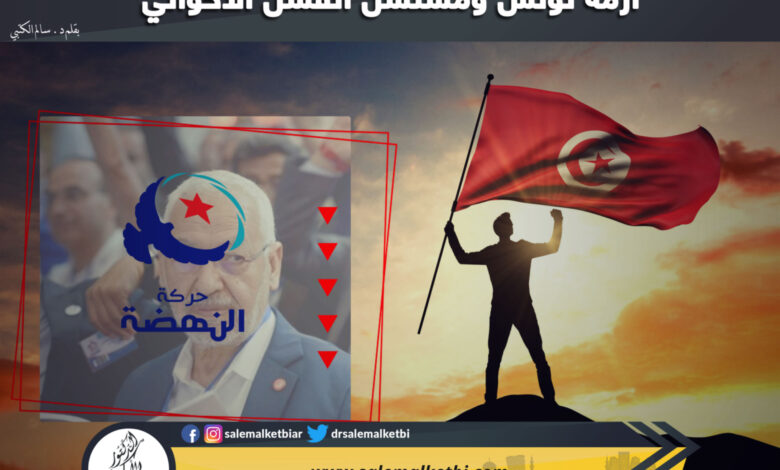
Looking at the intricacies of the Tunisian political scene, we see that this country is experiencing an exceptional situation that is unlike any other Arab country. Some even consider that the Muslim Brotherhood in Tunisia is not like other groups scattered in several Arab countries.
These believe that this Brotherhood branch has gained different experiences, as a result of their leaders having stayed in Western capitals for many years. But the Tunisian experience since 2011 has shown that Tunisia’s Brotherhood carries the same organizational genes as their counterparts in Egypt, Gaza, Yemen, Syria and elsewhere.
They have been entangled in deep and constant political conflicts since the return of leaders who were supposed to have learned some lessons from Western political experiences. Especially in terms of pluralism. But their reality has been revealed, with the first political experiment, by their insistence on going it alone in power.
But the Tunisian people with all their political forces proved to be well aware of this. As a result, they quickly turned to a scenario of pulling others down. They clash sometimes with the President of the Republic, sometimes with other partisan and political forces.
Then, they ended up clashing with the people themselves and trying to sacrifice them to mask their inability to assume their political responsibilities and respond to the aspirations of Tunisians.
In the wake of the president’s decisions, Tunisian Prime Minister Hichem Mechichi acknowledged in a statement “the limited potential of the state and the deterioration of the national economy and public finances.”
“The political convulsion has grown and the political system that emerged from the 2019 elections has failed to form a government due to the great disparity between the demands of the street and the priorities of political parties, which kept crumbling the parliamentary landscape to the point of causing a rift between citizens and politicians.”
He acknowledged the difficulty of finding a suitable way out of the political crisis that Tunisia is going through. This is a fact that explains President Kais Saied’s recourse to extraordinary procedures to deal with a crisis that he sees escalating apace. After all, the technocrat government solution failed to achieve its goals and reforms.
There are deep cleavages and differences between the pillars of power, in which Ennahda has played a leading role. The movement aimed to participate in early elections – in which it believes it will get a bigger slice of the political pie – regardless of the health disaster in the country, where the coronavirus epidemic has killed more than 17,000 Tunisians.
Ennahda has sought by all means, through parliament, to thwart any presidential or governmental effort to break the status quo. The president has even accused it of protecting the corrupt and obstructing legal processes. That angered the public, who called for the dissolution of parliament and the overthrow of the government.
People attacked and burned some of the headquarters of the Brotherhood movement, which holds the parliamentary majority and disrupts the role of the legislature. The real dilemma facing Tunisia at this point is Ennahda’s failure to respect the rules and principles of democratic practice. This is so even if the Tunisian situation allows it to engage in the democratic game.
Still, the movement carries ideological genes contrary to pluralism. It does not want to acknowledge its decline in popularity displayed during the electoral polls until 2019. The failure to qualify Abdelfattah Mourou for the second round of the presidential election did not sit well with it.
This movement and other Tunisian political elites have also failed to address the roots of the decline in popular participation in successive parliamentary elections. Tunisian youth are frustrated. The rate of illegal immigration has increased again. That means many lost years without a return to the development Tunisians have dreamed of since 2011.
The Brotherhood’s share of parliamentary seats in Tunisia has fallen from 89 seats in the first parliamentary elections after the overthrow of former president Zine El Abidine Ben Ali to 52 seats in the most recent elections. They won 69 seats in the second legislative elections in 2014. In the first election, the movement won 37 percent of the vote. In the second, 28%, and in the last, only 23%.
But the movement did not catch on to this significant drop in its popularity. It remained dogged, as did other Brotherhood groups before it. Although it promised the Tunisian people to “provide them with a decent life, increase their purchasing power and employability, strengthen security and fight against poverty, terrorism, corruption and smuggling.”
The Tunisian crisis mirrors the crisis of the Muslim Brotherhood and its groups in different countries. The organization is in total denial of its failure in politics. It has practiced politics according to a haughty hermetic logic, which does not accept pluralism, does not understand the lessons of the past and does not accept to learn from others.
It has tried to deceive everyone, including the people, only to lose both politics and the people. It cannot even keep its status as a religious guidance group anymore.