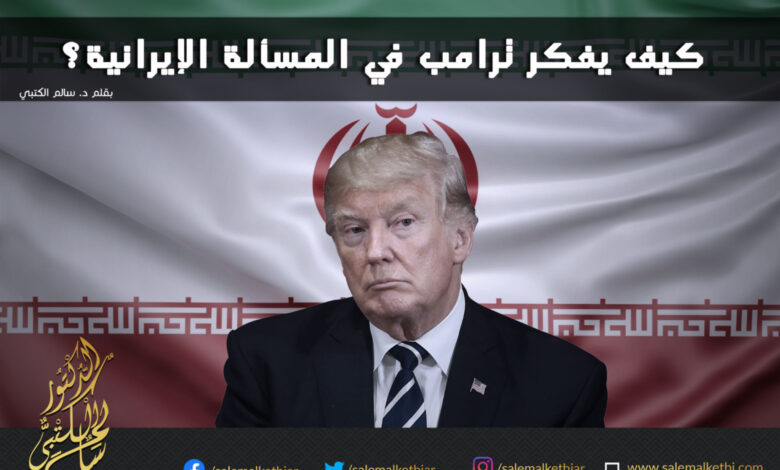
As is no secret to any analyst, US President Donald Trump prefers to avoid the war scenario with Iran in the current period, in the run-up to the US presidential election. But what happens after this election? How does President Trump think about the next step?
In one of his tweets he wrote last week, Trump said “Just remember the Iranians never won a war, but never lost a negotiation!” This statement has a number of implications from a political analysis angle.
To begin with, President Trump is not worried about going to war with Iran, contrary to what some believe. He would rather win the showdown without firing a shot. Such is his main bet through which he is looking to prove himself as different from other former US presidents.
In contrast, the tweet implies that President Trump is more cautious about sitting at the negotiating table with the Iranians than he is about facing them militarily. How so?
The White House knows that negotiating with the mullahs’ regime is a tough job, and I believe that will motivates President Trump to insist on negotiating with the regime and winning a political victory against it.
This could be enough to whet President Trump’s appetite for a negotiation battle with the mullahs. Trump’s businessman’s eye, his skill in negotiating agreements, is the driving force to enter into a negotiated battle. Winning will validate his political crisis management style.
US Secretary of State Mike Pompeo offered to visit Iran for talks. “Sure, If that’s the call, I’d happily go there I would welcome the chance to speak directly to the Iranian people,” he said in an interview with Bloomberg TV.
The offer, which was rejected by the mullahs’ regime, was only an attempt to open a direct line with the mullahs. Recently, the mediation of emissaries of the major regional and regional powers has stalled. So did the mediation of Republican Senator and Senate Foreign Relations Committee member Rand Paul.
The media reported that during his recent visit to UN headquarters last July, Paul was given the green light by his “friend” President Trump to meet Iran’s Foreign Minister Javad Zarif. Paul invited Zarif to Washington to discuss a solution to the mounting crisis.
Alongside its efforts to find a way out through negotiations, the administration is moving forward with harsh sanctions. Recent sanctions have been brought against Iranian Foreign Minister Javad Zarif, further to the sanctions against Iranian Supreme Leader Ali Khamenei, President Hassan Rouhani and the commanders of the Revolutionary Guards, led by Qods Force commander Gen. Qassem Soleimani.
The bottom line is that the measures taken by the administration are not clear. They do not yet form an integrated strategy to deal with the Iranian threat. But they are calculated steps that go along two parallel paths.
The first is to buy time and give the mullahs the rope with which to hang themselves. Coupled with this is an approach involving unprecedented severe sanctions. The bet is on the time factor to lead the mullahs to make mistakes, helping to build an international mobilization against them right up until the end of the coming US presidential election.
At that point, the scenario of disastrous military measures against the Iranian regime would be on the cards, once all possibilities for a political settlement of the crisis would have been exhausted.
The second is to try to negotiate with the regime on terms that meet President Trump’s goal. Trump is going for declawing the Iranian regime, keeping it from making a nuclear weapon, cutting its missile capabilities and weakening its regional influence, especially in Syria, to reassure and secure Israel.
Hyping Iran’s negotiating skills is what President Trump is interested in right now. I would say that his tweet on Iranians’ negotiating abilities is a way of entrenching the idea of Iran’ negotiating win in the 2015 deal signed between the mullahs and the P5+1 group.
To secure additional points beyond the terms of this agreement, in line with President Trump’s expectations, would be an unparalleled bargaining victory for the mullahs’ regime, from his administration’s viewpoint. The administration is working to get this done and then market it in the US presidential election as one of President Trump’s first-term accomplishments.