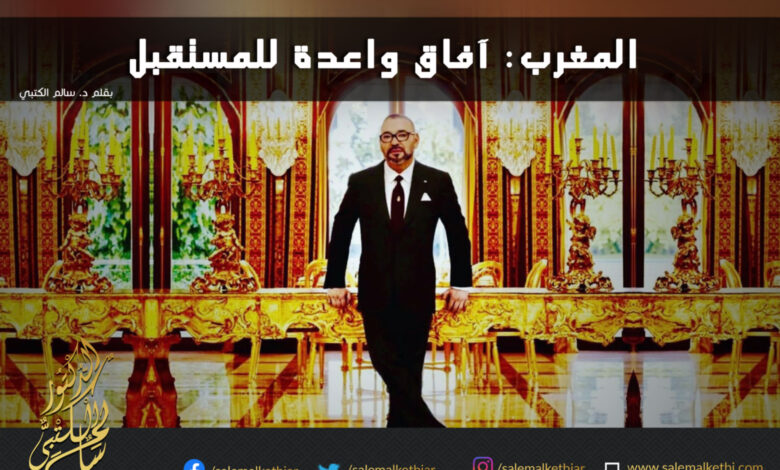
His Majesty King Mohammed VI’s speech on the occasion of the 20th anniversary of his accession to the throne was frank and straightforward. The heart-warming speech identified the challenges with a transparency that reassures the Moroccan people. The frankness has provided further proof of the strength of the ties that unite Moroccan leadership and its people.
In his speech, the King addressed several important points, taking stock of what has been done over the past two decades and presenting a well-thought-out vision of the future based on careful planning, not promises and wishes. First, it focused on governance and leadership.
In particular, he stressed the commitment to promote equality and work to ensure a free and decent life for all Moroccans. Another central point addressed was the national consensus that unites the Kingdom around the nation’s constants and sacred values.
Several Arab States have experienced the nightmare of fragmentation, dispersion and rivalry due to divisions, conflicts and sectarianism. It was therefore important to provide the moral foundations to maintain the national framework necessary for any development to take off.
In addition, the Moroccan sovereign reaffirmed the kingdom’s major strategic choices. The choices of the patriotic monarchy and citizenship are about getting closer to citizens, sharing their aspirations and hopes and working to satisfy them. The “democratic consolidation and quest for development” that the king is “resolutely” pursuing are based on the “profound reforms” and major projects carried out to build a “modern Morocco.” These are the outlines and framework of a real development effort.
In all objectivity, the Throne Speech on the occasion of this historic national anniversary was nothing short of unique. The Kingdom of Morocco has a particularity that makes it a unique case in the world of Arab and Middle Eastern politics. Its particularity is the impressive honesty. Frank talk is a reflection of a sense of patriotism and a high sense of responsibility and integrity towards the public.
The king spoke of the depth of his close relationship with his people. He constructively acknowledged that it was sometimes not possible to achieve everything that the leadership had hoped for its people. But this statement in itself is deeper than any desired achievement.
This patriotic spirit lays the foundation for the relationship and strong ties between the two parties, the leadership and the people. Being honest with the nation and speaking the truth are proof of a stronger and more lasting relationship, capable of meeting challenges and consolidating gains.
To win hearts and minds, and break with the illusioned political discourse that is far from citizens’ real lives, there is nothing better than transparency and sincerity. Such a message wakes up minds, brings people together and strengthens the determination of any young man who dreams of a better future. In the speech, the king expressed a greater determination to “stay the course, by capitalising on the achievements made, completing the dynamics of ongoing reforms, and correcting the dysfunctions observed on the ground.”
Researchers who are interested in this Arab kingdom rooted in history, we must pay great attention to this discourse of truth. One cannot build nations and ensure the future of millions of people through manoeuvring or falsehoods. There is no point in giving empty promises or feeding the people lies that cannot stand up to the slightest objective discussion.
On this historic occasion, the Throne Speech came out balanced. It showed that wise leadership is capable of understanding the facts and forces of both material and moral development. To modernise, infrastructure alone is not enough. Rather, the political and legislative system of practice should be galvanized and societal values strengthened.
The royal speech outlined this juxtaposition. The reference to a qualitative change in infrastructure was followed by the mention of “milestones” in rights and freedoms and the enshrinement of democracy. Then he noted that the effects of progress and achievements have not always benefited the different segments of Moroccan society.
The Moroccan throne speech, by its frankness, objectivity and clarity towards the public, deserves our appreciation as researchers. It reflects His Majesty’s willingness to work harder to achieve his aspirations and those of his people. All the same, the speech shows great political modesty and a close interaction with citizens.
History has taught us that people do not suffer so much from life difficulties as from worsening societal gaps. What they need is to be heard and to make the needs known to their leaders. In his speech, His Majesty also highlighted the weak spots of the development model followed in recent years, which has led to social issues. He nonetheless set out his treatment strategy by setting up a committee that would explore the facts impartially and seek courageous and innovative solutions.
Public affairs and the concerns of Moroccan citizens took up a large part of the speech on the 20th anniversary of the Throne Day. The speech outlined a clear roadmap with specific guidelines for the government to work on building the new Morocco. To do so will require a competitive economy that attracts investment and is highly engaged in the global economic system.
Moroccan national constants, including the Moroccan Sahara, national unity and territorial integrity and full sovereignty of the Kingdom over its entire territory, also received their fair share of the speech.
The King reaffirmed the commitment to a political settlement of the issue under the exclusive aegis of the United Nations. He also affirmed his support for the “extended hand” approach towards the “brothers in Algeria” and expressed his wish to realize the aspirations of the Maghreb people for unity, complementarity, and integration.
The beautiful reference to the feelings of joy of the Moroccan people to the Algerian team’s victory in the CAF Africa Cup of Nations showed a real royal will to translate the feelings of the Maghreb people into a unifying action that transcends the political differences.
The 20th anniversary speech also highlighted the constants of the social contract that links leadership to its people. It established the principle that “Morocco belongs to all Moroccans.” Morocco is the “shared home,” which “welcomes all its children, grants them, without exception or discrimination, the enjoyment of the same rights and freedoms and submits them, with respect for human dignity, to the same duties.”
This principle is the recipe against any ideology that is irrelevant to the constants of the Moroccan political mindset. Morocco’s politics drew on all its past experiences throughout its historical development. Its political mindset has given the country political and ideological immunity from foreign forces of division and manipulation of the capacities and gains of nations.
In the grand scheme of things, the royal speech provided a clear roadmap and a solid strategic vision. It showed that the leadership is grounded in reality and is committed to building a better future. The leadership aspires to offer better qualities of life to a people who deserve the best. The Moroccan people have the human and natural resources that makes their country one of the best placed countries to achieve full development. In short, it is a speech that reassures us about the future of this great Arab nation.