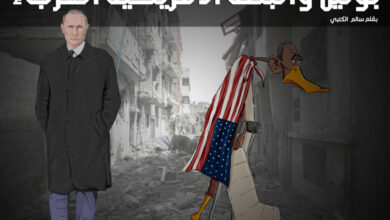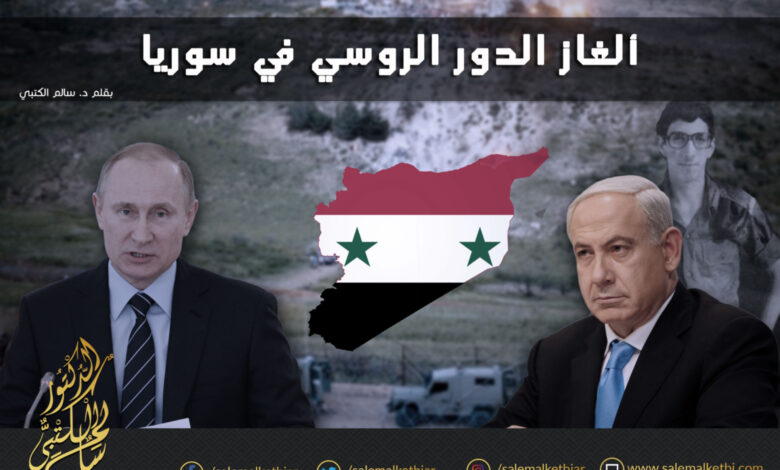
Russia’s role in Syria has not revealed much of its mysteries yet. Russia has come back strongly into the Middle East arena through the Syrian front, but many secrets and motivations for this role are waiting to be revealed in the coming period.
One of the mysteries of the Russian role has recently emerged. Russia helped Israeli Prime Minister Benjamin Netanyahu uncover the remains of Israeli soldier Zachary Baumel, who was killed during the 1982 Lebanon war.
Media reports revealed direct Russian assistance to Israel in finding and recovering the remains of the Israeli soldier. Netanyahu was given an additional point to strengthen his position ahead of the Israeli elections on April 9.
Netanyahu was given two precious gifts from the U.S. and Russian presidents. The first gave him an unlawful title of ownership of the occupied Syrian Golan. The second used the presence of his forces in Syria to order that the remains of the Israeli soldier be found and brought to the Israelis, much to the potential embarrassment of the Syrian regime. But Russia, like the Iranian regime, is acting in Syria according to its self-interests, not Assad’s.
Some believe that Russia violated Syria’s sovereignty when it searched for the remains of the Israeli soldier. But this idea is based on the claim that the Assad regime was unaware of what the Russian army has been doing. He was, he just did not have a say.
Russia, as well as Iran, believes the Assad regime owes its survival to it. So the regime cannot object to their actions in Syria.
Besides, some even doubt that Assad might want to object anything at all to Russia.
There are those who say that Russia should have handed over the remains of the Israeli soldier to the Assad regime, rather than organizing a ceremony at the Russian Defense Ministry in Moscow to hand over the remains to Israel. But that would be in an ideal world. The political world has no place for such dreams.
One ground for this perception is the belief that Russia and Israel have a lot of differences. But the many visits of Israeli Prime Minister Benjamin Netanyahu to Moscow say otherwise. Netanyahu visited Russia more than he did the United States.
Russia is a major force acting in accordance with its interests. This is the case in Syria and elsewhere. When Putin sees signs of strategic shifts in the Middle East, especially after the US administration recognized Israeli sovereignty over the occupied Syrian Golan, he will naturally engage in this strategy game to preserve Russia’s gains in Syria.
Here lies the problem facing the Arab side. The Arabs expect that the major powers might act in ways that serve Arab interests, which is absurd. Power politics operate on a system of mutual interests. A limitation to this is the pressure cards that each sides has that could influence any existing power relations.
But, at least for the moment, the Arab side has no pressure cards capable of influencing the events due to the post-2011 chaos that has rocked the Arab region. And even afterward, some Arab actors are still practicing politics like amateurs.
Many on the Arab side still stake on expressions such as historical friendship and traditional bonds, while ignoring how trade-offs and common interests shape modern international relations.